Every box in the flooring aisle says the same thing: waterproof, rigid core, SPC. Few tell you what’s inside the plank.
Pick the wrong core and you may end up with dents, gaps or a hollow sound under every step. Sales staff often use SPC, WPC (wood plastic composite) and LVP (luxury vinyl plank) as if they meant the same thing. They don’t.
This guide gives you the straight answer first, then shows you how to spot real SPC yourself. New to vinyl? Start with our guide to the types of vinyl flooring.
SPC flooring in one line: SPC flooring is rigid core vinyl built on a dense core of ground limestone and PVC. SPC stands for stone plastic composite. The stone core makes it waterproof, stable and hard to dent.
What Does SPC Stand For?
SPC stands for stone plastic composite, also written as stone polymer composite. When these floors first took off, the Multilayer Flooring Association, a US trade group, defined it as “solid polymer core.” All three names describe the same product.
| Name on the box | Is it SPC? |
| Stone plastic / stone polymer composite | Yes |
| Solid polymer core | Yes |
| Rigid core vinyl | Maybe: SPC or WPC |
| EVP (engineered vinyl plank) | Maybe: SPC or WPC |
| Hybrid (common in Australia) | Maybe: SPC or EPC |
| WPC / EPC | No. WPC (wood plastic composite) and EPC (expanded polymer core) use a lighter, foamed core |
Tip: Ignore the name on the front of the box. Read the core line on the spec sheet.
What Is SPC Flooring Made Of?
An SPC core is roughly 60 to 80% ground limestone by weight, bound together with PVC. That stone is what makes the plank heavy, stiff and waterproof.
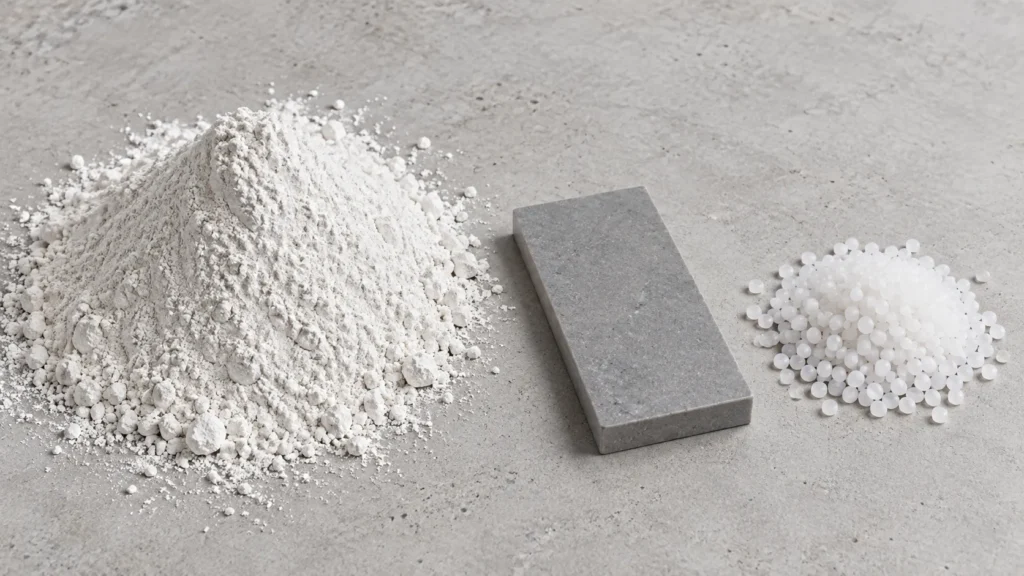
Flexible vinyl bends because it contains plasticizers, the additives that soften PVC. SPC uses little or none and packs in stone powder instead. That’s what keeps the plank stiff.
One factory formula shared by a plant engineer uses 150 kg (330 lb) of limestone for every 50 kg (110 lb) of PVC. That’s three parts stone to one part plastic.
| Ingredient | Typical share | Job |
| Limestone (calcium carbonate) | About 60 to 80% | Weight, stiffness, dent resistance |
| PVC resin | About 20 to 30% | Binds the powder, keeps water out |
| Calcium-zinc stabilizer | A few percent | Protects PVC from heat in production |
| Processing aids (ACR, CPE, PE wax) | Small amounts | Help the melt flow, toughen click joints |
| Plasticizer (such as DOTP) | Low or none | Adds flex; less means a stiffer plank |
What Are the Layers of SPC Flooring?
Most SPC planks have four or five layers. From top to bottom:
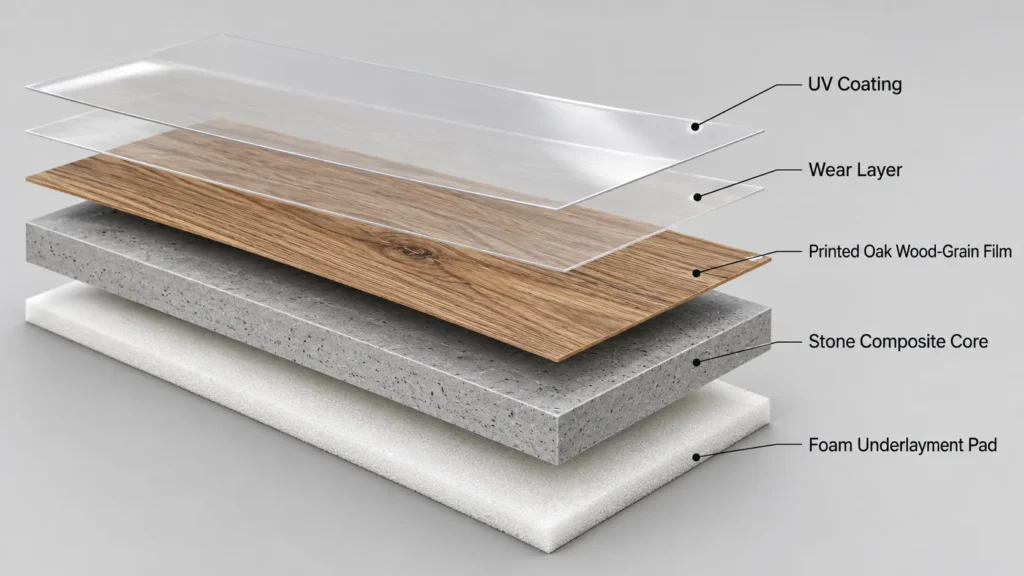
| Layer | Typical spec | What it does |
| UV coating | Thin cured finish | Sets the sheen, slows fading |
| Wear layer | 6 to 30 mil | Takes the scratches so the print doesn’t |
| Print film | Wood or stone image | Creates the look; EIR (embossed-in-register) texture follows the printed grain |
| SPC core | 3.2 to 7 mm | Waterproof, stable, dent-resistant |
| Attached pad (optional) | Foam (IXPE or EVA) or cork, 1 to 2 mm | Adds comfort, cuts noise |
The wear layer matters most. One mil is a thousandth of an inch, so a 20 mil layer is about 0.5 mm thick. As a rule of thumb, 12 mil suits bedrooms, and 20 mil or more suits kitchens, hallways and homes with kids or pets.
Design tip: Choose a matte finish with EIR texture. Glossy wood looks tend to read as plastic from across the room.
Buying for a condo? Ask for the pad’s IIC and STC ratings, which measure how much noise passes through the floor.
How Is SPC Flooring Made?
Factories press SPC out as one long, hot sheet, and the top layers fuse to it without glue. That’s why a well-made plank doesn’t peel apart.
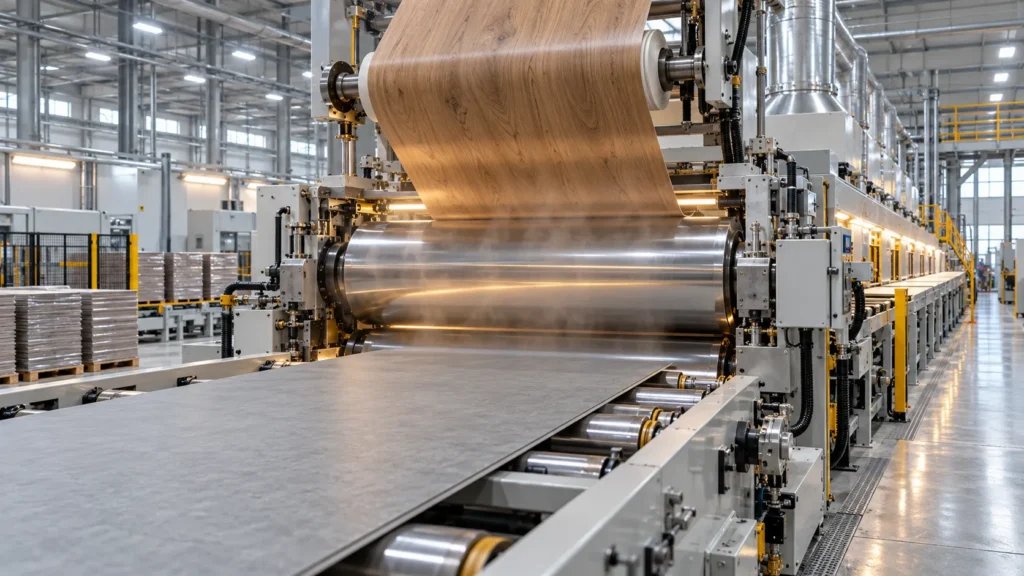
- Mix. Powders spin until friction heats them to 257 to 266 °F (125 to 130 °C), which drives off moisture.
- Extrude. Twin screws melt the mix at up to about 428 °F (220 °C) and push it through a flat die.
- Press and bond. Rollers set the thickness while the print film and wear layer press on.
- Coat. A roller spreads the UV top coat, and UV lamps cure it.
- Anneal. Controlled cooling releases stress from pressing.
- Cut and finish. Blades cut the planks, a milling line carves the click joints, and the pad goes on last.
Why step 5 matters: Stress left in the sheet can show up months later as warping or gaps. You can’t see it in a showroom, so a stability test result is worth asking for.
Is SPC the Same as Vinyl Flooring?
Yes. SPC is one type of luxury vinyl plank (LVP), the rigid, stone-core kind.
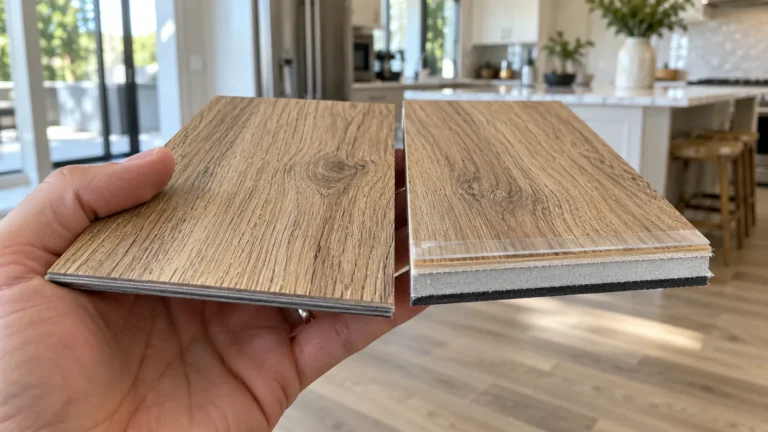
WPC came first, around 2010. Its foamed core felt soft but dented under heavy furniture. SPC swapped the foam for stone. Industry leaders quoted in Floor Covering Weekly put WPC at roughly half the density of SPC.
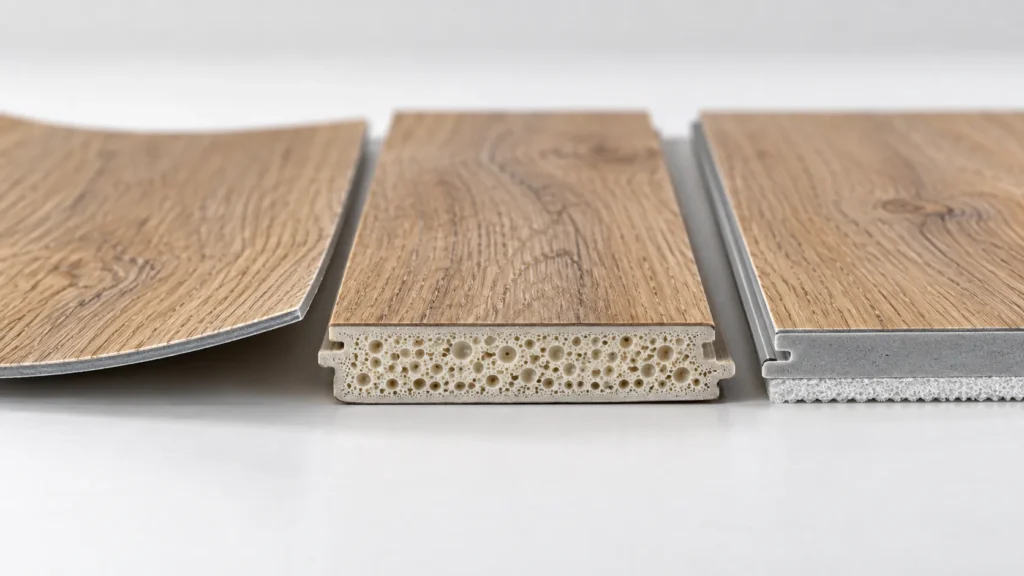
| Flexible vinyl | WPC | SPC | Laminate | |
| Core | Flexible PVC | Foamed PVC | Limestone and PVC | Wood fiber |
| Typical thickness | 2 to 4 mm | 6 to 8 mm | 4 to 7 mm | 7 to 12 mm |
| Core and water | Resists water | Sold as waterproof | Waterproof | Swells unless treated |
| Feel underfoot | Soft, flexible | Softest, warmest | Firm, cool | Firm |
Want to see how SPC and WPC compare inside a plank? Our LVP flooring guide breaks down both.
SPC cores also come in tile shapes, which stores sell as LVT. Our LVT flooring guide covers that format.
What Does the Stone Core Actually Do?
The stone core is where SPC earns its reputation. It gives the plank four traits:
- Waterproof core. The planks won’t swell, but water can still reach the subfloor (the base layer under your flooring) through seams and edges.
- Stable shape. One US brand reports just 0.17% movement between 0 and 140 °F.
- Dent resistance. Dense stone spreads the weight of fridge feet and table legs.
- Firm, cool feel. It’s harder and colder underfoot than WPC. Rugs and a good pad help.
Heat limit: Several manufacturers’ installation guides cap the floor surface at 80 °F (27 °C) over radiant floor heating. Run it hotter and the planks can shift or stress their joints.
Which Standards Should an SPC Label Show?
Look for ASTM F3261-26 on a US spec sheet. It’s the performance standard for rigid core vinyl, first published in 2017 and last updated in 2025.
| Label | What it proves |
| ASTM F3261 | Meets the US performance spec for rigid core vinyl |
| EN 16511 | Meets the European spec for click panels |
| ASTM F1914 | Tested for how deep a dent goes and how much springs back |
| FloorScore | Low emissions of 35 VOCs, the chemical fumes that affect indoor air |
| ASSURE Certified | Air quality, performance, heavy metals and phthalates; since 2026, edge strength too |
A product that names its standard is making a claim someone can check. If a spec sheet names none at all, I’d treat that as a warning sign.
Is It Really SPC? Five Checks You Can Do in the Store
Five quick checks tell you whether a plank is really SPC, whatever the box says. I’d trust them over any label, and none takes more than a minute.
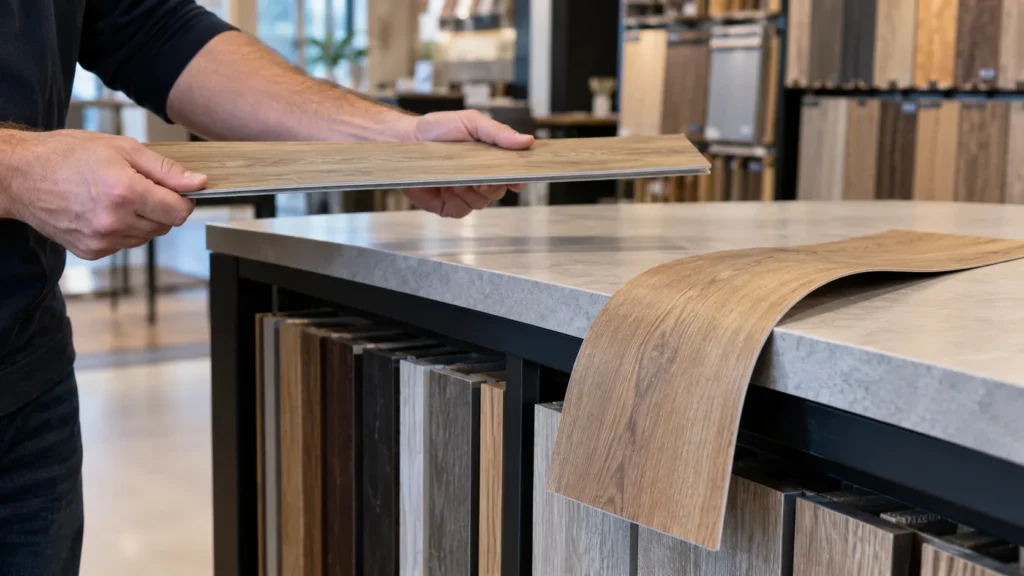
- Read the core line. It should name limestone, calcium carbonate or a stone core. “Foamed” or “wood” means WPC.
- Bend it. SPC barely flexes. Flexible vinyl droops like thick cardboard.
- Weigh it. Next to a sample of the same thickness, SPC feels noticeably heavier.
- Look at the cut edge. SPC looks solid. A foamed core shows tiny air pockets.
- Check the thickness. Most SPC is 4 to 7 mm. A soft plank of 8 mm or more is usually WPC.
Where Does SPC Flooring Work Best?
SPC works best where water and traffic meet: kitchens, bathrooms, laundry rooms, mudrooms, basements and rentals. Those are the rooms where wood and laminate struggle most.
Worried about seams in a small bathroom? Sheet vinyl can cover the whole floor in one piece.
Design tip: In an open-plan home, one SPC floor can run from the kitchen to the sofa with no change of material. That unbroken line makes small spaces feel bigger. Check the manufacturer’s limit on long runs first.
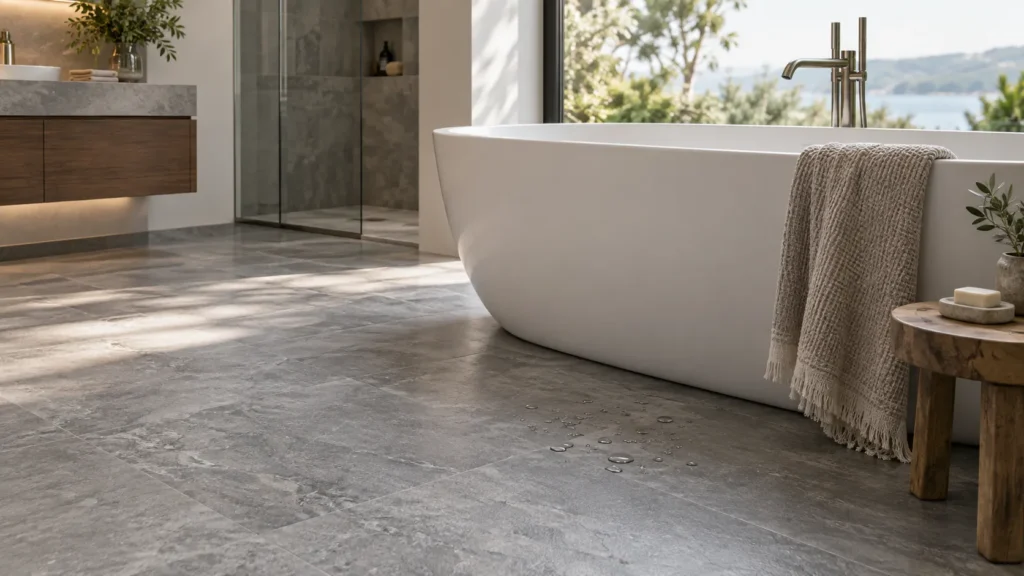
Skip it outdoors. Strong direct sun can also fade the print over time.
Is SPC Flooring Safe for Your Home?
SPC is still PVC plastic, so check what’s in it, not just the marketing. Two labels tell you most of what you need:
- FloorScore tests 35 VOCs for indoor air quality. It does not test for phthalates.
- ASSURE Certified, the Resilient Floor Covering Institute’s badge for rigid core, caps ortho-phthalates at 1,000 ppm (0.1%) and heavy metals at 100 ppm (0.01%) combined.
Phthalates were a real issue. A 2015 Ecology Center study found them in 38 of 65 vinyl tiles, and Home Depot and Lowe’s pledged to remove them that year.
What Should You Ask Your Contractor About SPC?
Bring these six questions, and ask to see the spec sheet behind each answer. A good contractor won’t mind, and a vague answer tells you something too.
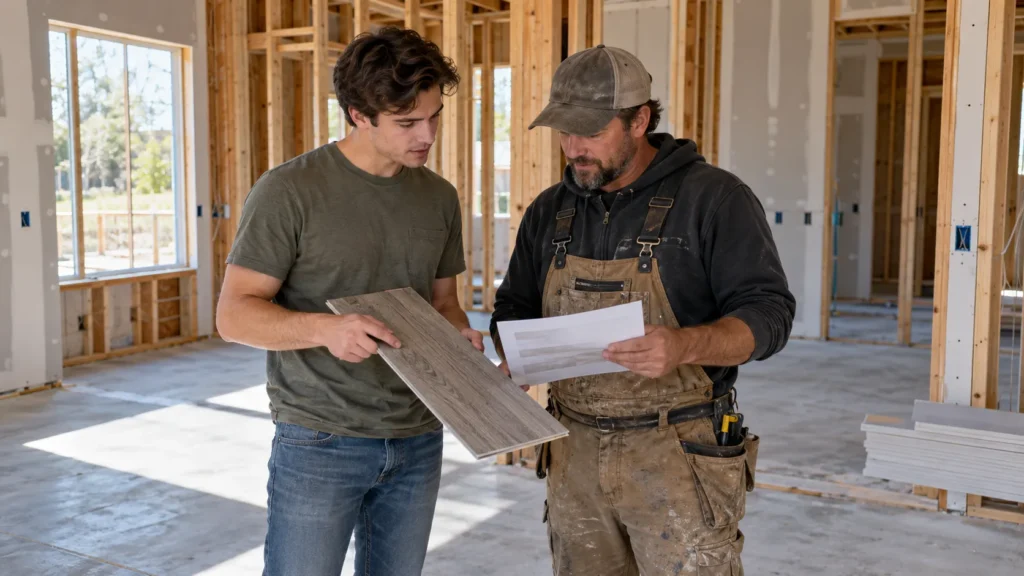
| Ask your contractor | What a good answer sounds like |
| Is the core SPC or WPC? | “SPC,” with limestone or calcium carbonate listed on the spec sheet |
| What’s the wear layer? | 12 mil or more for bedrooms; 20 mil or more for kitchens, halls, kids and pets |
| Is it rated for every room we’re using it in? | Bathrooms, basements and sunrooms named in the warranty, not just “waterproof” on the box |
| Will it work over our radiant floor heating? | Yes, with the manufacturer’s surface temperature limit in writing |
| Does it have an attached pad, and what are its IIC and STC ratings? | Yes, with the ratings listed, which matters most on upper floors |
| Which standards and labels does it carry? | ASTM F3261, plus FloorScore or ASSURE Certified |
Tip: Write the exact product name and color into your contract. That stops anyone from swapping in a cheaper plank later.
Five SPC Myths That Refuse to Die
Showrooms keep a few half-truths alive. Here are five of them, checked against the plank itself:
| The myth | The reality |
| “SPC is real stone.” | It’s ground limestone bound in PVC. Stone gives it weight, but it’s a plastic composite. |
| “Waterproof flooring makes the room waterproof.” | The planks won’t swell, yet water can still slip through seams and edges to the subfloor. |
| “Thicker is always better.” | SPC is thinner than WPC because it’s denser. For surface life, the wear layer matters more than total thickness. |
| “SPC and LVP are two different things.” | SPC is one type of luxury vinyl plank, the rigid stone-core branch. |
| “SPC can’t scratch.” | The wear layer resists scratches. It doesn’t stop them. Grit under a chair leg will still leave marks. |
Quick Answers to Common SPC Questions
What does SPC stand for in flooring?
Stone plastic composite. You’ll also see stone polymer composite or solid polymer core on spec sheets.
Is SPC flooring plastic or stone?
Both. Limestone makes up most of the core’s weight, and PVC binds it.
Is SPC the same as vinyl flooring?
Yes. It’s rigid core luxury vinyl with a stone-based core.
Is SPC flooring 100% waterproof?
The planks are. Water can still reach the subfloor through seams and edges.
Can SPC go over radiant floor heating?
Usually. Many manufacturers cap the floor surface at 80 °F (27 °C). Check your product’s installation guide.
How long does SPC flooring last?
It depends mainly on the wear layer and traffic. Residential warranties of around 25 years are common.
The Core Tells the Whole Story
SPC comes down to one thing: a stone-heavy core that shrugs off water, holds its shape and resists dents. Once you can read the layers, the box stops being a mystery.
Planning a project? Browse our flooring installation guides for the hands-on basics.