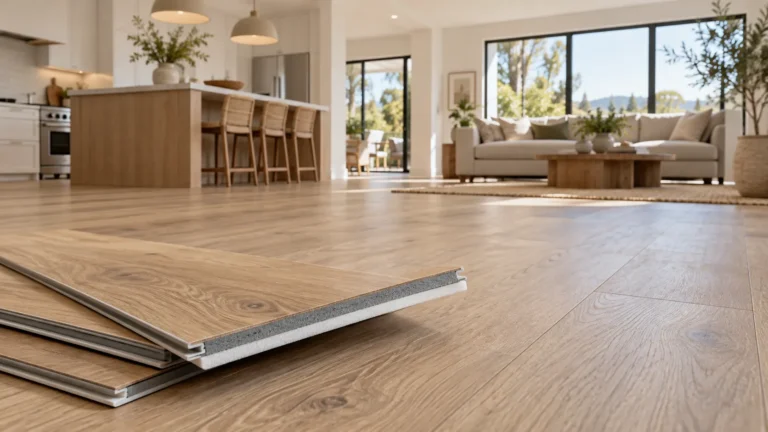
LVP flooring stands for luxury vinyl plank flooring. It is a resilient, multilayer floor made in individual boards, printed and textured to look like hardwood. Some LVP is thin and flexible and gets glued down. Most of what you will see in a US showroom today has a rigid SPC or WPC core and clicks together with no adhesive.
That is the definition. Here is what actually matters once you start shopping: “LVP” is a market category, not a specification. A 2 mm glue-down plank and a 10 mm rigid-core floating plank are both sold as luxury vinyl plank. They do not feel the same, install the same, or survive a refrigerator the same way.
So the useful question is not whether to buy LVP. It is which kind, and how to read the box. That is what this guide covers.
For the wider picture — sheet vinyl, LVT, and how the whole family fits together — start with our complete guide to vinyl flooring.
Key Takeaways
- LVP = luxury vinyl plank. A printed, multilayer vinyl floor made in board form.
- The core decides how it behaves. SPC is dense and firm. WPC is foamed, warmer, quieter.
- Wear layer is not thickness. Wear layer is in mils; plank thickness is in millimeters. 20 mil ≈ 0.5 mm.
- 12 mil is the entry point. 20 mil is the right answer for pets, kids, rentals, and busy entryways.
- “Waterproof” describes the plank, not the room. It does not replace shower waterproofing or slab moisture testing.
- AC ratings belong to laminate. Their absence on a vinyl box is normal.
LVP Flooring at a Glance
| Question | Quick Answer |
| What does LVP stand for? | Luxury vinyl plank. |
| What is it made of? | Topcoat, clear wear layer, printed design layer, structural core, often an attached pad. |
| Main constructions | Flexible vinyl, SPC rigid core, WPC rigid core. |
| Typical thickness | 2–3 mm flexible glue-down, 4–6 mm SPC, 6–10+ mm WPC. |
| Typical wear layer | 6–12 mil light use, 12–20 mil active homes, 20–40 mil commercial. |
| Is it waterproof? | The plank usually is. The room is not. |
| How is it installed? | Floating click-lock, glue-down, or purpose-built loose lay. |
| Same as LVT? | Same family. LVP is usually plank and wood-look; LVT is usually tile and stone-look. |
What Does LVP Stand For?
LVP stands for luxury vinyl plank. The word “plank” is the operative one — the material is made as separate boards, not a continuous roll. That format is what allows real board edges, bevels, mixed lengths, and layouts that read as hardwood rather than a photograph of it.
Two related abbreviations:
- LVT (luxury vinyl tile) usually means tile-shaped, stone- or ceramic-look products. Some manufacturers use it as the umbrella term for everything, so it is not a reliable distinction on its own.
- EVP (engineered vinyl plank) is a retail label, not a construction type. Pull the spec sheet and an EVP product is almost always SPC or WPC.
The word “luxury” does none of the work people assume. It is not a grade, not a certification, and nobody audits it. The specs on the back of the box tell you what you are buying.
For a formal definition, the Resilient Floor Covering Institute separates flexible luxury vinyl from rigid-core flooring by the presence of a rigid polymeric core beneath the decorative surface.
What Is LVP Flooring Made Of?
| Layer (top to bottom) | What it does |
| Factory finish / topcoat | Resists stains, scuffs, and surface scratching |
| Transparent wear layer | Protects the printed image from abrading away; measured in mils |
| Decorative layer | Creates the visible wood or stone appearance |
| Structural core | Provides stiffness, stability, and most of the thickness |
| Backing / attached pad | Sound reduction, underfoot feel, minor substrate isolation |
Three things worth knowing about those layers.
The wear layer is one-way. Once it abrades through, the printed pattern is exposed and the floor is finished. You cannot sand it, refinish it, or recoat it. That is why this single number deserves more attention than anything else on the box.
The topcoat is not the wear layer. Two floors can advertise an identical 20 mil wear layer and scuff completely differently, because the coating chemistry above it is different. This is much of why a cheap 20 mil plank and an expensive one are not the same purchase.
EIR is worth paying for. Embossed-in-register texture aligns the physical surface texture to the printed grain, so the knot you can see is also a knot you can feel. Generic embossing does not line up, and your eye notices even when you cannot say why.
One correction, because retail signage muddles it: EVA is a pad material, not a core type. If a display says “EVA core,” check the data sheet — you are looking at an SPC or WPC core with an EVA pad attached.
SPC vs WPC: The Decision That Actually Matters
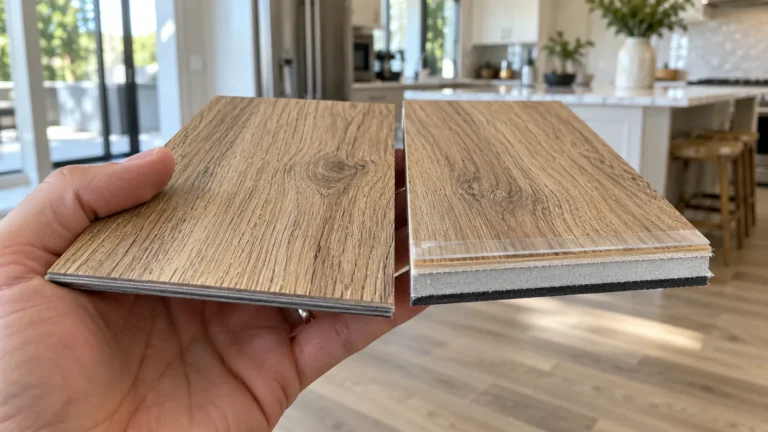
Installed, SPC and WPC can look identical — the visual package is independent of the core. The difference is inside the board, and it determines how the floor lives.
| SPC | WPC | |
| Core | Dense, rigid, mineral-filled | Foamed composite |
| Thickness | Usually 4–6 mm | Usually 6–10+ mm |
| Underfoot | Firm, harder, louder without a pad | Softer, warmer, quieter |
| Dents | Resists concentrated loads well | Yields more under point loads |
| Temperature swings | More dimensionally stable | Less stable |
| Cost | Generally lower | Generally higher |
Choose SPC for kitchens, entryways, rentals, homes with dogs, home gyms, sunrooms, and anywhere heavy furniture sits in one place for years. Choose WPC for upstairs bedrooms, condos with sound requirements, and rooms where bare feet and quiet matter more than dent resistance.
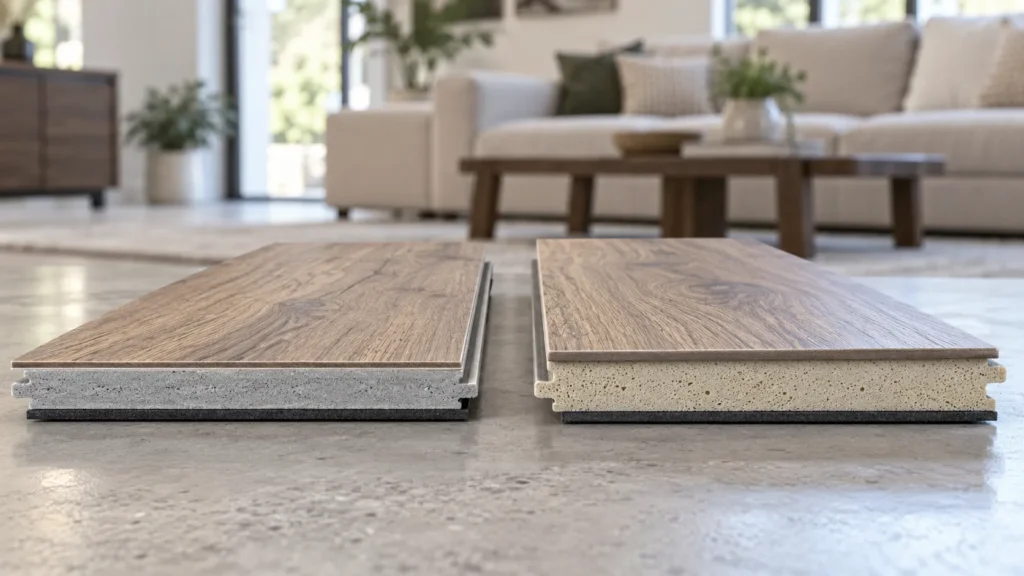
If you are torn, buy SPC with a good attached pad. You get most of WPC’s acoustic benefit without giving up indentation resistance. For most US homes, that is the right default. For a closer look at what’s inside a stone core, read our guide to SPC flooring.
Wear Layer vs Thickness: Why 20 Mil Is Not 20 mm
These get confused constantly, and the confusion costs people money.
A mil is one-thousandth of an inch. A millimeter is roughly 39 mils. The abbreviations look nearly identical in small print, but the units are not close.
| Wear layer | Equals | Right for |
| 6–8 mil | 0.15–0.2 mm | Closets, guest rooms — too thin for daily traffic |
| 12 mil | 0.3 mm | Standard residential, adults-only homes |
| 20 mil | 0.5 mm | Kids, dogs, rentals, entryways, whole-home installs |
| 28–40 mil | 0.7–1.0 mm | Retail, offices, multifamily corridors |
Total thickness is a different number entirely. A 3 mm commercial glue-down plank can carry a 20 mil wear layer. A 10 mm WPC plank can carry the same 20 mil, with the extra 7 mm being core and pad — comfort and structure, not surface life.
The rule:
- Surface wear life ≈ wear layer + topcoat + traffic + grit control
- Structural behavior ≈ core type + total thickness + joint design + subfloor quality
Buying on millimeters alone is the most common showroom mistake. A 4 mm plank with a 20 mil wear layer outlasts an 8 mm plank with a 6 mil wear layer at the surface, every time.
And no, LVP does not use AC ratings. AC1 through AC6 are Abrasion Class ratings from EN 13329, a European standard for laminate. The North American laminate standard does not even use the classification — NALFA published a white paper specifically because the term is so widely misapplied in marketing. If a salesperson tells you a vinyl plank is “AC5 rated,” they are repeating laminate copy.
Is LVP Waterproof?
Most rigid-core LVP sold in the US is marketed as waterproof, and for the plank itself that is largely accurate. Vinyl does not swell or delaminate from water contact the way a wood-fiber laminate core does.
But the plank being waterproof does not make the room waterproof. This is the most important caveat in the category, and almost no product page says it plainly.
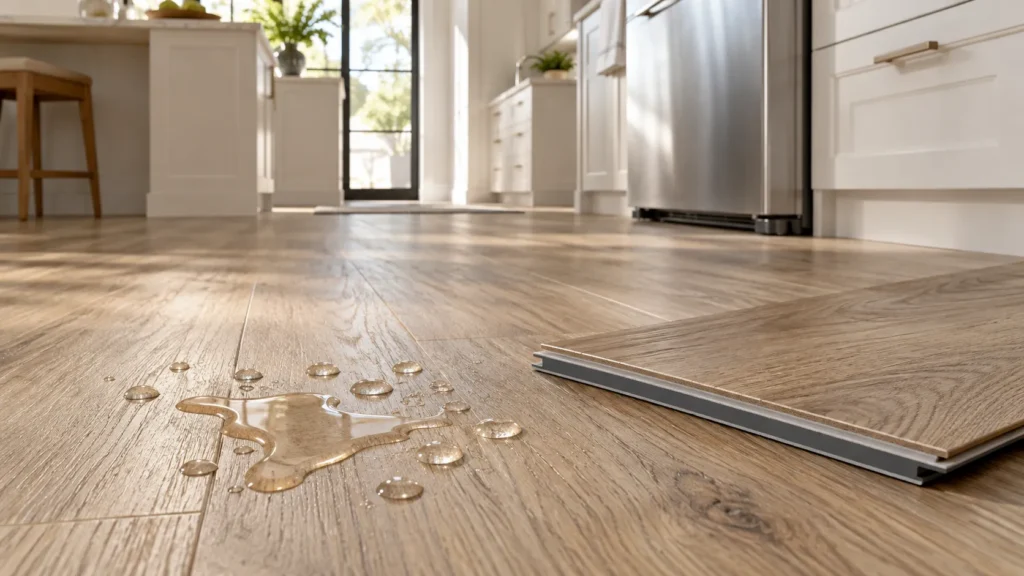
Water travels around a floating floor, not just through it — through perimeter gaps, around toilet flanges and pipe penetrations, under thresholds, through damaged joints. Once it reaches a plywood subfloor, the fact that the vinyl above is unaffected is cold comfort. You can have a perfectly intact waterproof floor sitting on a rotting substrate.
Two consequences:
- In bathrooms, waterproof LVP does not replace the waterproofing system required behind and beneath a shower.
- On concrete slabs, waterproof planks do nothing about moisture vapor rising through the slab. That is a subfloor problem, and it has to be tested and resolved before installation, not after.
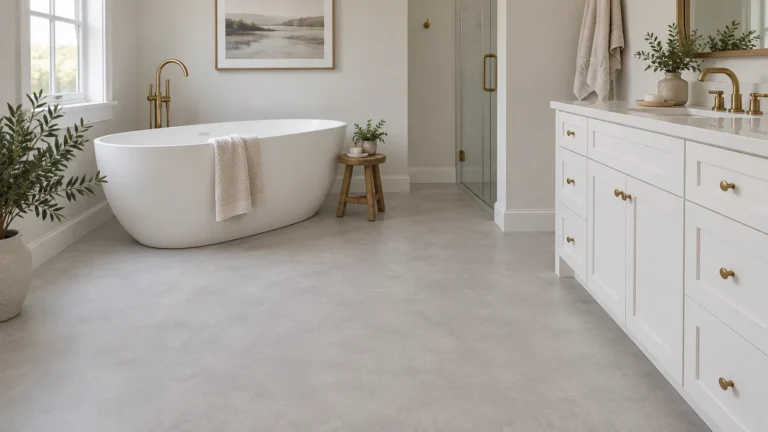
If joints in a small bathroom worry you, sheet vinyl can cover the floor in one piece.
Does LVP Scratch or Dent? What About Pets and Kids?
Scratching. LVP resists scratching reasonably well but is not scratch-proof, and no wear layer thickness changes that. The real offenders are grit tracked in on shoes and furniture dragged across the surface — not ordinary foot traffic, and not usually dog claws. A 20 mil wear layer with a quality urethane topcoat handles a large dog fine. A 6 mil budget plank does not.
Denting. This is where LVP is genuinely weaker than tile or hardwood. Concentrated point loads leave marks. A refrigerator rolled in on bare wheels, a piano caster, a dumbbell dropped from waist height — these dent vinyl. SPC resists it better than WPC. Nothing resists it completely.
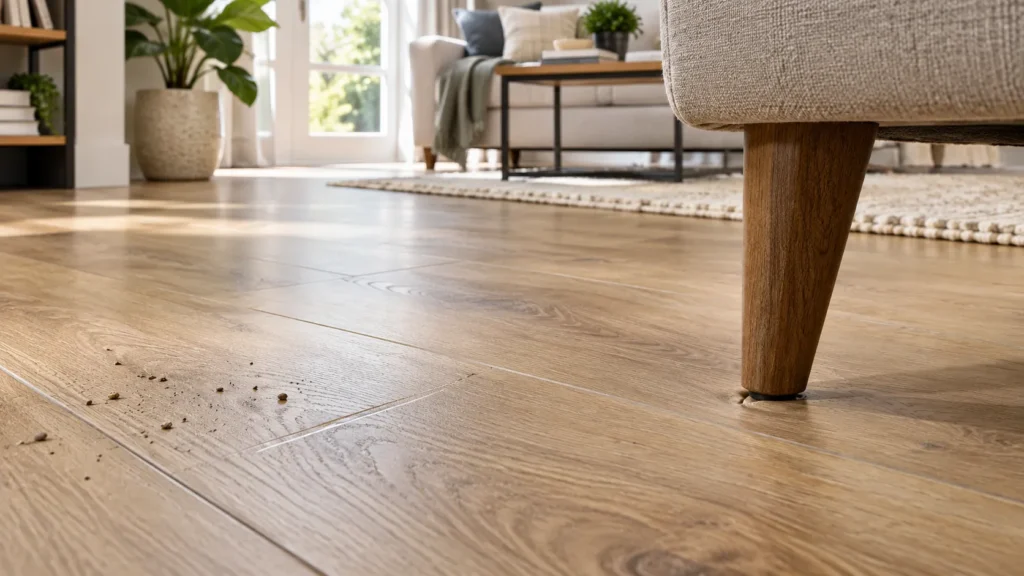
The problem is not weight, it is pressure — weight divided by contact area. A 200-pound bookshelf on four one-inch feet concentrates far more force per square inch than a 400-pound sofa on wide flat feet. That is why a chair leg dents a floor a refrigerator sits on happily.
What actually works:
- Felt pads under every furniture leg, replaced when they load up with grit
- Wide caster cups under anything heavy that rolls
- A real entry mat at every exterior door — grit control is the highest-leverage thing you can do
- Lifting furniture instead of sliding it
For kids, LVP is a good choice: warmer and softer than tile, quieter than laminate, and waterproof against the inevitable. The practical weakness is toys with hard narrow wheels on softer cores.
Where Can LVP Be Used?
| Room | Verdict | What to watch |
| Kitchen | Excellent | Go SPC — appliances and island stools concentrate loads |
| Bathroom | Widely approved | Seal the perimeter; the shower assembly still needs its own waterproofing |
| Basement | One of the best options | The slab must meet the product’s moisture limits |
| Bedroom / living room | Excellent | WPC or an attached pad if sound travels to the room below |
| Laundry / mudroom | Excellent | SPC, with pads under the washer feet |
| Home gym | Use caution | SPC only, plus rubber mats under racks and machines |
| Sunroom / unheated space | Often not approved | Check the manual first — this is the category’s most common failure |
| Stairs | Possible | Needs approved stair nose; treads are typically glued, not floated |
That sunroom row deserves emphasis. Three-season porches and unheated spaces swing through large temperature ranges, vinyl expands and contracts with temperature, and many LVP products explicitly exclude them. Installing anyway produces buckling, gapping, and a voided warranty.
Installation and Why the Subfloor Matters More Than the Plank
Three systems dominate:
- Floating click-lock — planks lock mechanically and are not bonded to the subfloor. Most residential renovations, most DIY.
- Glue-down — full-spread adhesive bonds each plank to the substrate. Commercial traffic, low profile, easy single-board replacement.
- Loose lay — purpose-built planks with high-friction backing. Only works with products engineered for it; it does not mean leaving ordinary planks unsecured.
Note that click-lock describes the joint; floating describes how the floor relates to the substrate. Some click products are also approved for glue-down.
Now the part that decides whether your floor lasts: rigid core is more forgiving than thin glue-down vinyl, not a way to skip subfloor prep. The substrate has to be structurally sound, clean, dry, and flat within the manufacturer’s tolerance. Real unevenness loads the locking joints and produces the hollow clicking sound people complain about six months in. On concrete, test the slab rather than guessing — excessive slab moisture is the leading cause of flooring system failure over concrete.
One more counterintuitive point: if your planks have an attached pad, do not add underlayment underneath. More cushion sounds like an upgrade, but excess compressible material under a floating click floor lets the joints flex, which is exactly how locking systems fail early.
LVP vs Laminate vs Hardwood vs Engineered Hardwood
| LVP | Laminate | Solid hardwood | Engineered hardwood | |
| Core | Vinyl multilayer, often SPC or WPC | Wood-fiber HDF | Solid wood | Veneer over plywood |
| Surface | Printed film under clear wear layer | Printed image under melamine | Real wood | Real wood veneer |
| Water | Plank usually waterproof | Product-specific | Moisture-sensitive | Moisture-sensitive |
| Refinishable | No | No | Yes, many times | Once or twice |
| Dents | Moderate; core-dependent | Good — HDF is hard | Varies by species | Varies by species |
| Sound | Quiet, especially WPC | Often hollow | Solid | Solid |
Two honest observations. Laminate is harder than LVP and dents less — its weakness is water, not durability. And hardwood is the only one you can refinish, which is the real argument for it in a house you plan to keep for decades.
How Long Does LVP Last?
The commonly cited range is 10 to 25 years, which is fine as a planning range and useless as a prediction. More realistically:
- A 6 mil plank in a busy entryway can look worn in 2–4 years
- A 12 mil plank in a normal household holds up 10–15 years
- A 20 mil plank with good grit control and proper installation reaches 20+ years
Installation quality matters more than people expect. A floor that fails at the joints because the subfloor was out of tolerance has not worn out — it has failed, and it fails on the same schedule regardless of how good the plank was.
And a “limited lifetime residential” warranty is a coverage document, not a lifespan forecast. It typically covers wear-through under normal residential use, with real exclusions for improper installation and moisture.
Frequently Asked Questions
Is LVP real wood?
No. LVP uses a printed design layer under a clear wear layer to reproduce the look of wood. Good LVP is convincing until you touch it.
Is 20 mil the same as 20 mm?
No. Twenty mil is 0.020 inch, about 0.5 mm. Twenty millimeters would be roughly forty times thicker — thicker than most complete floors.
What wear layer do I need?
12 mil is the minimum worth buying. Choose 20 mil if you have pets, kids, a rental, or are doing the whole house.
Is LVP good with dogs?
Yes, with a 20 mil wear layer. Claws matter less than the grit dogs track in, so entry mats do more for the floor than any spec. Choose SPC for large dogs.
Can LVP go over tile?
Often yes, if the tile is sound, flat, clean, and fully bonded. Deep grout lines may need filling, and the added height has to clear your doors and appliances.
Does every LVP need underlayment?
No. Many rigid-core products have an attached pad and should not have anything added underneath.
Is LVP safe indoors?
Look for a third-party certification on the specific product — FloorScore or GREENGUARD Gold — rather than a generic “low VOC” claim. Both test finished products for emissions.
Can LVP be repaired?
Individual planks are replaceable in glue-down installations. Floating floors require unclicking back to the damaged board. Buy 10 percent extra and store it — matching a discontinued run later is often impossible.
Does LVP add resale value?
Modestly, mostly by removing an objection. Replacing worn carpet with quality LVP reads as updated. It will not command the premium hardwood does in markets where hardwood is expected.
Does LVP need to acclimate?
Most manufacturers require 24–48 hours in the installation space at service temperature. Skipping it is a common DIY cause of gapping.
The Bottom Line
LVP is a luxury vinyl plank — a multilayer resilient floor made in individual boards, printed to look like hardwood, built around either a flexible body or a rigid SPC or WPC core.
What separates a good purchase from a disappointing one is not the brand on the box. It is four decisions:
- Wear layer — 12 mil minimum, 20 mil for most households
- Core type — SPC for dents and stability, WPC for warmth and quiet
- Room approval — check sunrooms, radiant heat, and bathrooms specifically
- Subfloor prep — do it properly, or the floor fails at the joints regardless of what you spent
Get those right and LVP is one of the best value floors in the US market. Get them wrong and you have a waterproof floor that looks tired in four years — which is exactly where the category’s reputation problem comes from.