Walk into any flooring store and you’ll see the same oak-look plank sold as LVT, LVP, SPC, WPC, rigid core and click vinyl, sometimes on the same shelf. Pick by looks alone and you can bring home two floors that photograph identically and behave nothing alike.
One dents under the refrigerator. The other sounds hollow underfoot. Both said “waterproof” on the box.
The fix is knowing what sits under the picture. LVT flooring, short for luxury vinyl tile, is a layered vinyl floor sold as individual tiles or planks and printed to imitate wood, stone and other materials. Once you can read its layers and core types, every other label on that shelf starts to make sense.
Key Takeaways
- LVT is a multi-layer vinyl floor: backing, core, printed design film, clear wear layer and a factory topcoat.
- “Tile” is historical. LVT now covers planks, herringbone pieces and large-format stone looks, and in US stores wood-look planks are usually labeled LVP.
- Flexible, SPC and WPC describe the core. Glue-down, loose-lay and click describe how the floor is held down. A product can be both SPC and click.
- The wear layer, quoted in mils (1 mil = 1/1,000 inch), protects the print. It is not the same as total plank thickness.
- The plank can be waterproof while the room is not. Seams, edges and the subfloor still matter.
What Is LVT Flooring?
LVT stands for luxury vinyl tile. It belongs to the resilient flooring family, the same group as sheet vinyl, vinyl composition tile (VCT), rubber and linoleum, and it is one branch of the wider vinyl flooring category. What separates LVT from the vinyl your grandparents had is construction: a printed design film sandwiched between a supportive core and a clear protective surface, sold in modular pieces you can lay in patterns.
Two words in the name mislead people. Tile suggests squares, yet walk the vinyl aisle in any US store and wood-look planks fill the shelf. Luxury is a marketing label, not a grade of PVC or a separate material.
Nobody certifies a floor as luxury. The word simply signals a layered, textured product rather than a flat printed sheet.
What Is LVT Flooring Made Of?
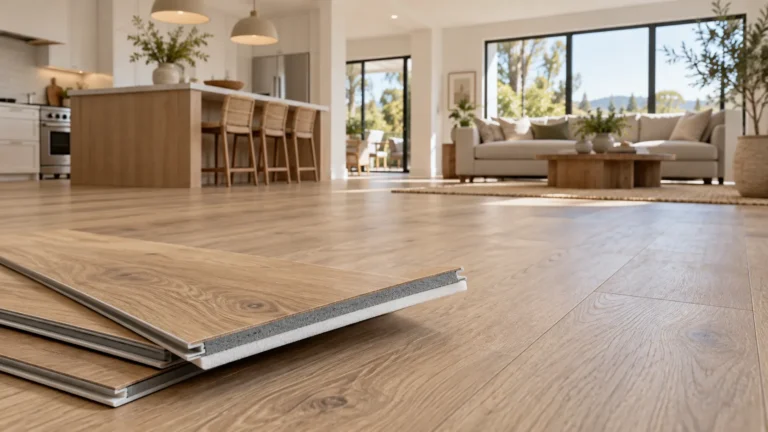
LVT is not a solid slab of printed plastic. The bulk of the product is PVC resin mixed with mineral fillers such as calcium carbonate, plus plasticizers and stabilizers, and each layer does a distinct job. Read the table bottom to top, the way the floor is built.
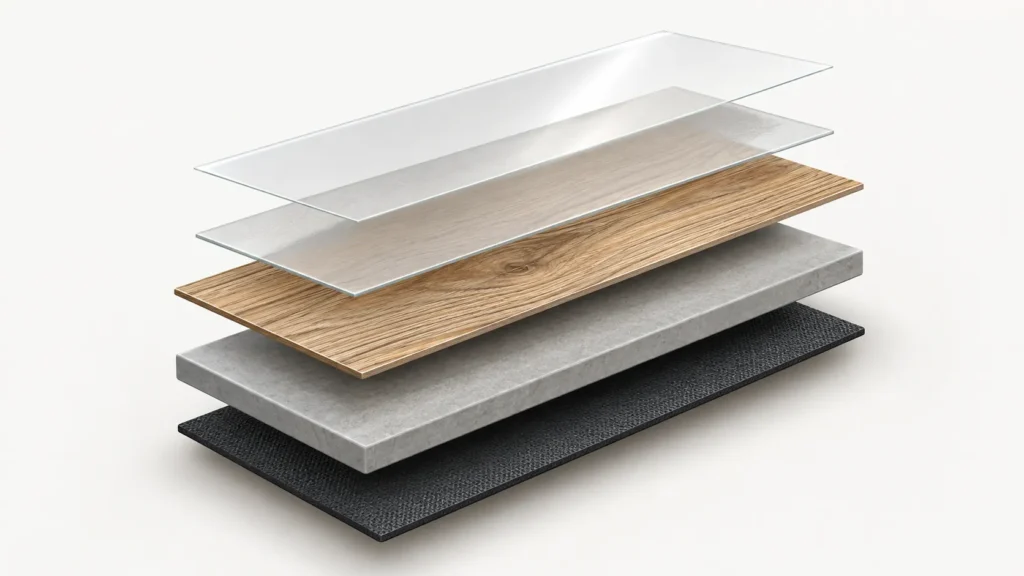
| Layer | What it is | What it does for you |
| Backing | Vinyl, a friction layer, or an attached foam or cork pad | Supports the plank and meets the subfloor; an attached pad softens sound and footfall |
| Core | Flexible vinyl, dense SPC, or foamed WPC | Gives the plank its body, stiffness and dent resistance; this is where most of the thickness lives |
| Design film | High-resolution printed image | Creates the wood, stone, concrete or pattern visual |
| Wear layer | Clear vinyl, measured in mils | Shields the print from foot traffic, grit and scuffs |
| Topcoat | Factory-applied urethane or similar finish, often with ceramic or aluminum-oxide particles | Handles day-to-day scratches, stains and gloss control |
Two of these layers deserve a closer look because they get confused most often.
The Wear Layer
The wear layer is the clear film directly over the print. Brands quote it in mils, and a mil is one thousandth of an inch, so 12 mil is about 0.3 mm, 20 mil about 0.5 mm and 28 mil about 0.7 mm. Thinner wear layers are common on entry-level residential planks; 20 mil is the threshold commonly quoted for commercial ratings.
It is a useful number but not a universal quality score. Grit scratches the finish, furniture legs dent the core, sunlight stresses the plank’s dimensional stability, and click joints carry their own loads. A thick wear layer solves one of those problems, not all of them.
The Topcoat
The topcoat is easy to ignore because it is fractions of a millimeter thick and invisible once the floor is down. Yet two planks with the same 20 mil wear layer can scuff and stain differently because their finish chemistries differ. When a spec sheet mentions a ceramic-bead or aluminum-oxide finish, it is talking about this layer.
LVT vs. LVP: What’s the Difference?
Mostly the shape. LVP means luxury vinyl plank, the long rectangular format that imitates hardwood boards. LVT means luxury vinyl tile, and in US retail it usually points to square or rectangular stone and ceramic looks. Some manufacturers use LVT as the umbrella term for both; others treat them as separate aisles.
Underneath the print, the construction is often identical. A plank and a tile from the same collection typically share the same core, wear layer and locking system. So when you compare products, compare layers and specs, not the letters on the label.
Types of LVT Flooring: Core Types
Here is the single biggest source of confusion in this category. Flexible LVT, SPC and WPC describe the core. Glue-down, loose-lay and click describe how the floor is secured. Retail pages routinely mix the two lists as if they were alternatives. That is how shoppers end up asking whether to buy “SPC or click” when the plank in their cart is both.
Sort by core first, then by format.
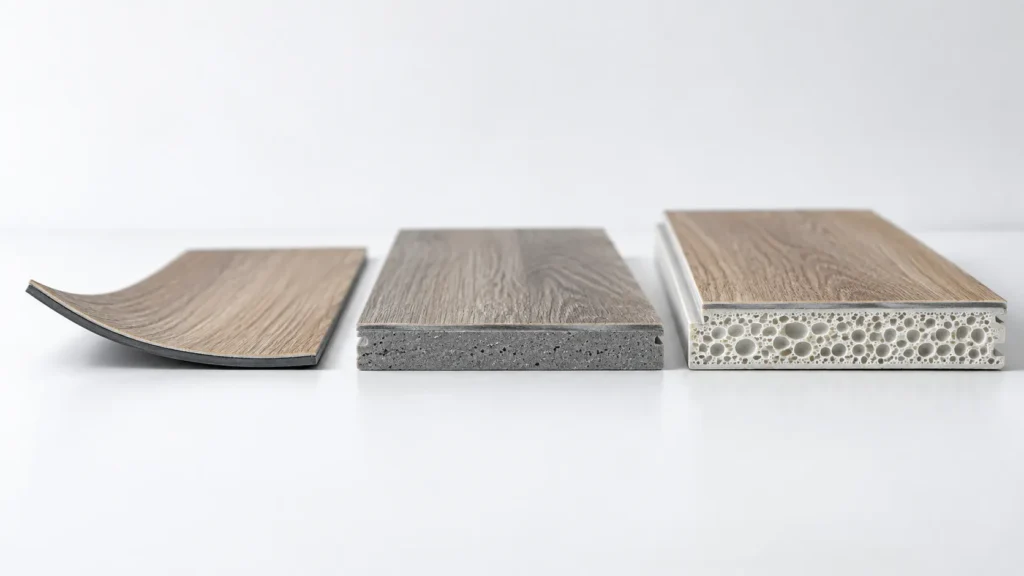
Flexible LVT
Flexible LVT is the original build: thinner, pliable, and usually glued down or laid loose. Because it bends, it follows whatever is beneath it, so a smooth subfloor matters more than it does with a rigid product. Designers like it for detailed layouts, borders and mixed-material patterns, and it has long been the standard in commercial interiors.
Rigid Core: SPC and WPC
Rigid core LVT replaces the flexible body with a stiff polymer core and is almost always a floating click floor. This is the category behind the big-box brands US shoppers meet first, such as LifeProof and COREtec. It comes in two families.
SPC (stone plastic composite) uses a dense mineral-loaded core. Stiff, dimensionally stable and resistant to concentrated loads, it is a common pick for kitchens with heavy appliances. It also feels harder and sounds sharper underfoot.
Our SPC flooring guide breaks the stone core down layer by layer
WPC (wood plastic composite) uses a lighter foamed core. Despite the name, many WPC cores contain little or no wood. The foam structure gives a softer, quieter, warmer feel at the cost of some dent resistance.
Companies expand these acronyms differently, and marketing terms drift, so core density and test data tell you more than the initials. In the US, rigid core products follow ASTM F3261 and solid vinyl tile follows ASTM F1700. The industry group RFCI also runs an ASSURE Certified program that tests rigid core products against a set of performance criteria; it is worth checking for on a spec sheet.
Glue-Down, Loose-Lay and Click: Formats, Not Types
These three words describe attachment, and any core type can appear in more than one of them.
- Glue-down planks or tiles are bonded to the subfloor with adhesive. Common for flexible LVT and for commercial jobs where rolling loads and long runs need a fully fixed floor.
- Loose-lay LVT is a thicker, heavier flexible product with a high-friction backing that holds it in place by weight and grip, usually with adhesive only at the perimeter.
- Click (or click-lock) planks have milled tongue-and-groove edges that snap together and float over an underlayment. This is the standard format for SPC and WPC.
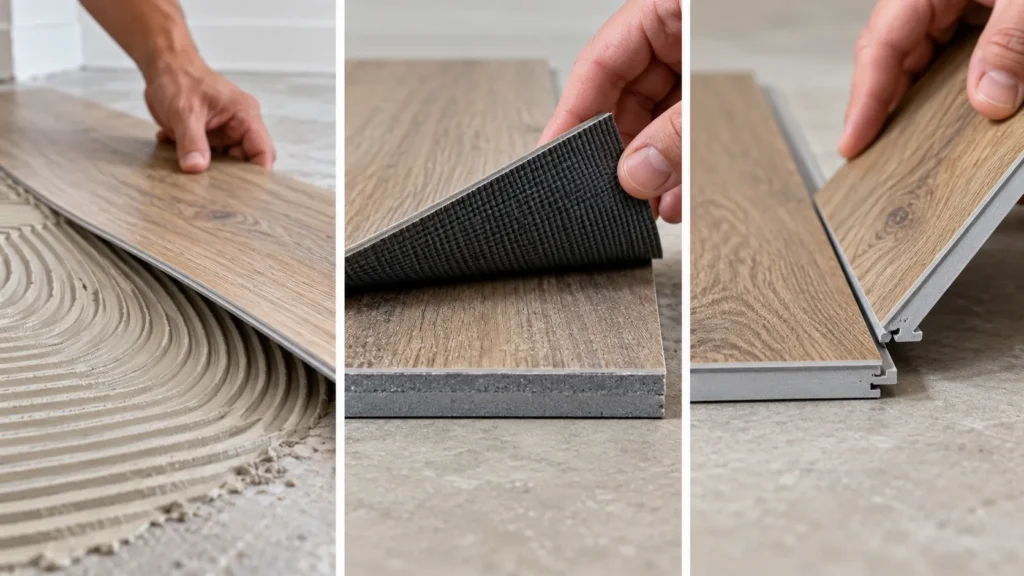
A separate guide on this site will cover installation methods in detail. For a definition post, the point is simply this: format and core are two different questions, and you need an answer to both.
What Does LVT Flooring Look Like?
Almost anything the design film can print. Wood and stone dominate, but current collections also cover polished concrete, terrazzo, encaustic tile patterns, parquet blocks and abstract graphics.
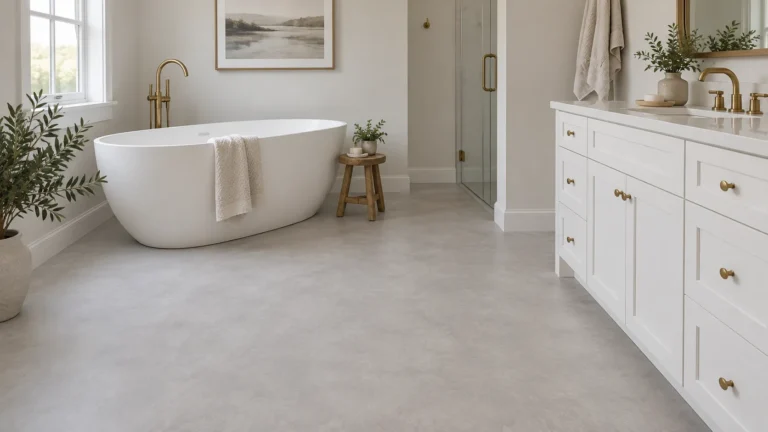
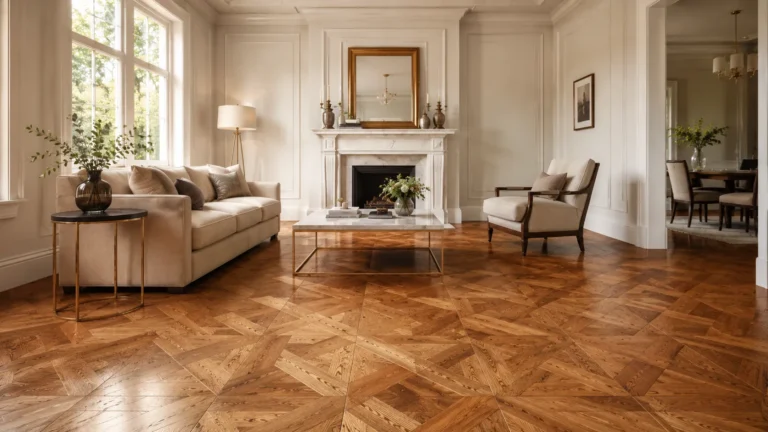
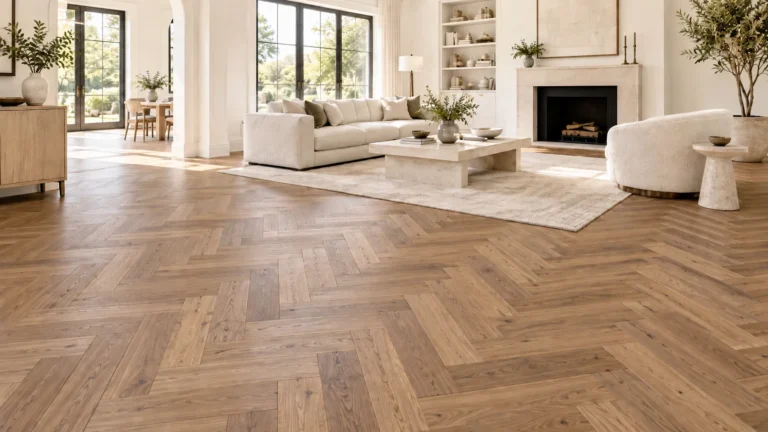
Wood-look LVT reproduces oak, hickory, walnut, maple and ash, from pale Scandinavian tones to smoked and hand-scraped effects. Long planks read as floorboards; shorter pieces open up herringbone and chevron layouts. Stone-look LVT covers marble, slate, travertine and limestone in square and rectangular modules, often with a grout-line bevel so the floor reads as tile. Concrete and contemporary designs suit rooms that want a mineral, architectural feel without the hardness of real stone or ceramic.
How to Tell Convincing LVT From the Obvious Stuff
Print resolution is only part of realism. When you compare samples, judge five things together:
- Pattern repetition. Count the unique plank images in a collection. Too few, and the same knot shows up every fourth board.
- Emboss alignment. On better products the texture is “embossed in register,” meaning the ridges follow the printed grain instead of a generic pattern stamped anywhere.
- Gloss level. Real oak and limestone are not shiny. A matte or low-sheen finish hides the plastic more effectively than any print.
- Proportions. Wide, long planks reduce visible joints; oversized stone tiles look more like slab than mosaic.
- Edge detail. A micro-bevel defines each piece like a real board; a square edge creates a flatter, more continuous field. Neither is wrong, but they read differently in a room.
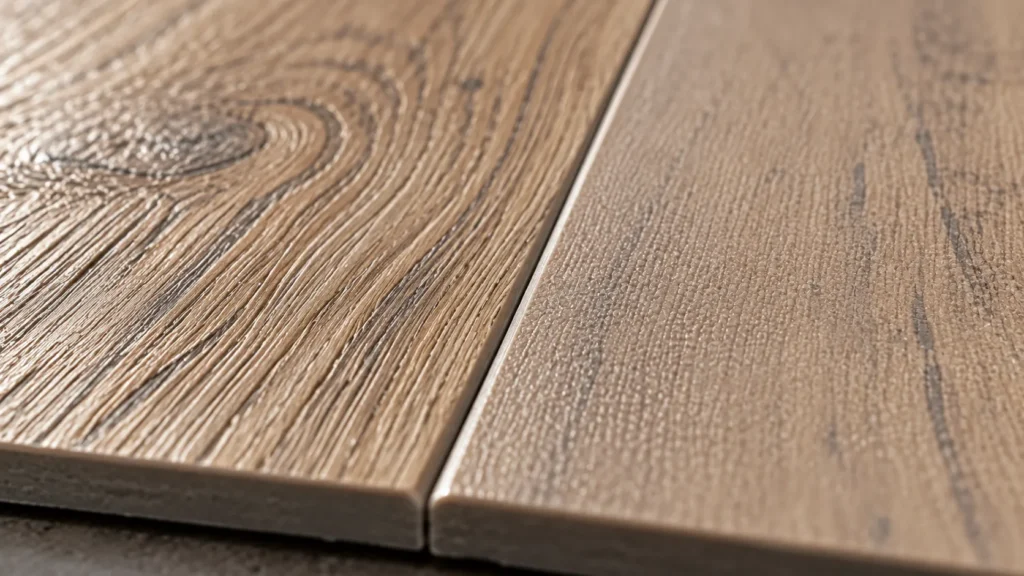
Hold two samples side by side under your own room’s light rather than the showroom’s. Gloss and color shift more than most people expect.
Is LVT Flooring Waterproof?
The vinyl itself, yes. Water does not swell or warp PVC the way it swells the fiberboard core of laminate, so the “waterproof” label on a rigid core box holds for the plank itself. Spills, pet accidents and wet boots are everyday events for this floor.
Here is the limit the box does not mention: a waterproof plank is not a waterproof room. Water can still travel through seams, under baseboards and into the subfloor, and moisture rising through a basement slab is a building problem, not a flooring one. For bathrooms and laundry rooms, treat the product claim and the room’s own waterproofing as two separate questions.
How Durable Is LVT Flooring?
LVT handles heavy foot traffic well. You will find it in hospital corridors, hotel lobbies and school hallways as often as in living rooms. Durability, though, is not one property.
Shoes and grit work on the topcoat. Furniture and appliances create point loads on the core. Sunlight and heat test dimensional stability. Click joints take their own mechanical stress every time the floor expands and contracts.
So “scratch-resistant” is the accurate phrase, not “scratch-proof.” Dragged furniture, hard chair casters and tracked-in grit can mark any resilient floor. Total plank thickness is also a poor shortcut: a 6 mm SPC plank does not have a 6 mm wear surface. Most of that depth is core and backing, and the print is protected only by the clear layer above it.
How Long Does LVT Flooring Last?
There is no standards-based lifespan for the category. Service life depends on traffic, wear layer, core, sun exposure and how well the installed floor was prepared, and consumer guides that quote a single number are guessing.
Warranties are a better clue than they look, provided you read them as contracts rather than predictions. A 25-year residential warranty tells you the manufacturer expects the product to survive normal home use for a long time under its stated conditions. It does not promise the floor will look new in year 24, and it will not cover damage from a wet subfloor or a missing expansion gap.
Where Can You Use LVT Flooring?
Almost anywhere indoors. Versatility, more than any single spec, explains its popularity. A few rooms have specific things worth knowing.
Kitchens suit it well: splash-tolerant, warmer than tile, and available in wood looks that can run straight through from the living room without a transition strip. Choose a dense SPC core if the refrigerator and range are heavy. Bathrooms and laundry rooms work when the manufacturer approves that exact product for the space; the floor covering still is not the room’s waterproofing system. Living rooms and bedrooms give LVT room to show off, with long planks for a calm field or herringbone for a statement, and the resilient build feels less brittle underfoot than ceramic.
Basements are where moisture language needs the most care. The plank tolerates surface water; a slab that wicks moisture from below needs a vapor test and possibly a barrier before any floor goes down. Entryways and mudrooms combine grit, water and concentrated traffic, so the topcoat earns its keep there. Commercial spaces from retail to healthcare use LVT constantly, but the spec conversation shifts to traffic class, rolling loads, slip resistance and acoustics rather than the design label.
Is LVT Flooring Safe and Environmentally Friendly?
No blanket answer covers every vinyl floor ever made, and anyone offering one is selling something. Formulations vary by manufacturer and by year. The useful approach is to ask three separate questions: what is it made from, what does it release into the air, and what happens to it at end of life.
For indoor air, look for FloorScore certification. The Resilient Floor Covering Institute (RFCI) administers FloorScore, SCS Global Services certifies it, and the program tests hard-surface flooring, adhesives and underlayments against California’s VOC emission criteria (the CDPH Standard Method, often called Section 01350). Certified products qualify for indoor-air credits under LEED v4.1, WELL and Green Globes. Certification tells you something specific about emissions; it says nothing about PVC content or recyclability.
For life-cycle impact, look for an Environmental Product Declaration (EPD). An EPD is a disclosure document, not a green badge, and it reports impacts under a defined method. RFCI publishes industry-wide EPDs for nine resilient flooring types, with separate declarations for glue-down LVT, loose-lay LVT, SPC and WPC, a reminder that these constructions are not one identical product environmentally. The honest downside is end of life: multi-layer vinyl is hard to separate and recycle, and unless a manufacturer runs a take-back program, an old floor’s destination is the landfill.
Three Myths About LVT Flooring
Myth: LVT and Laminate Are the Same Thing
They compete for the same customers and often sit in the same aisle, but the construction is different. Laminate carries its printed image on a high-density fiberboard core, so it swells when water reaches the seams. LVT is vinyl through the body. In a wet area the vinyl core is the deciding advantage.
Myth: All LVT Is the Same Quality
Two planks can share the same oak image and still differ in wear layer, topcoat, core density, backing and locking system. Visual similarity proves nothing about performance. Spec sheets do.
Myth: LVT Is Only Made to Look Like Wood
Wood is the look you will see most on the shelf, not the only one available. Stone, ceramic, concrete, terrazzo and geometric patterns are all in current collections, and some of the most convincing installations are stone looks in large format with a matte finish.
Frequently Asked Questions About LVT Flooring
What does LVT stand for in flooring?
Luxury vinyl tile. In practice the term now covers modular vinyl flooring sold as tiles and planks, including flexible and rigid core products.
Is LVT the same as vinyl flooring?
LVT is one type of vinyl flooring. The broader category also includes sheet vinyl, vinyl composition tile (VCT) and solid vinyl tile.
Is LVT flooring real wood?
No. Wood-look LVT reproduces wood with a printed design film. There is no hardwood surface to sand or refinish, so deep damage means replacing the plank.
Is LVT good for kitchens and bathrooms?
Yes for both, provided the manufacturer approves the specific product for those rooms. The material tolerates everyday moisture; it does not replace a bathroom’s waterproofing system or fix a wet basement slab.
Does LVT scratch easily?
It is scratch-resistant, not scratch-proof. Grit, hard casters and dragged furniture can mark the finish. A higher-mil wear layer and a matte, particle-reinforced topcoat help.
Can pets damage LVT flooring?
Claws and tracked-in grit can scuff any resilient floor, but a 20 mil wear layer handles normal household pet traffic well, and pet accidents will not swell the plank the way they swell laminate.
How thick is LVT flooring?
There is no single standard. Flexible glue-down LVT is relatively thin; rigid core planks are thicker because the core and attached pad add depth. Remember that total thickness and wear layer thickness are different numbers.
Is LVT suitable for commercial spaces?
Yes. It is a standard specification in retail, hospitality, education and healthcare. Commercial use shifts the conversation to traffic class, rolling loads, slip resistance and acoustic ratings, not just the visual.