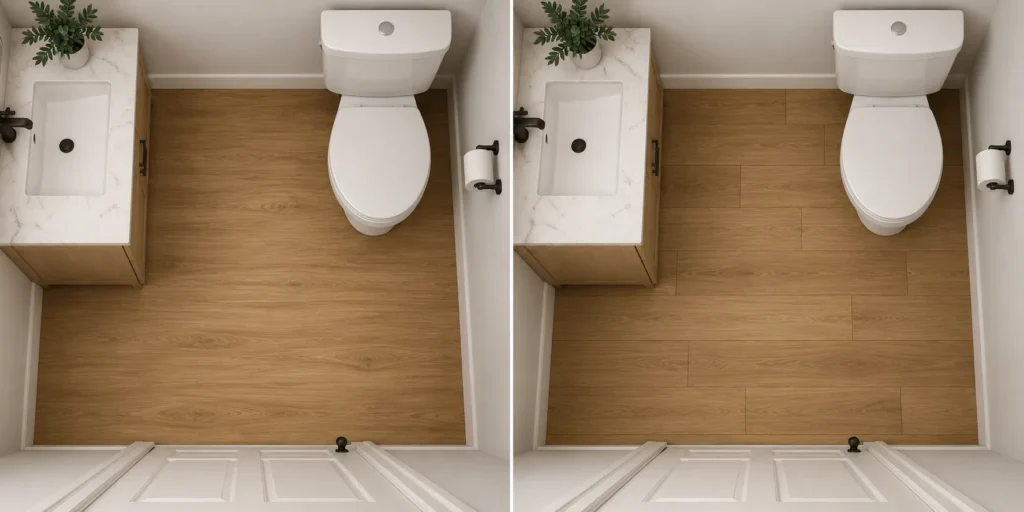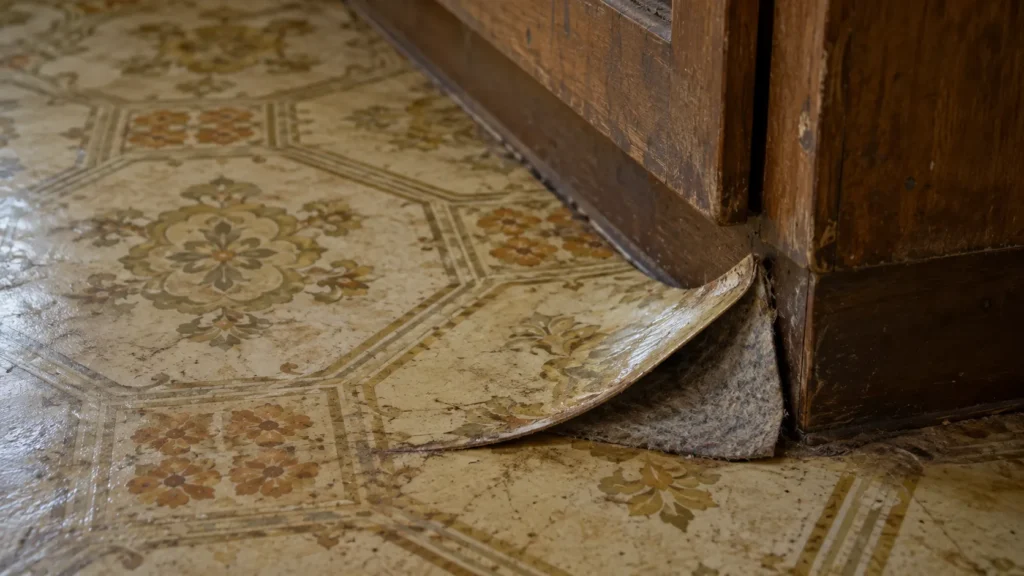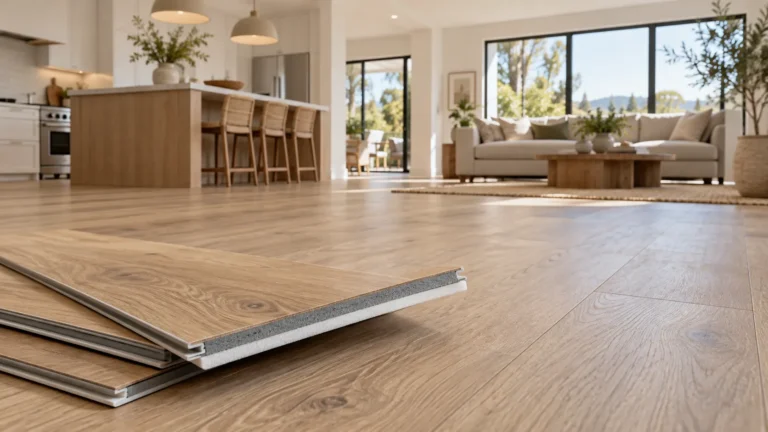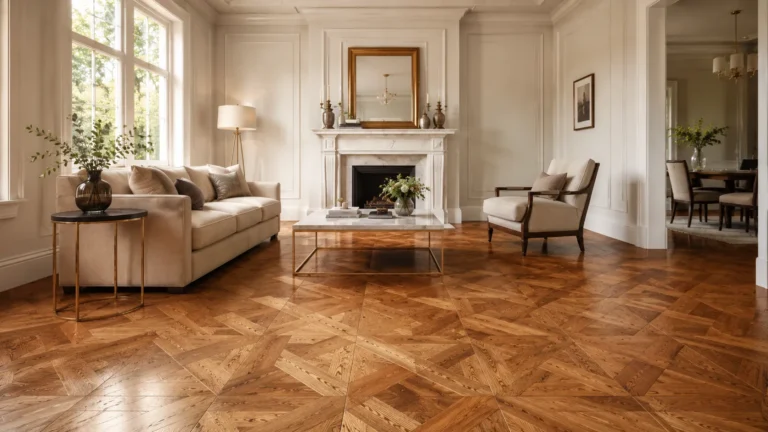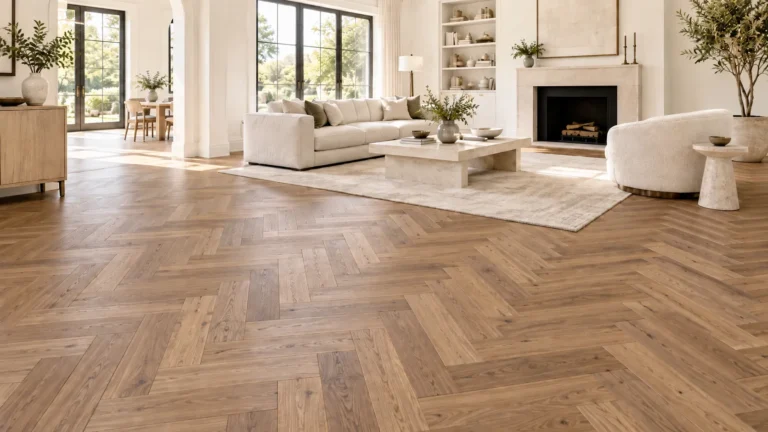
Sheet vinyl flooring has changed considerably from the thin, dated-looking flooring many homeowners remember. Modern products offer convincing wood, stone, tile and geometric designs while retaining the practical advantages that have kept sheet vinyl popular: relatively low cost, few seams, simple cleaning and good moisture resistance.
The most important lesson is that the visible design is only one part of the decision. Backing construction, wear layer, subfloor preparation, seam placement and installation method have a major effect on how the finished floor performs.
What Is Sheet Vinyl Flooring?
Sheet vinyl flooring is a resilient floor covering supplied in wide rolls and installed in one or a few large pieces. It is affordable, easy to clean, comfortable underfoot and particularly useful in kitchens, bathrooms, laundry rooms and rentals. Its performance depends heavily on subfloor preparation, seam placement and the correct installation method.
Residential sheet vinyl commonly comes in 6- or 12-foot rolls, although other widths are available. Because a room may be covered by one continuous piece, the finished floor usually has fewer joints than vinyl tile or luxury vinyl plank.
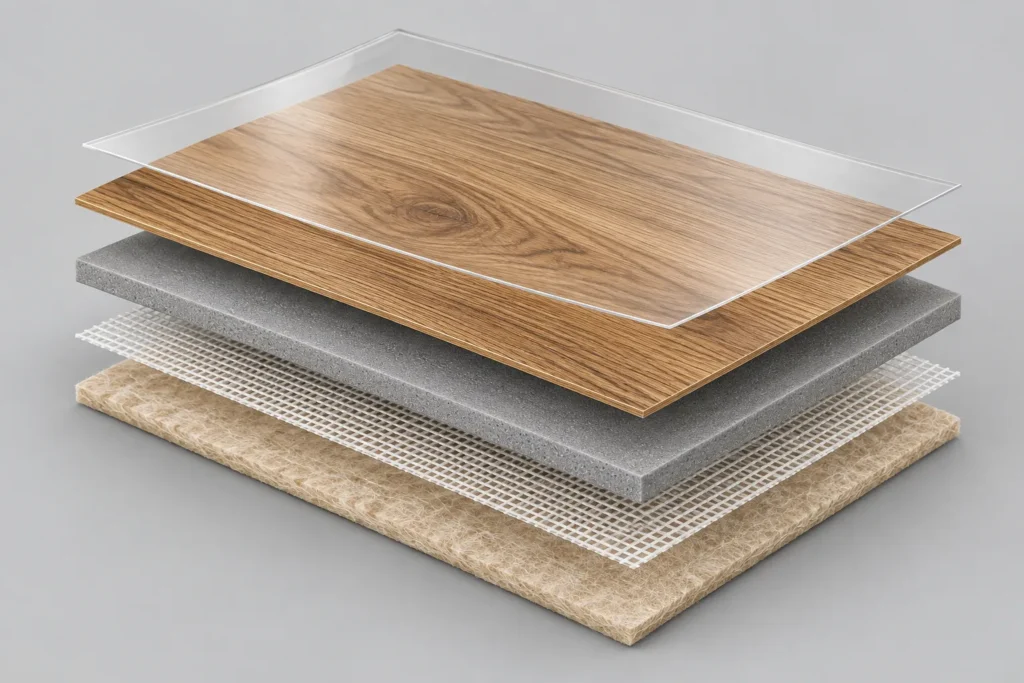
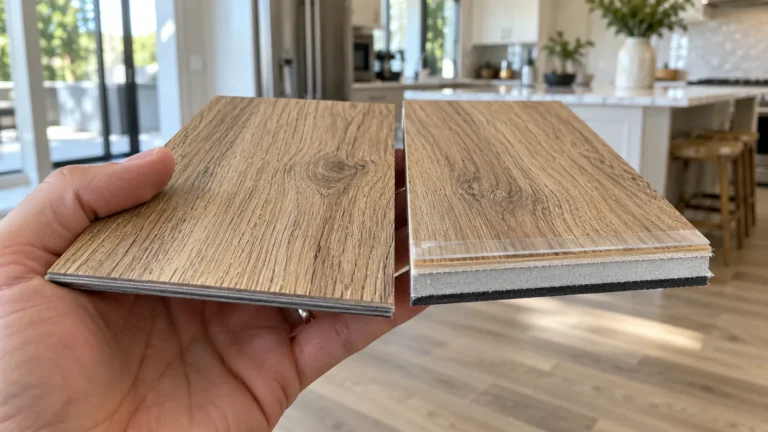
A typical product contains several functional layers:
- Wear layer: Protects the printed design from traffic, stains and routine cleaning.
- Protective finish: Often a urethane or enhanced urethane coating.
- Design layer: Creates the wood, stone, ceramic, terrazzo or geometric appearance.
- Support layer: Adds dimensional stability.
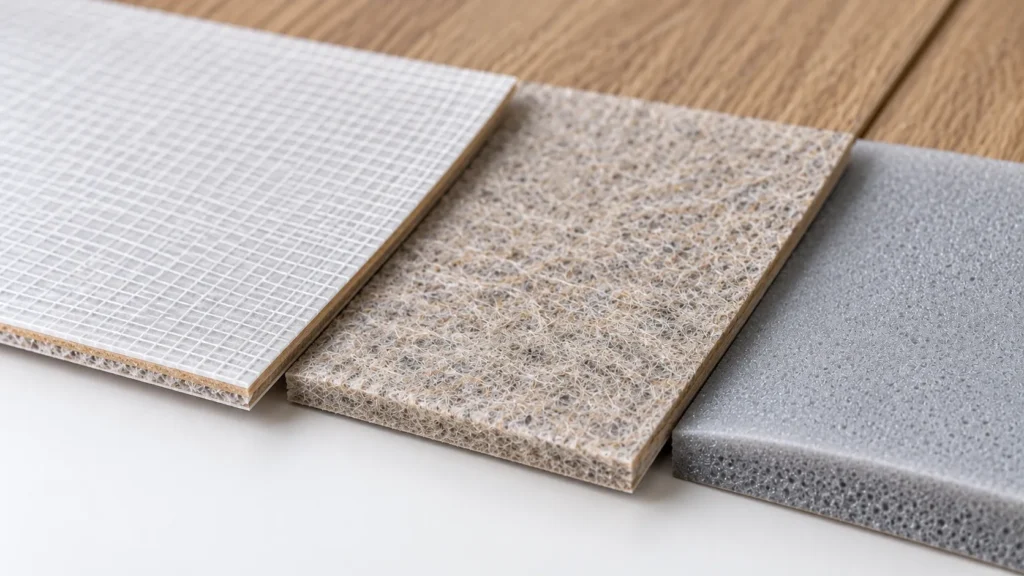
- Backing: May be fibreglass, felt, composite or another product-specific construction.
The exact construction determines which adhesive, installation system and maintenance products should be used.
Main Types of Sheet Vinyl Flooring
Fibreglass-backed sheet vinyl

Fibreglass-backed products are dimensionally stable and may qualify for loose-lay, modified loose-lay or releasable adhesive installation. This makes them appealing for straightforward residential renovations.
Felt-backed sheet vinyl

Felt-backed products commonly require a permanent full-spread adhesive. They can provide a firm, traditional installation but demand careful adhesive application and subfloor preparation.
Luxury vinyl sheet flooring

Luxury vinyl sheet uses higher-definition printing, enhanced texture and stronger finishes to create a more realistic wood, stone or tile appearance. It remains a rolled product and should not be confused with luxury vinyl plank or luxury vinyl tile.
Commercial sheet vinyl flooring

Commercial products are selected according to traffic, slip resistance, rolling loads, hygiene requirements and maintenance programmes. Some installations use full-spread adhesive, heat-welded seams and integral coving to create a more hygienic surface.
Advantages and Disadvantages
| Advantages | Disadvantages |
| Few seams in smaller rooms | Subfloor defects may show through |
| Good resistance to everyday spills | Sharp objects can cut or gouge the surface |
| Affordable material options | Localised repairs may remain visible |
| Fast installation in suitable rooms | Large rolls can be difficult to handle |
| Easy routine cleaning | Poor cutting can waste an entire sheet |
| Softer and warmer than ceramic tile | Heavy furniture can cause indentations |
| Wide choice of patterns | Direct sunlight may cause fading |
| Suitable for many pet and family homes | Seam or edge failure can allow moisture underneath |
Beauflor’s competitor guide similarly identifies water resistance, comfort, durability and easy maintenance as strengths, while warning about sunlight discoloration, subfloor flatness and the difficulty of replacing damaged areas.
Where Does Sheet Vinyl Flooring Work Best?
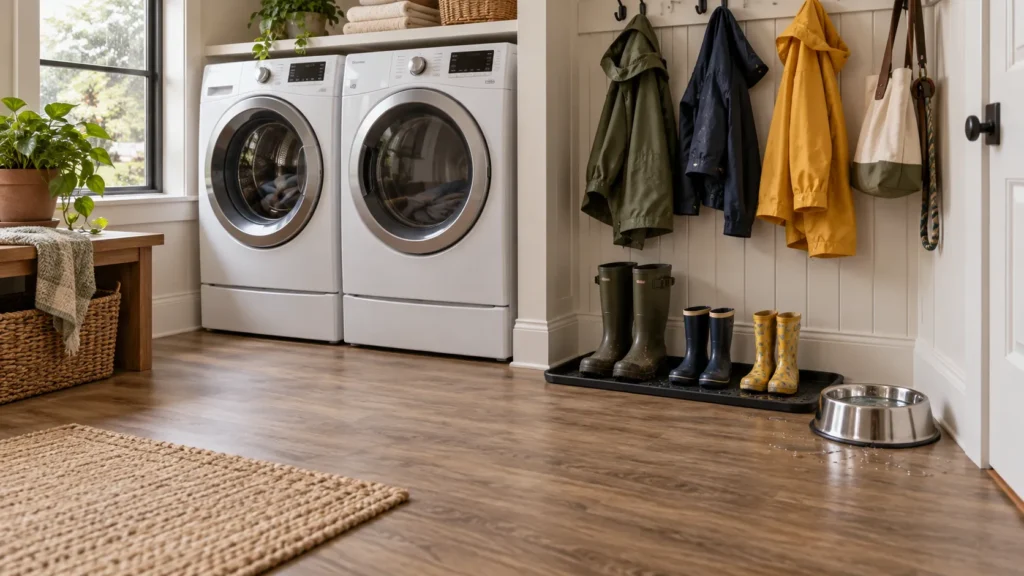
Sheet vinyl is particularly useful in moisture-prone areas because large sheets reduce the number of joints. Competitor guides regularly recommend it for bathrooms, kitchens, laundries, mudrooms and rental properties.
Homeowners comparing sheet vinyl with other options can also explore All Flooring Types to understand where different flooring materials work best.
| Room or property type | Suitability | Key consideration |
| Bathroom | Very good | Seal edges and penetrations correctly |
| Kitchen | Very good | Choose good indentation and wear resistance |
| Laundry room | Very good | Protect edges around appliances and water connections |
| Mudroom | Good | Use entrance mats with non-staining backing |
| Basement | Conditional | Test concrete moisture before installation |
| Rental property | Very good | Affordable, easy to clean and quick to replace |
| Children’s playroom | Good | Softer than tile but can still be cut by sharp toys |
| Bedroom | Good | Comfortable, quiet and easy to maintain |
| Living room | Conditional | LVP may provide a more realistic plank appearance |
| Stairs | Generally unsuitable | Use a product specifically approved for stairs |
| Heavy commercial space | Product-dependent | Verify traffic class, rolling loads and seam requirements |
Sheet vinyl is particularly useful in moisture-prone areas because large sheets reduce the number of joints. Competitor guides regularly recommend it for bathrooms, kitchens, laundries, mudrooms and rental properties.
Sheet vinyl flooring for bathrooms

Bathroom flooring must be evaluated for more than surface water resistance. The floor also needs:
- Correctly sealed edges
- Secure seams
- Proper fitting around the toilet flange
- Suitable adhesive
- A dry, stable subfloor
- Prompt leak detection
Sheet vinyl is economical and comfortable underfoot, but it requires a smoother, more stable substrate than some rigid-core products. It can also be more susceptible to scratches than harder LVP or LVT surfaces.
Manufacturer instructions may require caulking around toilets, tubs and showers to help prevent water from migrating below the flooring.
Sheet vinyl flooring for kitchens

A kitchen floor must tolerate:
- Food and drink spills
- Frequent cleaning
- Chair movement
- Standing for long periods
- Heavy refrigerators and ranges
- Dropped utensils
- Direct sunlight near exterior doors
Sheet vinyl is comfortable and easy to clean, but appliance movement requires care. Use hardboard runways or suitable sliders and never drag a refrigerator directly over the surface.
Sheet vinyl flooring for basements

The vinyl itself may tolerate moisture, but that does not mean it can be installed over damp concrete. Moisture vapour can affect adhesive, encourage growth beneath the floor and contribute to edge or seam failure.
Before basement installation:
- Investigate visible dampness.
- Test the concrete using the flooring manufacturer’s approved method.
- Correct active leaks.
- Confirm that the adhesive is suitable for the measured moisture level.
- Follow all slab-age and environmental requirements.
Is Sheet Vinyl Flooring Waterproof?
The vinyl material itself is generally nonporous and often marketed as waterproof. However, the complete installed floor is only as secure as its:
- Seams
- Edges
- Doorways
- Floor penetrations
- Adhesive
- Subfloor
- Installation workmanship
Water can still reach the substrate through a damaged seam, unsealed perimeter, plumbing leak or cut in the surface. Therefore, waterproof flooring does not make the room waterproof.
In bathrooms and laundries, minimise seams, seal required edges and repair lifting or damage promptly. Large sheets provide better surface continuity than floors assembled from many individual pieces, but standing water should still be removed quickly.
How Much Does Sheet Vinyl Flooring Cost?
For US budgeting, material-only sheet vinyl often falls around $1–$4 per square foot. Straightforward installed projects commonly fall around $3–$7 per square foot, while premium products, extensive subfloor work, difficult layouts or regional labour differences can move the total towards $4–$13 per square foot.
Planning ranges
| Project component | Approximate planning range |
| Basic sheet-vinyl material | $1–$2 per sq. ft. |
| Mid-range or upgraded material | $2–$4+ per sq. ft. |
| Straightforward material and installation | $3–$7 per sq. ft. |
| Premium or preparation-heavy project | $4–$13 per sq. ft. |
| Removal, levelling and repairs | Additional project-specific cost |
These figures are planning ranges, not quotations.
Factors that increase the final cost
- Old-floor removal and disposal
- Subfloor patching or replacement
- Moisture remediation
- Pattern matching
- Complex room shapes
- Multiple seams
- Toilet or appliance removal
- Underlayment installation
- Premium wear layers or finishes
- Commercial adhesives
- Heat-welded seams
- Base or cove work
- Furniture moving
Congoleum specifically advises including old-floor removal, subfloor repair, tools, furniture handling and the difficulty of cutting and fitting a large roll when calculating a realistic budget.
How to Identify High-Quality Sheet Vinyl Flooring
Do not judge a product only by total thickness or appearance.
1. Check the wear layer and finish
A stronger wear surface generally provides better resistance to traffic, stains and repeated cleaning. Compare products using manufacturer specifications rather than relying solely on showroom feel.
2. Match the product to the traffic level
A lightly used guest bathroom does not have the same requirements as a rental kitchen, busy family entrance or commercial corridor.
3. Examine the backing
The backing affects:
- Dimensional stability
- Adhesive requirements
- Loose-lay eligibility
- Comfort
- Ability to bridge minor imperfections
- Removal difficulty
4. Review indentation performance
Softness adds comfort, but heavy furniture, narrow chair legs and appliances can leave permanent depressions. Use broad, non-staining protectors.
5. Inspect pattern quality
Look for:
- Clear print definition
- Natural colour variation
- Texture aligned with the visual
- Appropriate pattern scale
- Manageable pattern repeat
- Realistic grout or plank lines
6. Read the complete warranty
Check exclusions involving:
- Incorrect adhesive
- Moisture
- Direct sunlight
- Rolling loads
- Improper maintenance
- Unapproved cleaners
- DIY installation
- Commercial use
- Installation over unsuitable floors
7. Obtain samples
View samples under daytime and artificial light. Test how easily dust, footprints and pet hair appear. Also inspect the sample next to cabinetry, walls and fixed finishes.
Roll Widths, Patterns and Design Choices
Most residential products are sold in 6- or 12-foot widths. Certain specialty retailers also carry 15-foot-wide rolls, but availability, colour and quality options may be more limited.
A wider roll can reduce or eliminate seams, but it may also be:
- More difficult to transport
- Harder to manoeuvre through doorways
- More difficult for a DIY installer to position
- More expensive to replace after a cutting error
Popular design categories
- Wood-look sheet vinyl
- Stone-look sheet vinyl
- Ceramic-tile patterns
- Black-and-white checkerboard
- Terrazzo visuals
- Cobblestone patterns
- Geometric designs
- Floral or retro patterns
- Plain commercial colours
For patterned floors, calculate the manufacturer’s pattern-repeat allowance before ordering. Two rolls of the same nominal size may require different waste allowances depending on the repeat and seam placement.
Sheet Vinyl Installation Methods
Installation instructions are product-specific. Do not select an adhesive or installation method before confirming the backing construction and manufacturer requirements.
| Method | How it works | Best suited to | Main risk |
| Loose lay | Sheet rests freely with limited or no adhesive | Approved products in smaller, simple rooms | Movement, edge curl or moisture migration |
| Modified loose lay | Tape or adhesive used at selected edges and transitions | Approved fibreglass-backed products | Incorrect taping or perimeter restriction |
| Releasable full spread | Pressure-sensitive adhesive covers the floor | Residential installations requiring stability and easier future removal | Wrong open time or adhesive transfer |
| Permanent full spread | Permanent adhesive covers the entire substrate | Felt-backed products, new construction, high traffic or specialised areas | Difficult removal and visible adhesive errors |
| Heat-welded commercial installation | Full adhesion with welded seams | Healthcare, veterinary and hygienic commercial environments | Requires specialist equipment and skill |
The STAINMASTER document lists loose lay, releasable full spread and permanent full spread as distinct systems, with selection based on room dimensions and day-to-day use.
Congoleum further explains that fibreglass and composite-backed products may permit modified loose lay or full-spread adhesive, while felt-backed products generally require permanent full spread.
Why Subfloor Preparation Matters
Sheet vinyl is flexible. That allows it to conform to the substrate, but it also means imperfections can eventually become visible through the surface. This is known as telegraphing.
Potential defects include:
- Raised plywood joints
- Trowel ridges
- Screw heads
- Cracks
- Old embossed flooring
- Adhesive residue
- Chips in concrete
- Low spots
- Dust or grit
Before installation, the substrate should be:
- Structurally sound
- Clean
- Smooth
- Flat
- Dry
- Secure
- Compatible with the adhesive
A product-specific installation guide may set exact moisture thresholds. For example, the supplied STAINMASTER guide requires wood-subfloor moisture not to exceed 14%, but this limit should not be applied universally; always use the chosen product’s published requirements.
Does sheet vinyl flooring need underlayment?
Not always.
An additional underlayment may be needed when:
- The subfloor has joints or minor imperfections
- A plywood surface is unsuitable for direct bonding
- Existing flooring requires isolation or smoothing
- The manufacturer specifies an approved panel
- Additional substrate preparation is necessary
Underlayment should not be used as a shortcut for correcting structural movement, serious moisture or major unevenness.
How to Install Sheet Vinyl Flooring

The following steps provide an overview rather than a substitute for the manufacturer’s instructions.
Step 1: Confirm product and room compatibility
Check:
- Backing type
- Approved substrate
- Moisture limits
- Room size
- Maximum number of seams
- Adhesive type
- Required environmental conditions
- Warranty restrictions
Step 2: Measure the room
Measure the longest length and width, including recesses and doorways. Account for:
- Pattern repeat
- Seam positioning
- Cutting allowance
- Waste
- Irregular walls
Step 3: Prepare the substrate
Remove loose materials and repair defects. Vacuum thoroughly. Apply primer, patch or embossing leveller only when compatible with the complete flooring system.
Step 4: Position and relax the sheet
Unroll the material without creating sharp creases. Allow it to relax or acclimate according to product instructions.
Step 5: Make relief cuts
Make cautious relief cuts at corners, cabinets and penetrations. Leave excess material until the sheet is lying flat.
Step 6: Trim the perimeter
Use a sharp blade and suitable straightedge. Change blades frequently because a dull blade can tear the wear layer.
Step 7: Apply the approved adhesive
For a full-spread installation, fold back part of the sheet without creasing it, spread the correct adhesive with the specified trowel and observe the required open time.
Step 8: Roll and secure the floor
Press the sheet into the adhesive and use the specified flooring roller. Work in the recommended direction to remove trapped air and achieve adhesive transfer.
Step 9: Treat seams
Depending on the product, seams may require:
- Double-cutting
- Seam sealer
- Double-sided acrylic tape
- Chemical welding
- Heat welding
Floors For Paws describes loose-lay and full-stick installation and explains that specialised commercial environments may use heat- or chemical-welded seams.
Step 10: Finish edges and penetrations
Install trim without pinching or nailing through the flooring. Apply approved sealant where required around tubs, toilets, showers and other water-exposed penetrations.
Georgia Carpet’s installation sequence similarly emphasises accurate cutting, relief cuts, adhesive application, rolling and sealing around bathroom fixtures.
DIY or Professional Installation?
DIY may be realistic when:
- The room is small and nearly rectangular
- The selected product specifically permits loose lay
- No seam is required
- The substrate is already smooth and dry
- Few fixtures or door jambs need cutting
- The installer has suitable tools and enough working space
Hire a professional when:
- The floor requires permanent full-spread adhesive
- A seam is necessary
- The pattern must be matched
- The room contains an island, multiple cabinets or complex alcoves
- Concrete moisture is uncertain
- The substrate needs levelling or repair
- The floor is commercial
- Heat welding or integral coving is required
- Old flooring may contain asbestos
One incorrect cut can ruin an entire sheet. Professional installation may cost more initially but can reduce material waste, visible seams, adhesive marks and warranty problems.
How to Clean Sheet Vinyl Flooring

Routine maintenance schedule
| Frequency | Recommended task |
| Daily or as needed | Sweep with a soft broom and clean spills |
| Two or three times weekly | Vacuum using the hard-floor setting with the beater bar off |
| Weekly | Damp mop using a suitable pH-neutral cleaner |
| Monthly | Inspect seams, edges and high-traffic areas |
| Periodically | Deep-clean using a manufacturer-approved product |
| As needed | Replace damaged furniture pads and entrance mats |
The supplied Strata guide recommends routine dry-soil removal, immediate spill cleaning, damp mopping with a pH-neutral cleaner and regular seam inspection.
Cleaning practices to avoid
Do not use:
- Steam mops
- Steel wool
- Abrasive pads
- Solvent-based cleaners
- Undiluted bleach
- Ammonia
- Excessive water
- Paste wax unless specifically approved
- Beater-bar vacuuming
- Unapproved “mop and shine” products
Steam, excessive water and abrasive tools can damage the finish or allow moisture to reach seams.
Furniture and sunlight protection
- Install broad felt or non-staining plastic protectors.
- Lift furniture rather than dragging it.
- Use protective boards when moving appliances.
- Avoid rubber- or latex-backed mats unless approved.
- Use blinds or curtains where intense sunlight reaches the floor.
- Place non-staining mats at exterior entrances.
Common Problems and Solutions
| Problem | Likely cause | Recommended response |
| Bubbles | Trapped air, poor adhesive transfer or moisture | Professional assessment may be needed |
| Edge curl | Temperature movement, moisture or inadequate bonding | Correct moisture source and re-bond where appropriate |
| Open seam | Wear, water exposure or installation failure | Keep dry and arrange professional seam repair |
| Indentations | Heavy furniture or narrow legs | Use broader protectors; severe dents may be permanent |
| Scratches | Grit, dragging furniture or abrasive tools | Clean light scuffs; patch deep damage |
| Yellow staining | Rubber mat, chemical reaction or product buildup | Remove the source; some staining is permanent |
| Pattern fading | Prolonged sunlight | Use window coverings; UV damage is usually permanent |
| Telegraphing | Subfloor joints or imperfections | May require replacement and substrate correction |
Deep cuts, open seams and widespread adhesive failure are not normally solved by applying more cleaner or household glue. A flooring professional should inspect the substrate and identify the cause before repair.
Sheet Vinyl vs LVP, LVT and Linoleum
| Feature | Sheet vinyl | LVP/LVT | Linoleum sheet |
| Format | Large continuous roll | Individual planks or tiles | Large roll |
| Seams | Few | Many joints | Few |
| Moisture resistance | Very good when fitted correctly | Product-dependent; joints remain | Water-resistant but requires proper sealing |
| Subfloor tolerance | Low; defects can telegraph | Rigid-core products may bridge minor defects | Requires careful preparation |
| Repairability | Patch may remain visible | Individual plank or tile can be replaced | Professional patching often needed |
| Comfort | Softer than tile and many rigid products | Varies by core and underlayment | Resilient and comfortable |
| Design realism | Good to very good | Often strongest for plank visuals | Distinctive natural appearance |
| Installation | Large-sheet handling and precise cutting | Easier piece-by-piece handling | Specialist fitting often preferred |
| Typical budget | Usually economical | Low to premium | Often mid-range to premium |
Choose sheet vinyl when seamless coverage, budget and easy cleaning matter most. Choose LVP or LVT when individual-piece repairability and realistic plank or tile definition are more important. For a broader comparison of materials, construction, applications and selection factors, see our Full Guide About flooring types.
Commercial Sheet Vinyl Flooring
Commercial sheet vinyl should not be selected merely by choosing a residential pattern labelled “durable.”
Review:
- Intended traffic class
- Wear-layer specification
- Rolling-load requirements
- Slip resistance
- Chemical resistance
- Cleaning protocol
- Hygiene requirements
- Seam-welding method
- Cove-base compatibility
- Adhesive moisture limits
- Warranty for the specific use
Permanent full-spread installation may be required for high-traffic, rolling-load, new-construction or specialised applications.
Healthcare, veterinary and food-related environments may require welded seams and detailed cove transitions. These should be installed by trained commercial flooring contractors.
Important Warning About Asbestos and Old Vinyl Flooring
Some older sheet flooring, backing materials and flooring adhesives may contain asbestos. It cannot be reliably identified by appearance alone.
Do not sand, grind, drill, mechanically scrape or dry-remove old flooring or black adhesive when asbestos is possible. Disturbing suspect material can release fibres. Stop work and arrange assessment by a qualified asbestos professional. Local and state requirements may govern testing, containment and disposal. The CPSC and EPA advise homeowners not to disturb suspected asbestos flooring and to use properly trained professionals where removal is necessary.
In some cases, leaving sound material undisturbed and covering it with an approved flooring system may be safer than removal, but that decision requires product compatibility and professional guidance.
Final Recommendation
Sheet vinyl flooring is a strong choice when the priorities are:
- Low to moderate cost
- Few seams
- Easy cleaning
- Comfort underfoot
- Good everyday moisture resistance
- Fast coverage of kitchens, bathrooms, laundry rooms or rentals
It is less suitable when the homeowner expects easy individual-piece repairs, has a severely uneven substrate, wants the deepest plank realism or needs a floor for stairs.
Before purchasing, compare backing type, wear surface, roll width, pattern repeat, adhesive requirements, moisture limits and warranty terms. The best-looking product will still perform poorly if the substrate or installation system is wrong.
8. FAQ
What is sheet vinyl flooring?
Sheet vinyl is a resilient floor covering supplied in wide rolls. It is cut to fit the room and installed as one or a few large pieces, resulting in fewer seams than vinyl plank or tile.
Is sheet vinyl flooring waterproof?
The material is generally nonporous and highly water-resistant, but the installed floor is not automatically waterproof. Water may reach the subfloor through damaged seams, cuts, unsealed edges or plumbing leaks.
Is sheet vinyl good for a bathroom?
Yes. Its low seam count, easy cleaning and moisture resistance make it suitable for bathrooms. Correct fitting around toilets, tubs, doors and edges is essential.
How much does sheet vinyl flooring cost per square foot?
Material commonly costs approximately $1–$4 per square foot. Straightforward installed projects frequently cost around $3–$7 per square foot, while premium products or extensive preparation can cost more.
How long does sheet vinyl flooring last?
A well-selected and properly maintained floor may last around 10–20 years, although actual service life depends on product grade, traffic, installation, sunlight, cleaning and moisture exposure.
Does sheet vinyl need underlayment?
Not always. Some products can be installed directly over an approved smooth substrate. Underlayment may be required to create a compatible surface, cover joints or meet manufacturer specifications.
Can sheet vinyl be installed over existing flooring?
Sometimes. The existing floor must be firmly bonded, smooth, clean, dry and approved by the new flooring manufacturer. Cushioned, floating, damaged or moisture-affected floors may require removal.
Can homeowners install sheet vinyl themselves?
A small, simple, seam-free loose-lay room may be manageable for an experienced DIYer. Full-spread adhesive, complex cutting, pattern matching, seams and moisture problems are better handled professionally.
What adhesive should be used for sheet vinyl?
Use only the adhesive approved for the exact product, backing, substrate and room conditions. Felt, fibreglass and composite-backed products may have different adhesive requirements.
Can double-sided tape be used?
Only when the manufacturer permits a modified loose-lay or perimeter-bond installation. General-purpose carpet tape should not be substituted for an approved acrylic flooring tape.
How should sheet vinyl be cleaned?
Remove loose grit, clean spills quickly and damp mop using a manufacturer-approved pH-neutral cleaner. Avoid steam, abrasive pads, harsh chemicals and excessive water.
Can damaged sheet vinyl be repaired?
Minor scuffs may be cleaned, while deep cuts can sometimes be patched. Because the replacement section may remain visible, professional repair is recommended for prominent areas, seams or moisture damage.
Is 15-foot-wide sheet vinyl available?
Yes, selected retailers and manufacturers offer 15-foot-wide products, but the available patterns, quality levels and stock may be more limited than standard 6- or 12-foot rolls.
Can old sheet vinyl contain asbestos?
Some older flooring backings and adhesives may contain asbestos. Do not sand, drill, grind or scrape suspect flooring. Arrange professional assessment before disturbing it.