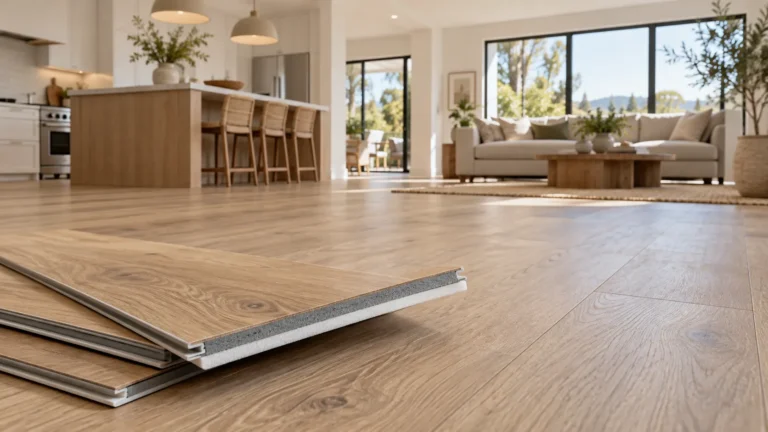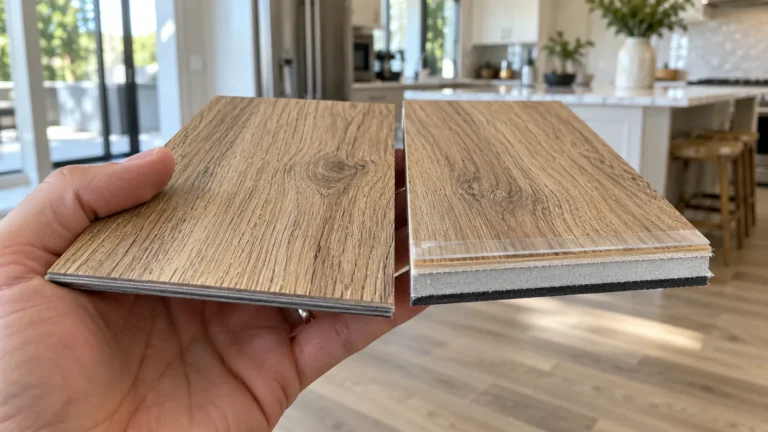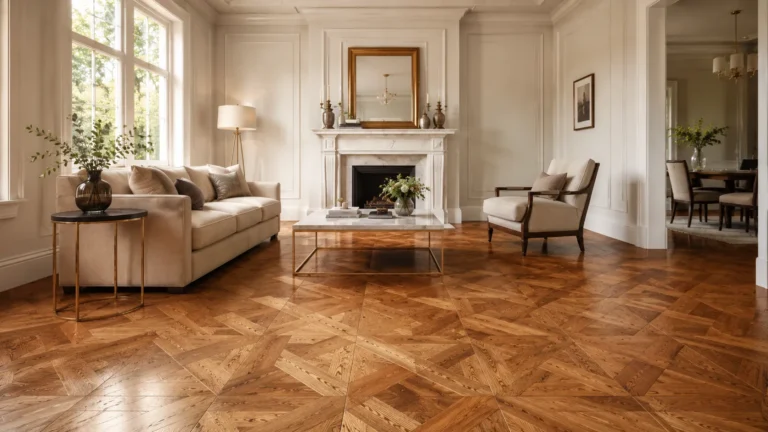
Herringbone flooring is a floor pattern made from rectangular planks, blocks, or tiles laid so that the short end of each piece meets the long side of the next at a 90-degree angle. Repeated across the room, that arrangement creates a broken zigzag that looks like the skeleton of a herring fish, which is where the name comes from.
Herringbone describes how a floor is laid out, not what it is made of. The same pattern can be built from solid hardwood, engineered wood, laminate, luxury vinyl, porcelain, ceramic, or natural stone. So “herringbone flooring” does not automatically mean hardwood flooring, a mix-up that causes a lot of confusion when people start shopping.
Key Takeaways
- Herringbone is a layout pattern, not a flooring material.
- Its pieces are square-ended rectangles that meet at 90 degrees, forming a staggered zigzag.
- Chevron is different: its pieces have angled ends that meet point to point in a continuous V.
- Herringbone is one type of parquet, but not every parquet floor is herringbone.
- There is no standard herringbone size. Small blocks look traditional; large planks look modern.
- Durability and room suitability depend on the material, not the pattern.
What Does Herringbone Flooring Look Like?
Herringbone looks like rows of rectangular pieces pointing in alternating directions. Instead of running end to end like ordinary plank flooring, each piece turns 90 degrees from its neighbor, producing a zigzag with staggered joints.
Look closely and you’ll see that a true herringbone floor never forms one clean, unbroken V. Each piece runs slightly past the one beside it, and that offset gives the pattern its woven, stepped look.
A quick way to identify it:
Rectangular pieces + square ends + staggered right-angle joints = herringbone.
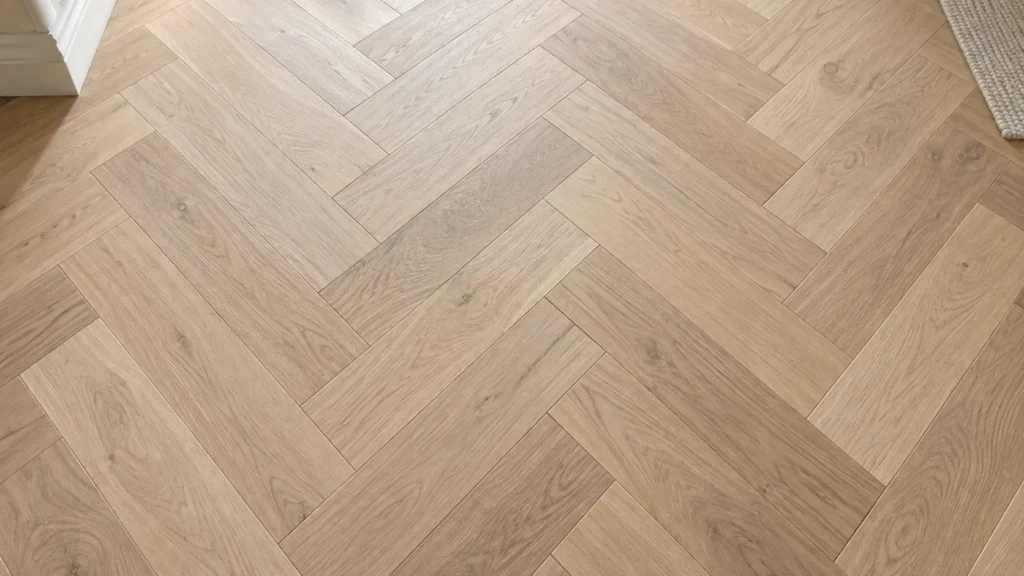
If a floor matches that description, it’s herringbone, whether it’s made of oak, vinyl, or porcelain.
Is Herringbone a Flooring Type or a Pattern?
Herringbone is a layout pattern. Words like hardwood, engineered wood, laminate, vinyl, and porcelain describe what a floor is made of. Herringbone describes how its visible pieces are arranged.
All of these are herringbone floors:
- A white oak hardwood floor laid in herringbone.
- An engineered wood floor laid in herringbone.
- A luxury vinyl plank floor laid in herringbone.
- A porcelain tile floor laid in herringbone.
From across the room they can look alike, but they are completely different products. When a listing calls a floor “herringbone,” it tells you the pattern. It tells you nothing about the floor’s construction, thickness, finish, or water resistance, so always check the product specifications for those.
Is Herringbone the Same as Parquet Flooring?
Herringbone is a type of parquet, but not all parquet is herringbone.
Parquet is the broader category. It traditionally refers to wood flooring made from smaller pieces arranged in repeating geometric patterns rather than long parallel boards. Herringbone is the best-known parquet pattern. Others include chevron, basketweave, and Versailles panels. The French even have separate names for the two most famous patterns: bâton rompu (“broken stick”) for herringbone and point de Hongrie (“Hungarian point”) for chevron.
When herringbone is made from wood, it’s correct to call it herringbone parquet. When the same layout is made from porcelain tile or vinyl, herringbone pattern flooring is the clearer term. For a full look at parquet patterns and how to spot real wood parquet, see our guide to what parquet flooring is.
Herringbone vs. Chevron Flooring: What Is the Difference?
The difference is in the ends of each piece. Herringbone uses rectangles with square ends. Chevron uses pieces whose ends are cut at an angle so two pieces meet neatly at a point.
| Feature | Herringbone | Chevron |
| Piece shape | Rectangle | Parallelogram (angled ends) |
| Ends | Square | Cut at an angle, commonly 45° or 60° |
| How pieces meet | End of one meets the side of the next | Angled ends meet tip to tip |
| Overall line | Broken, staggered zigzag | Continuous, clean V |
| Visual effect | Woven and textured | Sharp and directional |
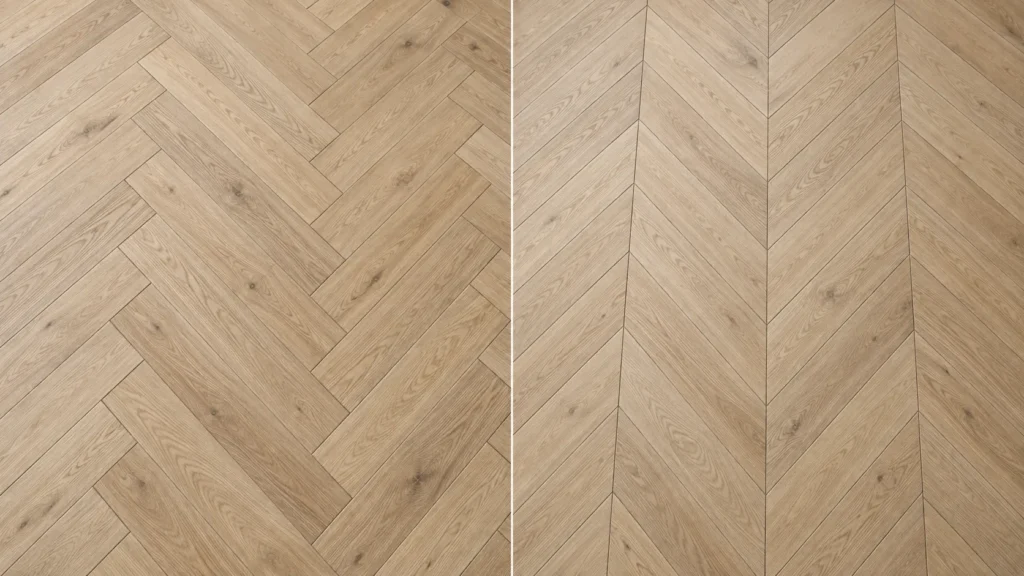
So chevron isn’t just “herringbone at a different angle.” The pieces themselves are cut differently, and each product is made for its own pattern. Flooring manufacturer Kährs draws the same line, describing herringbone as rectangular boards and chevron as boards with angled ends.
What Angle Is Herringbone Flooring?
In classic herringbone, neighboring pieces meet at a 90-degree angle. Once the floor is laid, the individual pieces usually appear to run at about 45 degrees to the walls, but that doesn’t change the right-angle relationship between the pieces themselves.
Chevron is where other angles come in. Its ends are factory-cut, most commonly at 45 or 60 degrees. A 45-degree chevron produces a flatter, wider V, while a 60-degree chevron produces a steeper, more pointed V.
The easiest way to tell them apart is to ignore the overall angle and look at a single piece: square-ended rectangles mean herringbone; angled ends meeting tip to tip mean chevron.
Where Did Herringbone Flooring Come From?
The herringbone layout is far older than wood flooring. Roman builders used an arrangement called opus spicatum, Latin for “spiked work,” a reference to the way grain grows on an ear of wheat. They set rectangular bricks and tiles on a diagonal to create what we now call herringbone.
This isn’t just a story repeated in flooring blogs. The British Museum holds a real piece of Roman opus spicatum paving made from rectangular ceramic tiles. (View the Roman opus spicatum paving in the British Museum collection.)
Wooden herringbone came much later. Parquet became a feature of European interiors from the Renaissance onward, and France played a central role in developing decorative wood floors.
Many flooring histories say herringbone wood flooring began at the Château de Fontainebleau in the 16th century, often around 1539. Fontainebleau is a well-known early example, but claims that it was definitively the first herringbone wood floor are repeated more often than they are documented, so treat that date as a tradition rather than an established fact.
The reliable version of the history is this: the herringbone layout dates back to ancient Rome, and wooden herringbone developed later as part of the European parquet tradition.
What Materials Can Herringbone Flooring Be Made From?
Because herringbone is a pattern, it shows up across nearly every hard-flooring category. Many herringbone products, especially wood, are sold as mirrored left and right pieces that alternate to build the pattern. Some newer click-together products use a single reversible plank instead.
Solid hardwood herringbone
Solid hardwood is one piece of timber through its full thickness. Oak is the wood most closely tied to traditional herringbone parquet, though walnut, maple, ash, hickory, and other species are also used. In solid wood, the grain, color variation, knots, and mineral streaks all become part of the pattern. To see how solid wood compares with engineered and other wood floors, read our guide to types of wood flooring.
Engineered wood herringbone
Engineered wood has a real hardwood top layer bonded to a layered core. Because the surface is genuine wood, it can look almost identical to solid hardwood once it’s laid. The herringbone pattern stays the same; “engineered” only describes what’s underneath. White oak is especially common in today’s engineered herringbone collections.
Laminate herringbone
Laminate uses a printed decorative layer over a manufactured fiberboard core. Some laminate herringbone is sold as individual planks that are physically laid in the pattern. Other products print a herringbone image onto larger panels. Both look similar, but they’re built differently.
Luxury vinyl herringbone
Luxury vinyl tile (LVT), luxury vinyl plank (LVP), and rigid-core SPC flooring all come in herringbone. As with laminate, some products are individual pieces laid in the pattern, while others print the pattern onto a larger surface. That creates a useful distinction between a floor physically laid in herringbone and a herringbone-look floor. Learn more about what LVP flooring is and the different types of vinyl flooring.
Ceramic and porcelain herringbone
Rectangular ceramic and porcelain tiles make a true herringbone pattern. In the U.S., herringbone subway tile is a familiar look on bathroom floors and kitchen backsplashes. Because tile comes in so many sizes, colors, and surfaces, the same layout can resemble wood parquet, handmade ceramic, marble, or concrete. Grout color also changes the result: matching grout softens the pattern, while contrasting grout outlines every piece.
Natural stone herringbone
Marble, limestone, travertine, and other stones can be cut into rectangles and laid in herringbone. The natural veining adds another layer of movement on top of the geometry.
What Types of Herringbone Patterns Are There?
Classic herringbone uses one piece for each leg of the zigzag. This is what most people mean by “herringbone flooring.”
Double herringbone places two parallel pieces side by side before the pattern changes direction. The right-angle relationship stays the same, but the zigzag becomes wider and bolder.
Triple herringbone uses three parallel pieces per leg, making the pattern broader still.
Bordered herringbone frames the herringbone field with straight boards or a contrasting strip around the edge of the room. A border gives the pattern a finished, rug-like look and is common in formal and traditional rooms.
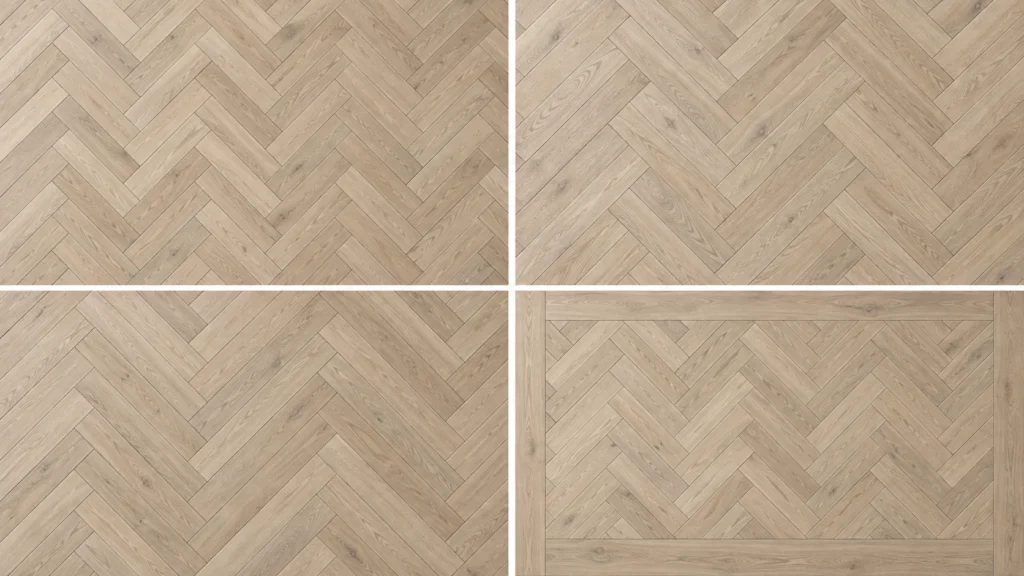
Some patterns are often sold alongside herringbone but are not herringbone:
- Basketweave groups parallel pieces into square blocks that alternate direction, like a woven basket.
- Brick bond offsets straight rows like a brick wall.
- Ladder patterns combine parallel and perpendicular pieces in a rung-like arrangement.
These all belong to the wider family of geometric or parquet flooring, which is why two floors can both be called “parquet” and still look nothing alike.
What Size Is Herringbone Flooring?
Herringbone flooring has no standard size. No single width, length, or thickness defines it.
Traditional wood parquet uses fairly small blocks, while many modern collections use much larger planks, sometimes called large-format or oversized herringbone. For example, traditional solid-oak parquet blocks sold by Havwoods measure roughly 2¾ × 11 inches, while Kährs’ large-format engineered herringbone boards are about 4¾ × 23½ inches. In the U.S., herringbone is usually listed in inches, and you’ll find everything from narrow blocks around 2 to 3 inches wide to planks 5 inches wide or more.
How piece size changes the look
Imagine the same room covered first with hundreds of narrow blocks and then with long, wide planks.
The small blocks create many more joints, color changes, and zigzags, so the eye reads a detailed, traditional pattern. The larger planks create fewer, broader diagonals, so the eye reads the direction of the pattern before it notices individual pieces. A small-format oak floor feels like classic European parquet; a wide, pale white oak herringbone feels modern, even though the layout is identical.
As a general guide:
- Hallways, foyers, and small rooms often suit narrower pieces, which keep the pattern in proportion to the space.
- Large living areas and open-concept spaces often suit larger formats, which read as calmer and avoid looking busy across a big floor.
Neither size is “more herringbone.” Size is a design choice, not part of the definition.
Which Wood Species Are Used for Herringbone Floors?
White oak is one of the most popular choices in the U.S. Its fairly neutral tone and even grain take natural, light, and stained finishes well, so it works in both traditional and modern homes.
Red oak, long the most common American flooring species, has a warmer, slightly pink undertone and a more pronounced grain. That grain makes each piece stand out, giving the pattern a more traditional, textured look.
Walnut, maple, ash, and hickory are also used. Walnut brings rich browns, maple looks clean and light, and hickory has dramatic color variation from board to board.
Species matters for more than color. Because herringbone keeps changing the direction each piece faces, pieces with strong grain catch the light differently, which makes the pattern visible even when every board is a similar color. Calmer grain and low color variation give a more subtle result.
What Colors and Finishes Does Herringbone Flooring Come In?
There is no special “herringbone color.” Color comes from the material, wood species, stain, or printed surface.
Wood and wood-look herringbone commonly comes in natural oak, pale white oak, honey and golden tones, greige, medium brown, smoked brown, walnut, and deep espresso. Tile and stone widen the range to white marble looks, charcoal porcelain, terracotta, green ceramic, and more.
For wood, common finishes include smooth, wire-brushed, matte, satin, natural-look oil, smoked, and stained surfaces. Tile adds polished, matte, glazed, handmade, stone-effect, and concrete-effect finishes.
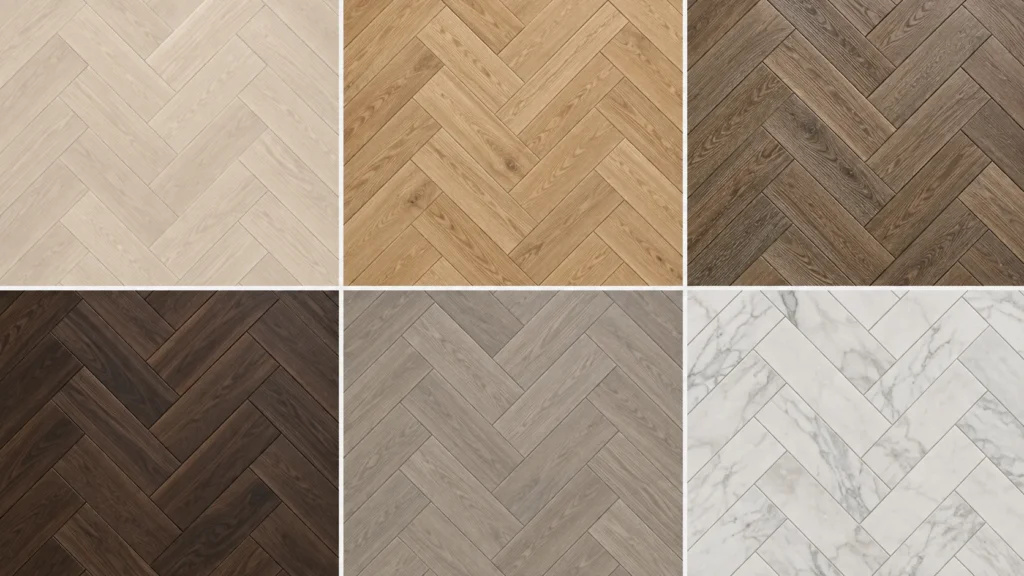
Two details change how strongly the pattern shows:
- Contrast. When neighboring pieces are similar in tone, the zigzag feels quiet. Strong variation in color or grain makes each piece stand out and gives the floor a bolder, more graphic look.
- Edges. Beveled or micro-beveled edges create a small groove around each piece that outlines the pattern. Square, tight edges make the floor look smoother and more seamless.
A matte, pale oak herringbone looks calm and modern. A darker wood with strong grain contrast pushes the same pattern toward a traditional or dramatic room.
Which Direction Should Herringbone Flooring Run?
Herringbone has a clear “spine”: an imaginary line running through the points of the zigzag. Which way that line runs changes how the room feels, so it’s worth deciding before any flooring is ordered.
Common design choices include running the spine:
- Along the longest wall, which emphasizes the length of the room.
- Toward the main entrance or a focal point, such as a fireplace or a large window, so the pattern leads the eye into the space.
- Down the length of a hallway, which pulls the eye forward and makes a narrow space feel intentional.
In connected rooms, keeping the pattern running the same way helps the spaces flow together. Changing direction or adding a border at a doorway can help separate zones. Layout is best confirmed with your installer, since the room’s shape and doorways affect where the pattern should be centered.
How Is Herringbone Different From Straight-Plank Flooring?
The difference is the geometry. Straight-plank flooring creates long parallel lines that carry the eye in one direction across the room. Herringbone keeps changing direction, so it creates more movement and turns the floor itself into a design feature. It also has many more visible joints.
That’s true whatever the material, so the real comparison isn’t one material against another. It’s a patterned layout against a parallel one. If you’re still choosing the material itself, our overview of types of flooring compares hardwood, vinyl, laminate, tile, and stone.
Does Herringbone Flooring Make a Room Look Bigger?
Herringbone can change how big a room feels, but it doesn’t automatically make every room look larger.
Its diagonals keep the eye moving across the floor instead of stopping at a single line. Depending on the room’s shape and the direction of the pattern, that movement can emphasize length, width, or overall flow.
Several factors decide the result:
- Piece size. Larger pieces with low contrast create a broader, calmer surface. Many small pieces with strong contrast create more visual activity.
- Color. Lighter tones reflect more light and tend to feel more open than dark, high-contrast floors.
- Direction. Running the pattern along the longest wall usually stretches the room visually.
- Borders. Heavy borders can frame a room and make it feel cozier rather than larger.
- Furnishings and lighting. How much floor stays visible matters as much as the pattern itself.
A more accurate answer than “herringbone makes rooms bigger” is this: herringbone can change a room’s perceived size and direction, but the effect depends on scale, color, orientation, lighting, and the rest of the room.
Can Herringbone Work in a Small Room?
Yes, herringbone can work well in a small room. The real question is how much you want the pattern to stand out.
Very small pieces create many repeats in a compact space, which gives a detailed, decorative look. Slightly larger pieces with low color contrast create fewer interruptions and feel quieter. Simple walls, restrained furniture, and consistent tones let the floor be the feature without making the room feel crowded.
Where Is Herringbone Flooring Commonly Used?
Foyers, entryways, and hallways are classic spots for herringbone because its diagonal rhythm naturally creates a sense of direction.
Living rooms and dining rooms show off the full pattern, where it becomes part of the room’s architecture rather than just a background.
Bedrooms often use lower-contrast wood tones so the pattern stays understated.
Open-concept spaces use herringbone to tie a large area together, while a change in direction, material, or a border can help define separate zones.
Kitchens, bathrooms, and mudrooms can have herringbone too, often in tile or waterproof vinyl. Whether a floor suits those rooms depends on the material and the specific product, not the pattern.
Herringbone is also common in restaurants, hotels, retail stores, and offices, where the floor helps create a distinctive look.
Does the Herringbone Pattern Make Flooring More Durable?
The herringbone pattern does not make flooring more durable. “Herringbone” is not a durability rating.
A porcelain herringbone floor, a solid oak herringbone floor, and a vinyl herringbone floor can share the same layout while performing very differently. Durability comes from the material, wood species, finish, wear layer, product construction, and how much traffic the floor gets. The pattern tells you how the floor looks; the product specifications tell you how it will hold up.
What Interior Styles Work With Herringbone Flooring?
Herringbone is closely tied to historic European interiors, but it isn’t limited to traditional design.
- Traditional: medium or dark wood, visible grain, crown molding, and classic furniture lean into its parquet heritage.
- Transitional: natural white oak pairs the old pattern with simpler furniture and lighter colors.
- Modern and minimalist: larger pieces, pale tones, low contrast, and clean walls make herringbone feel architectural rather than ornamental.
- Scandinavian, industrial, Art Deco, and luxury interiors also use it, because the pattern is geometric rather than tied to one era.
The material changes the character dramatically. The same layout can look like a 19th-century Parisian parquet floor in dark oak or a minimalist surface in large, pale porcelain tiles.
Is Herringbone Flooring Still in Style?
Herringbone is better described as a long-established pattern than a passing trend. The layout has been used for centuries, and major manufacturers still make dedicated herringbone collections in hardwood, engineered wood, laminate, vinyl, and tile.
What changes with trends is how it’s used: the size, color, material, texture, and contrast. Traditional homes tend to favor smaller blocks and richer wood tones. Current interpretations often use larger planks, natural or pale white oak, matte finishes, and simple surroundings. That flexibility is why herringbone keeps coming back.
Herringbone Beyond the Floor
The pattern isn’t limited to flooring. You’ll see herringbone in tile backsplashes, shower walls, wood accent walls, ceilings, brick patios and garden paths, and even fabric, where herringbone tweed uses the same zigzag weave. Repeating the pattern on a backsplash or accent wall is a popular way to echo a herringbone floor elsewhere in the home.
Cost, Installation, and Care: What to Know Next
Once you know what herringbone is, the next questions are usually practical ones. In short, herringbone usually costs more to install than a straight-laid floor of the same material. The extra cost comes mainly from labor, careful layout, more cuts, and more waste, not from the pattern making the material itself more expensive.
Installation is also more demanding than a standard plank floor, because small layout errors become visible across the whole pattern. Care and maintenance depend on the material: a herringbone floor is cleaned and maintained the same way as any other floor made of the same product.
For the basics of laying wood floors, see our guide on how to install hardwood flooring.
Herringbone Flooring Terms Worth Knowing
- Herringbone: Rectangular pieces laid in a staggered zigzag, meeting at right angles.
- Chevron: Pieces with angled ends that meet point to point in continuous V shapes.
- Parquet: A broad category of geometric wood flooring made from smaller pieces or patterned panels.
- Bâton rompu / point de Hongrie: The French terms for herringbone and chevron.
- Opus spicatum: The ancient Roman herringbone arrangement used with brick and tile.
- Double herringbone: A variation that uses two parallel pieces for each leg of the zigzag.
- Left and right pieces: Mirrored planks that alternate to form the pattern in many herringbone products.
- Engineered hardwood: Flooring with a real hardwood top layer bonded to a layered core.
- LVT / LVP: Luxury vinyl tile and luxury vinyl plank, resilient floors that can reproduce wood, stone, and patterns.
- SPC: Stone-plastic (or stone-polymer) composite, a rigid-core vinyl flooring sometimes made in herringbone planks.
So, What Is Herringbone Flooring?
Herringbone flooring is a pattern made from rectangular flooring pieces laid at right angles to create a staggered zigzag. It began as a Roman paving technique, became one of the defining patterns of European parquet, and today appears in solid hardwood, engineered wood, laminate, vinyl, ceramic, porcelain, and stone.
The most useful thing to remember is that herringbone tells you how a floor is arranged, not what it’s made of. Keep that in mind and the rest, from chevron and parquet to materials and sizes, becomes much easier to sort out.
Frequently Asked Questions About Herringbone Flooring
What is herringbone flooring in simple terms?
Herringbone flooring is a pattern in which rectangular planks, blocks, or tiles alternate direction at right angles, creating a broken zigzag across the floor.
Why is it called herringbone?
The pattern looks like the bones along the spine of a herring fish. The same layout has been used for centuries in paving, brickwork, and fabrics.
Is herringbone always hardwood?
No. Hardwood is only one option. Engineered wood, laminate, luxury vinyl, porcelain, ceramic, and natural stone can all be laid in herringbone.
What is the difference between herringbone and chevron?
Herringbone uses square-ended rectangles whose ends meet the sides of neighboring pieces. Chevron uses pieces with angled ends that meet point to point, forming continuous V shapes.
Which way should herringbone flooring run?
Most designers run the pattern’s center line along the longest wall, toward the main entrance or focal point, or down the length of a hallway. The best direction depends on the room’s shape and doorways.
Is herringbone flooring more expensive than regular flooring?
Usually, yes, mainly because installation takes more labor, more cuts, and more material waste than a straight-laid floor of the same product.
Can you put herringbone flooring in a kitchen or bathroom?
Yes, if the material suits the room. Porcelain tile and waterproof vinyl are common choices for wet areas. Whether wood or laminate is suitable depends on the specific product and the manufacturer’s guidelines.
Does herringbone flooring work with radiant floor heating?
It depends on the material and the product, not the pattern. Engineered wood, vinyl, and tile are often approved for radiant heat, while solid wood is more limited. Always check the manufacturer’s heating guidelines.
Is herringbone an old-fashioned floor pattern?
No. Herringbone has historic roots, but its look changes with material, size, color, and finish. Large-format, pale oak versions look very different from traditional dark parquet.