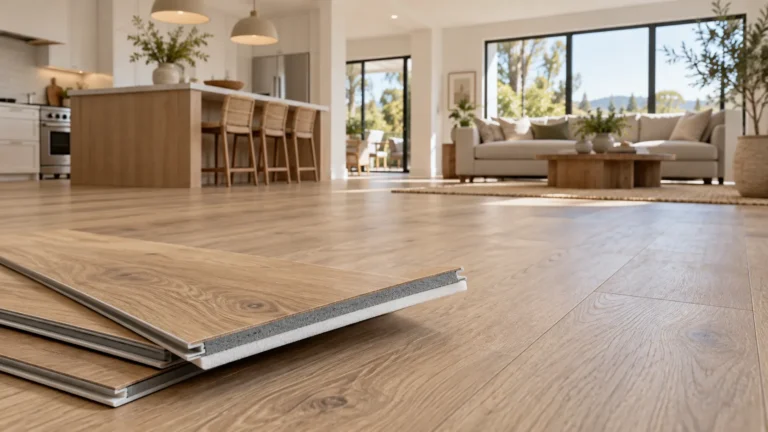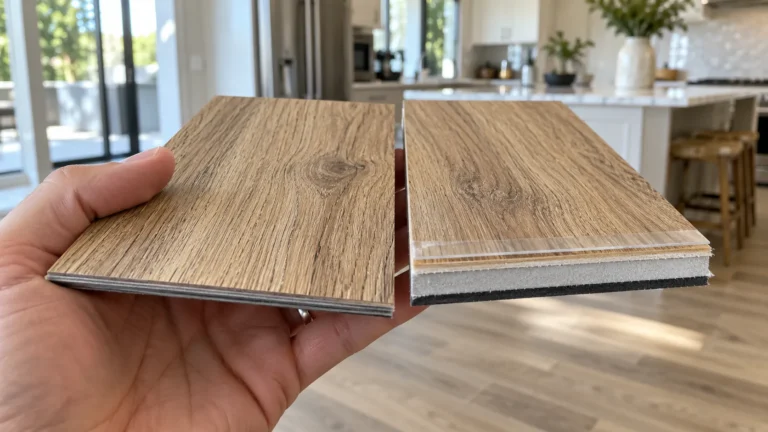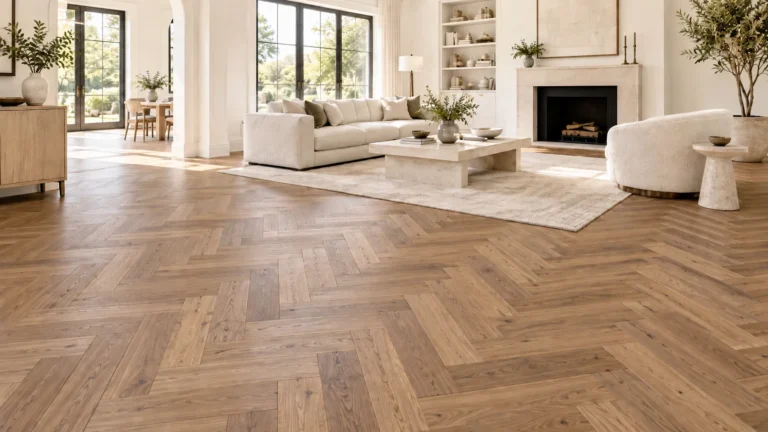
Parquet flooring is a wood floor made from small blocks or strips of solid or engineered hardwood laid in a repeating geometric pattern, such as herringbone, chevron, basketweave, or Versailles panels, instead of long parallel planks. Parquet describes how the wood is laid, not a separate kind of wood.
Parquet is one of the styles we cover in our complete guide to types of wood flooring. This article goes deeper: what parquet is made of, every major pattern, typical sizes, the wood species used in U.S. homes, and how to tell real wood parquet from a printed look-alike before you pay for it.
Key takeaways
- Parquet is a pattern, not a material. The pieces can be solid hardwood or engineered hardwood.
- Herringbone blocks are square-cut and laid at 90°. Chevron pieces are mitered, usually at 45°, so their points meet in a continuous V.
- Solid parquet is hardwood all the way through, usually ¾” thick. Engineered parquet has a real wood wear layer, commonly 2–6 mm, over a layered core.
- Real parquet is always wood. Laminate, vinyl, and tile can copy the pattern, but not the material.
- No wood parquet is waterproof, so it suits living areas better than wet rooms.
- Old parquet in 1950s–1970s homes may sit on black adhesive that can contain asbestos. Don’t disturb it until it has been tested.
Parquet flooring at a glance
| Question | Short answer |
|---|---|
| What is it? | Small wood pieces laid in a geometric pattern |
| Is it real wood? | Yes, genuine parquet is solid or engineered hardwood |
| Most common patterns | Herringbone, chevron, basketweave, checkerboard, mosaic, Versailles |
| Most common species (U.S.) | White oak, red oak, walnut, maple, hickory |
| Typical block size | About 2½–5″ wide × 9–24″ long; tiles 9×9″ to 12×12″ |
| Famous early U.S. example | Monticello, installed around 1804–1805 |
| Waterproof? | No |
What Is Parquet Flooring? Meaning and Definition
The word comes from French. Parquet is a diminutive of parc, meaning a small enclosed area, and by the late 1600s it described floors built from small, fitted pieces of wood. You’ll also see parquetry, which strictly means the craft of cutting and fitting those pieces. In everyday American usage, the two words are used interchangeably. Parquetry’s cousin, marquetry, uses the same idea with thin veneers to make pictures on furniture rather than floors.
What separates parquet from an ordinary hardwood floor is direction. A standard plank floor runs every board the same way, so your eye follows the grain and the length of the boards. Parquet turns the pieces against one another, so your eye reads the geometry first and the grain second.
Is Parquet Flooring Real Wood?
Genuine parquet is real wood, either solid hardwood or engineered hardwood with a real wood surface. The confusion comes from look-alikes. Manufacturers print or mold herringbone and chevron designs onto laminate, luxury vinyl plank (LVP), SPC flooring, and porcelain tile. From across a room they can pass for parquet, but they aren’t wood.
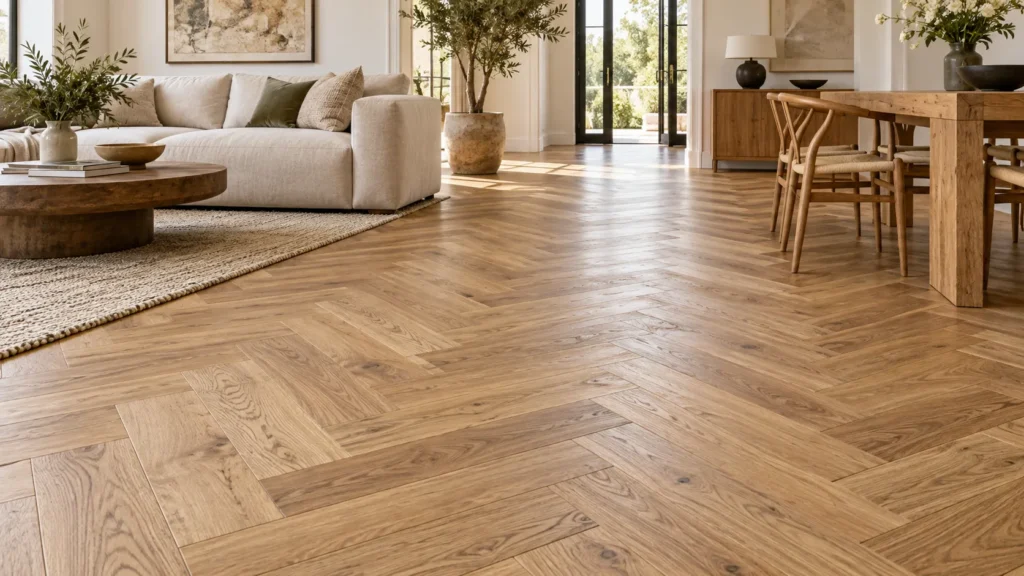
Here’s the distinction that clears it up: herringbone is a pattern, parquet is a way of laying wood, and hardwood is the material. A herringbone floor can be any of those look-alikes, so the pattern alone tells you nothing about what the floor is made of.
The fastest way to check is the unit on the spec sheet, because each material gets measured differently:
- Wear layer listed in millimeters (for example, 3 mm or 4 mm): engineered hardwood, which is real wood.
- “Solid hardwood,” usually ¾” thick: solid wood parquet.
- Wear layer listed in mils (12 mil, 20 mil): vinyl, LVP, or SPC, which is not wood.
- AC rating (AC3, AC4): laminate, which is a printed image, not wood.
- PEI rating: ceramic or porcelain tile.
What Is Parquet Flooring Made Of?
Solid wood parquet
Solid parquet is one piece of hardwood from top to bottom. Traditional blocks are usually ¾” thick with tongue-and-groove edges, while some older mosaic tiles are as thin as 5/16″. Because the wood runs all the way through, thick solid parquet has plenty of usable wood above the tongue.
The trade-off is movement. Solid wood expands and contracts more with seasonal humidity, so it is best suited to rooms at or above grade rather than over a damp concrete slab.
Engineered parquet
Engineered parquet has a real hardwood wear layer, commonly 2–6 mm, bonded to a cross-layered plywood or HDF core. The layers run in different directions and restrain each other, which makes the floor more stable over concrete slabs and radiant heating (always confirm the manufacturer approves it for your subfloor).
The number that matters is the wear layer, not the total thickness, because it tells you how much real hardwood sits on top. Because engineered cores use adhesives, look for CARB Phase 2 or TSCA Title VI formaldehyde compliance. We compare the core options in our guide to types of engineered hardwood flooring.
Parquet tiles (mosaic or finger-block)
Parquet tiles are squares made of several short strips of wood, often called “fingers,” held together by a mesh, paper facing, or backing. They were a staple in American homes and apartments built from the 1950s through the 1970s.
End-grain wood blocks
End-grain blocks are cut across the log, so you see the growth rings rather than long grain. They are extremely tough and were historically used in factories and workshops. Today they are a niche, high-character option, but you may run into them when shopping reclaimed flooring.
A Short History of Parquet: From Versailles to American Homes
Parquet took off in 17th-century France. The story most historians tell is that around 1684, at the Palace of Versailles under Louis XIV, wood parquet replaced marble floors that needed frequent washing, and the water was damaging the wooden joists underneath. The framed, interlaced panel design used there became known as parquet de Versailles, and it spread through European palaces and townhouses over the following century.
Parquet arrived in America early. Thomas Jefferson designed a parquet floor for the parlor at Monticello, his Virginia home, with red cherry squares framed in pale beech. It was installed around 1804–1805, is considered one of the first parquet floors in the country, and is still there today, which is a good answer to anyone who asks how long parquet can last.
Victorian-era American homes used decorative wood borders and inlays. After World War II, factory-made oak mosaic tiles made parquet widely available, and it became common in mid-century houses and apartments. Many of those floors were later hidden under wall-to-wall carpet. Parquet is back now, mostly as engineered herringbone and chevron in lighter white oak with matte finishes.
Parquet Flooring Patterns
Parquet isn’t one look. The pattern decides how busy, formal, or directional the floor feels, so it is worth comparing them side by side.
| Pattern | Piece shape | What you see | Works well in |
|---|---|---|---|
| Herringbone | Rectangles, square-cut ends | Broken zigzag | Hallways, living rooms, most styles |
| Chevron | Ends mitered, often 45° | Continuous V | Long rooms, modern spaces |
| Basketweave | Groups of strips in squares | Woven over-and-under look | Entryways, traditional rooms |
| Checkerboard | Squares, grain rotated 90° | Grid of alternating squares | Dining rooms, retro-style spaces |
| Mosaic / finger-block | Short strips grouped in squares | Small, busy grid | Mid-century homes, budget projects |
| Brick (running bond) | Rectangles offset by half | Brick-wall layout | Casual or rustic rooms |
| Versailles | Framed, interlaced panels | Diagonal lattice in squares | Formal living and dining rooms |
Herringbone parquet
Herringbone uses rectangular blocks with square-cut ends, laid at right angles. The end of one block butts into the side of the next, making a broken zigzag. Engineered herringbone is usually sold as “A” and “B” boards, with the tongue on opposite sides, so the pattern can alternate. Common U.S. sizes run about 3–5″ wide and 12–24″ long. Herringbone isn’t limited to wood, though. The same layout is made in vinyl, laminate, and tile, which is why not every herringbone floor is parquet. For the pattern’s Roman origins, its variations like double herringbone, and how it compares with chevron in every material, see our full guide to what herringbone flooring is.
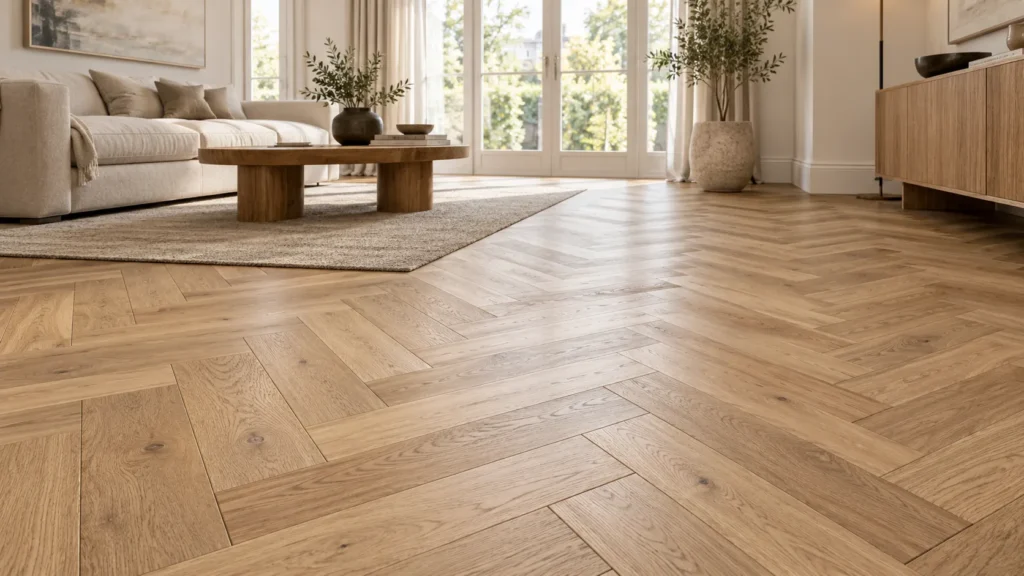
Layout tip: in a hallway, run the zigzag points along the length of the space. It pulls the eye forward and makes a narrow hall feel longer.
Chevron parquet
Chevron pieces have their ends mitered, most often at 45° (some products use 30° or 60°), so the tips meet point to point and form a continuous V. Each piece has to be cut specifically for the pattern, so chevron boards are a different product from herringbone boards, not the same boards laid differently.
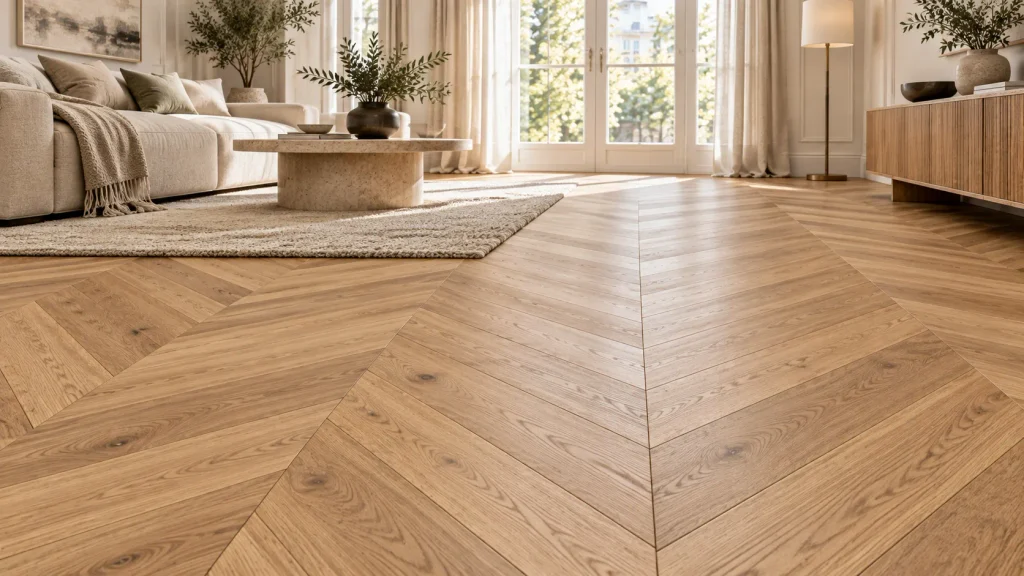
To tell them apart in a photo, look where two pieces meet at the center line. A clean, pointed V means chevron. If the end of one rectangle hits the side of another, it’s herringbone.
Basketweave parquet
Basketweave groups two or three strips into a square, then alternates each square between horizontal and vertical.
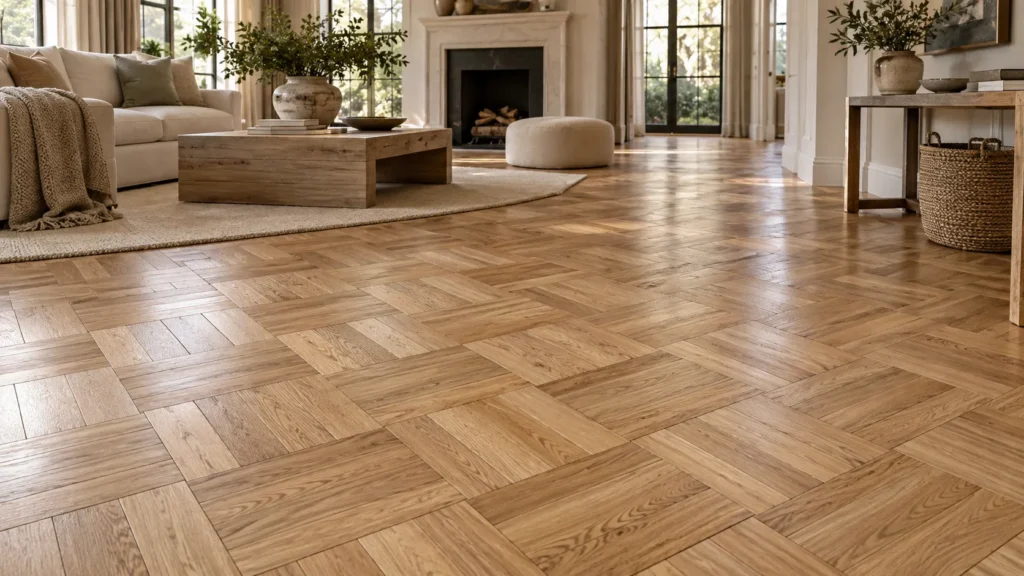
The result looks like strips passing over and under each other. It feels more traditional and segmented than herringbone, and it is often finished with a border.
Checkerboard (square-on-square) parquet
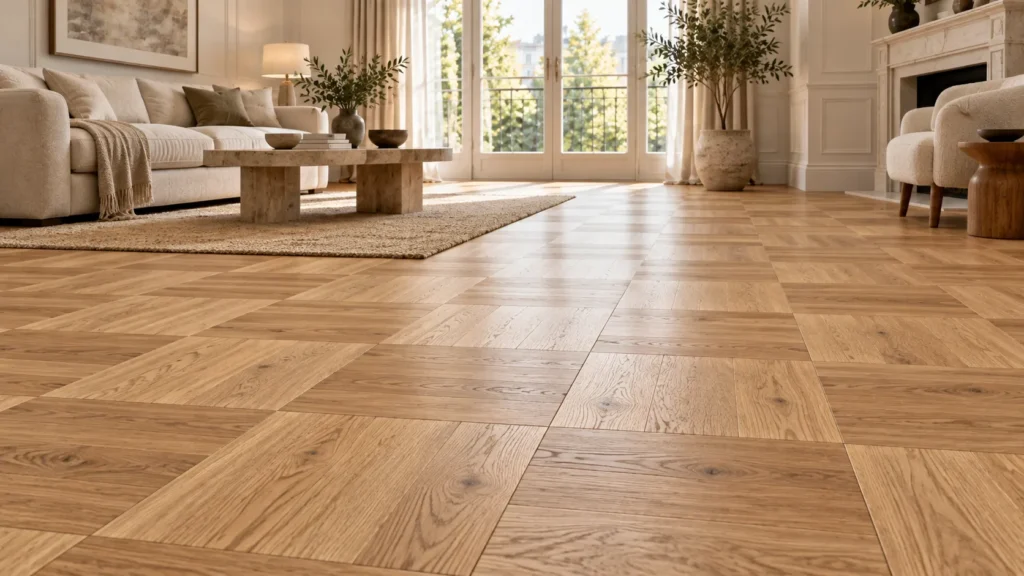
The checkerboard divides the floor into squares with the grain turned 90° from its neighbor. Even with a single species, light hits each square differently, so the grid shows. Some designs use two tones, like oak and walnut, for a stronger contrast.
Mosaic or finger-block parquet
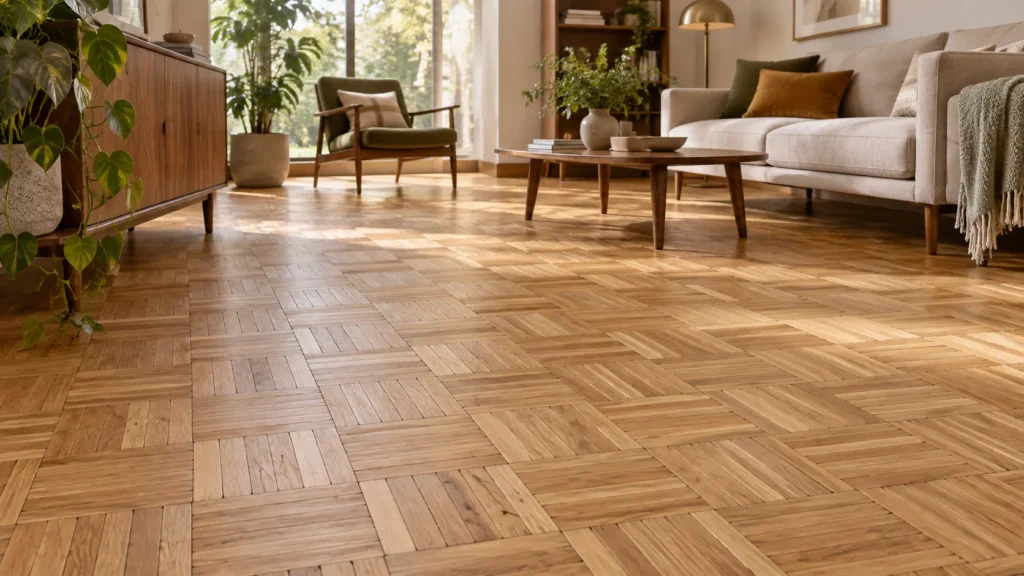
Mosaic parquet groups short, parallel fingers into small squares and rotates the neighboring squares. It is the classic mid-century American parquet tile, often sold in 9×9″ or 12×12″ units. Some retailers lump mosaic and brick patterns together, so check the photo rather than the name.
Brick (running bond) parquet
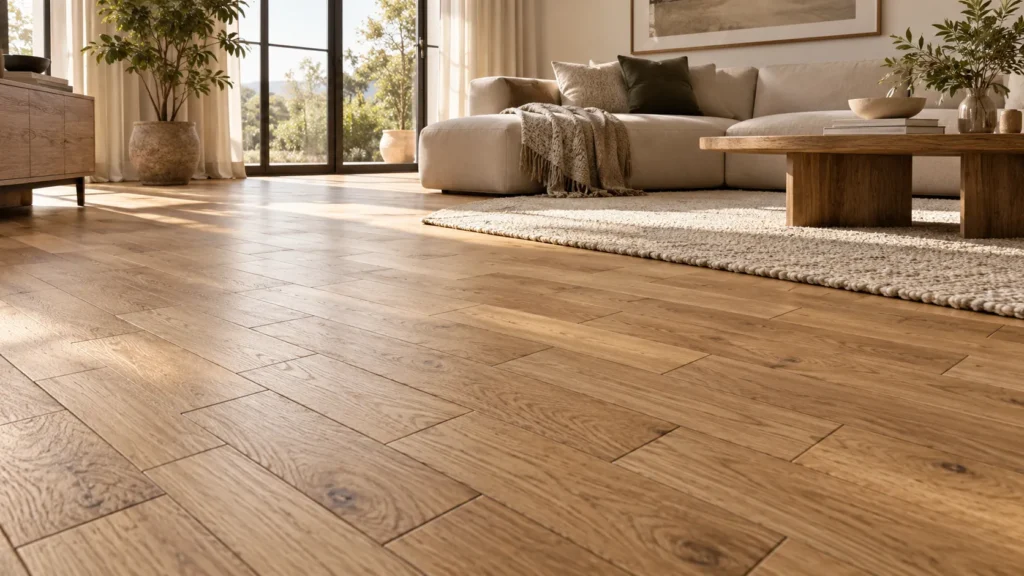
Brick-pattern parquet lays rectangular blocks in rows, each row offset by half a block, like a brick wall. It keeps the small-block texture of parquet with less visual movement than herringbone.
Versailles parquet
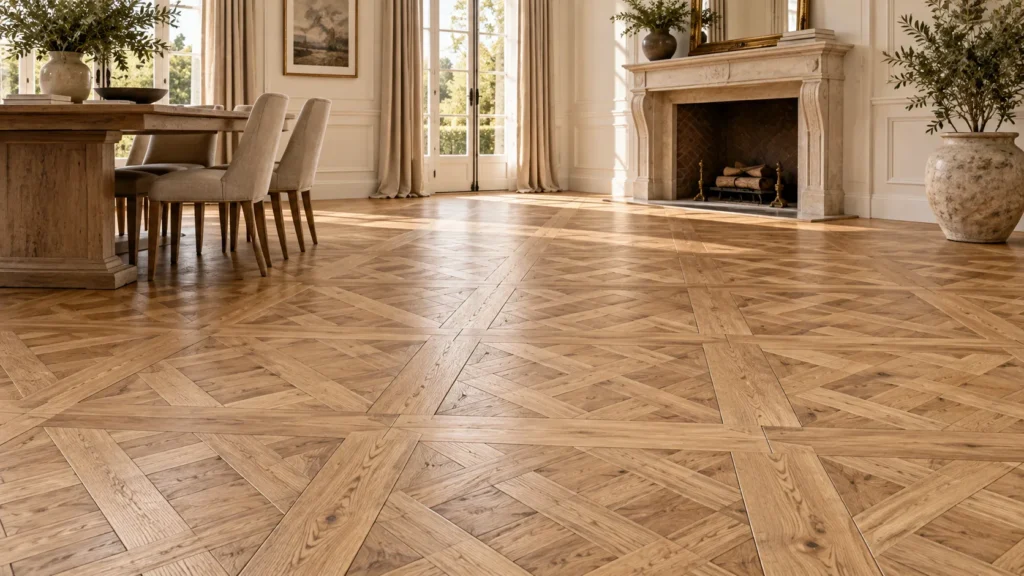
Versailles panels frame a diagonal lattice of interlaced strips inside a square border. Panels are pre-assembled, often roughly 2–3 feet square, and repeated across the room. It is the most formal parquet pattern.
Borders, medallions, and inlays
Parquet can also include contrasting wood borders around a room, a central medallion, or a framed “rug” of pattern inside plain planks. A simple border is an easy way to define a dining area in an open floor plan.
Parquet Sizes and Formats: Blocks, Tiles, Boards, and Panels
The same pattern can arrive in very different formats, and the format changes how the finished floor looks up close.
| Format | What it is | Typical size (U.S.) | Good to know |
|---|---|---|---|
| Loose blocks | Individual solid pieces | About ¾” thick; 2½–5″ × 9–24″ | The traditional, most customizable format |
| Parquet tiles | Fingers on mesh or backing | 9×9″ to 12×12″; 5/16″–¾” thick | Classic mid-century American format |
| Engineered A/B boards | Herringbone or chevron boards | About 3–6″ wide × 14–36″ long | Left and right boards alternate the pattern |
| Decorative panels | Pre-assembled Versailles or basketweave | Often 2–3 ft square | Most formal look |
Sizes vary by manufacturer, so treat these as ballpark figures. Scale changes the look more than most buyers expect: small pieces read busy, while longer, wider herringbone looks calmer and more modern.
Tip: don’t judge parquet from a single sample board. A 12-inch sample shows barely one repeat of the pattern. Ask for a full box, or at least a few square feet, and lay it out on the floor of the actual room before you decide.
Which Wood Species Are Used for Parquet?
Species sets the color, grain, and dent resistance. The Janka hardness score measures the force needed to press a steel ball halfway into the wood, and red oak’s 1290 is the usual benchmark. (Our wood flooring guide explains the full Janka scale.)
| Species | Janka | Look | In a parquet pattern |
|---|---|---|---|
| White oak | 1360 | Neutral tone, tight grain | The top choice today; takes light and matte finishes well |
| Red oak | 1290 | Warmer, pink undertone | Common in mid-century tiles; affordable |
| Hard maple | 1450 | Pale, quiet grain | Pattern shows through clearly; blotches with dark stain |
| Black walnut | 1010 | Rich chocolate brown | Dramatic, but dents more easily |
| American cherry | 950 | Reddish, ambers with age | Classic accent wood (see Monticello) |
| Hickory | 1820 | High color variation | Very tough; can look busy in small blocks |
| Ash | 1320 | Light, bold grain | Lively texture |
| Brazilian cherry (jatoba) | 2350 | Deep red-brown, darkens in sun | Very hard exotic |
Janka figures: NWFA and USDA Forest Products Laboratory.
One thing that’s specific to parquet: since the pieces run in different directions, strongly grained woods like oak, ash, and hickory make the pattern feel more energetic, while maple and walnut let the geometry do the talking. If you’re buying imported exotic species, reputable U.S. sellers should be able to document legal harvesting under the Lacey Act. Bamboo can also be made in herringbone formats, but it is a grass rather than a hardwood.
Wood Species vs. Wood Grade
Species tells you what tree the wood came from. Grade tells you how it looks. U.S. oak flooring is commonly graded Clear, Select, #1 Common, and #2 Common, moving from uniform color with few knots to more knots, mineral streaks, and color variation. Manufacturers also use labels like “prime,” “natural,” and “character” or “rustic.”
Grade matters more in parquet than in wide planks because every small block shows its own piece of character. A rustic-grade herringbone packs a lot of knots and color shifts into each square foot. That can look wonderfully relaxed, or it can fight with the pattern. For a crisp, modern herringbone, a Select or prime grade is the safer pick.
Prefinished vs. Unfinished Parquet and Finish Types
Prefinished parquet is coated at the factory, usually with a UV-cured polyurethane containing aluminum oxide, which is very abrasion resistant. Most prefinished boards have small beveled edges. On a herringbone floor that means a bevel around every block, which outlines the pattern and makes each piece more visible.
Unfinished parquet arrives raw and is finished on site. The surface ends up smooth with no bevels between blocks, and you can choose any stain color.
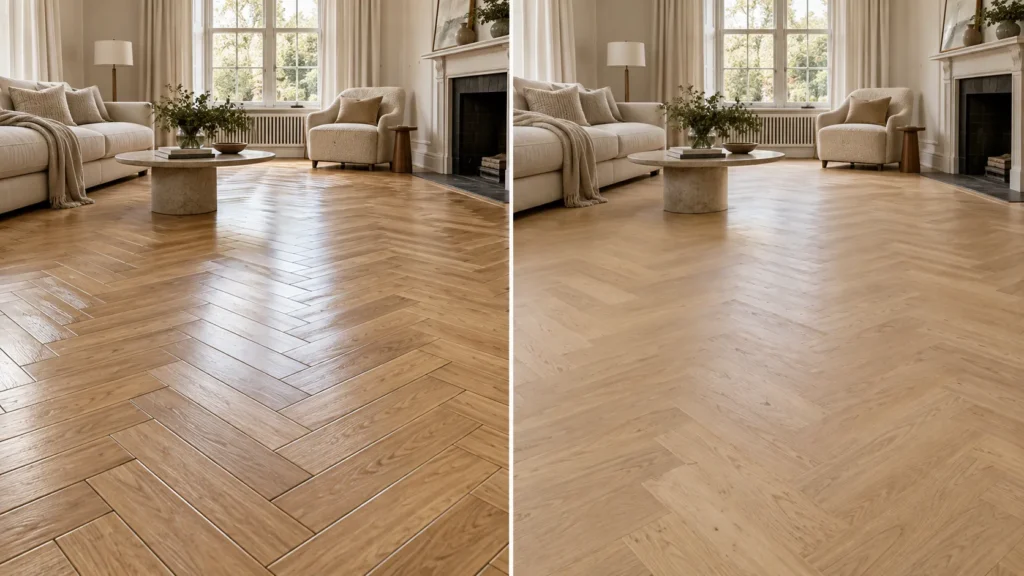
Finish is separate from construction. You can buy:
- Solid parquet, prefinished
- Solid parquet, unfinished
- Engineered parquet, prefinished
- Engineered parquet, unfinished (less common)
The most common finishes are water-based polyurethane (clear, stays close to the natural wood color), oil-based polyurethane (warms to amber over time), and hardwax oil (low-sheen, natural feel). Sheen runs from matte and satin through semi-gloss and gloss. Matte and satin are the most popular today because they hide scuffs and look more like natural wood.
Color changes how loud the pattern is. Light natural oak keeps herringbone soft. Medium honey tones feel traditional. Dark stains make every joint and direction change more visible, which is dramatic, and also shows dust more.
Parquet vs. Hardwood Planks
This comparison trips people up, because parquet is hardwood. The real comparison is parquet vs. conventional plank flooring.
| Feature | Parquet | Plank hardwood |
|---|---|---|
| Layout | Geometric pattern | Parallel boards |
| Piece size | Short blocks, strips, tiles, panels | Long planks, often 3–7″+ wide |
| Material | Solid or engineered hardwood | Solid or engineered hardwood |
| Seams per sq. ft. | Many | Few |
| Grain direction | Changes every few pieces | Runs one way |
Parquet vs. Laminate, Vinyl, and Tile
| Flooring | Surface | Parquet pattern available? | Real wood? |
|---|---|---|---|
| Solid parquet | Solid hardwood | Yes | Yes |
| Engineered parquet | Hardwood wear layer | Yes | Yes |
| Laminate | Printed image under resin | Yes | No |
| LVP / LVT / SPC | Printed vinyl with clear wear layer | Yes | No |
| Porcelain tile | Glazed or through-body ceramic | Yes | No |
If you want the parquet look in a space that gets wet, a herringbone luxury vinyl or SPC product is the more practical choice, but it is a printed look-alike rather than real wood parquet.
Is Parquet Flooring Waterproof?
No. Neither solid nor engineered wood parquet is waterproof. Parquet also has far more seams per square foot than plank flooring, and each seam is a place where water can reach the edges of the wood.
Wood also reacts to indoor humidity. In very dry air, small gaps can open between blocks; in very humid conditions, blocks can swell and cup. Engineered parquet moves less than solid parquet because of its cross-layered core.
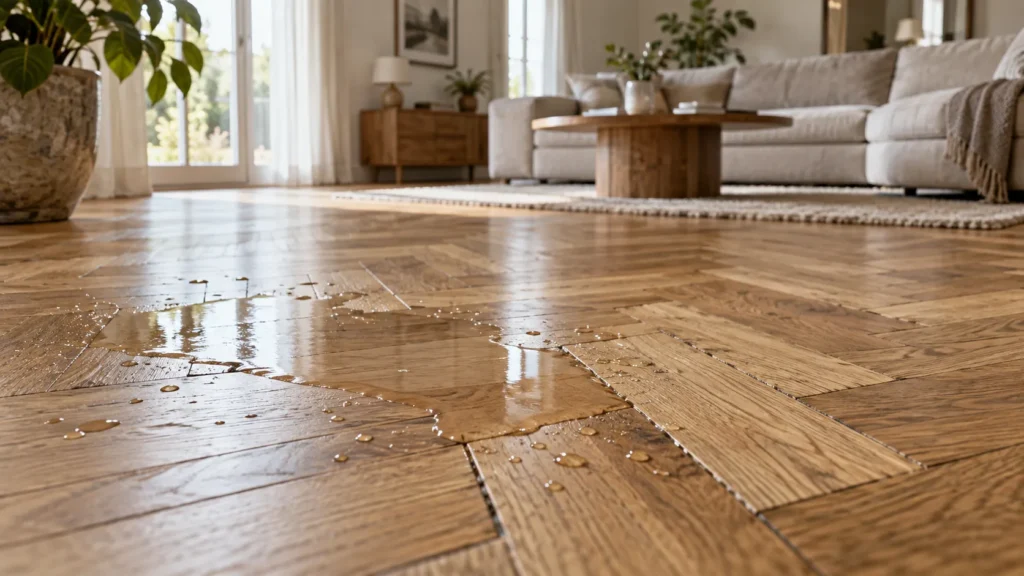
That is why wood parquet is most at home in living areas. It is a poor fit for full bathrooms, laundry rooms, and basements with any history of water, where a parquet-pattern vinyl or tile makes more sense.
Found Old Parquet Under Your Carpet? Read This First
Plenty of American homeowners discover parquet the day they rip out old carpet. If your house or apartment was built between roughly the 1950s and the 1970s, you’ll probably find thin oak mosaic or finger-block tiles in 9″ or 12″ squares.
If the tiles are stuck down with a black, tar-like glue, be careful. That adhesive is often a cutback or asphalt-based mastic, and some adhesives from that era contain asbestos. The U.S. EPA advises homeowners not to sand or try to level flooring or backing that may contain asbestos, and recommends using a trained, accredited professional for sampling. The EPA’s page on protecting your family from asbestos exposure explains what to do and who to call.
If the tests come back clear and most of the tiles are intact, an old parquet floor is often worth keeping, since it may be solid oak that has been hidden for decades.
Where Parquet Flooring Works Best
Parquet shines in rooms where you want the floor to be part of the design: entryways, hallways, dining rooms, living rooms, home offices, and bedrooms. A few layout ideas help it look intentional:
- Hallways: run herringbone or chevron points down the length to make the space feel longer.
- Small rooms: choose larger blocks or a simple herringbone, since tiny mosaic pieces can make a small room feel busy.
- Open floor plans: keep one pattern direction throughout, or use a border to frame a dining zone.
- Busy furniture and rugs: pair them with a quieter pattern or a lower-contrast finish so the room doesn’t feel crowded.
Is Parquet Flooring Eco-Friendly?
It can be, but it depends on the product rather than the pattern. Look for:
- FSC certification, which traces the wood to responsibly managed forests.
- Reclaimed parquet, salvaged blocks from older buildings that avoid new harvesting.
- Lacey Act documentation for imported and exotic species.
- CARB Phase 2 or TSCA Title VI compliance for engineered cores, and FloorScore certification for indoor air emissions.
- Low-VOC finishes, such as many water-based polyurethanes.
Engineered parquet uses less premium hardwood per square foot, since only the top layer is the face species. Solid parquet uses more wood, but it can last for generations, and a floor that stays in place for 100 years has a strong sustainability case of its own.
Before You Buy: A 7-Point Parquet Spec Check
Before you order, make sure the product listing or spec sheet answers each of these:
- Surface material. Is it solid hardwood, engineered hardwood, laminate, vinyl, or tile?
- Construction. If engineered, what is the wear layer in millimeters?
- Species and grade. For example, white oak, Select grade.
- Pattern. Herringbone, chevron, or another pattern? Are A and B boards included in the right ratio?
- Format and size. Loose blocks, tiles, boards, or panels, and what are the dimensions?
- Finish. Prefinished or unfinished, and what finish type and sheen?
- Suitability. Is it approved for your room, your subfloor, radiant heat, and does it carry FSC, FloorScore, or CARB/TSCA labels?
If a listing says “parquet look” or “parquet effect” and gives no wear layer in millimeters, assume it isn’t real wood until the seller proves otherwise.
Frequently Asked Questions About Parquet Flooring
What is parquet flooring in simple terms?
Parquet flooring is real wood cut into small pieces and laid in a repeating geometric pattern, such as herringbone, chevron, or basketweave, instead of long straight planks.
Is parquet the same as herringbone?
No. Herringbone is one parquet pattern among several. Herringbone designs are also made in vinyl, laminate, and tile, so not every herringbone floor is parquet.
What’s the difference between parquet and parquetry?
Parquet usually refers to the floor itself, while parquetry is the craft of cutting and fitting the wood pieces into a pattern. In everyday use, the terms are interchangeable.
Is parquet flooring outdated?
No. The 1970s mosaic tile look has faded, but engineered herringbone and chevron in light white oak with matte finishes are among the most requested wood floor styles today.
Can you put parquet in a kitchen or bathroom?
Wood parquet is best suited to living areas. It is not recommended for full bathrooms or areas with standing water, where herringbone vinyl or tile is the safer choice.
Is engineered parquet real wood?
Yes. Engineered parquet has a genuine hardwood wear layer over a plywood or HDF core. Laminate and vinyl parquet-look floors use a printed image instead.
The Bottom Line
Parquet flooring is small pieces of real wood, solid or engineered, arranged in a geometric pattern. What makes one parquet floor different from another is the combination of material, wear layer, species, grade, pattern, piece size, and finish, not the word “parquet” on the box.
If you’re still deciding between parquet and other wood options, start with our complete guide to solid, engineered, and other wood flooring types, then come back here to choose your pattern. And if you’re lucky enough to find old parquet hiding under your carpet, have the old adhesive tested before you disturb it.