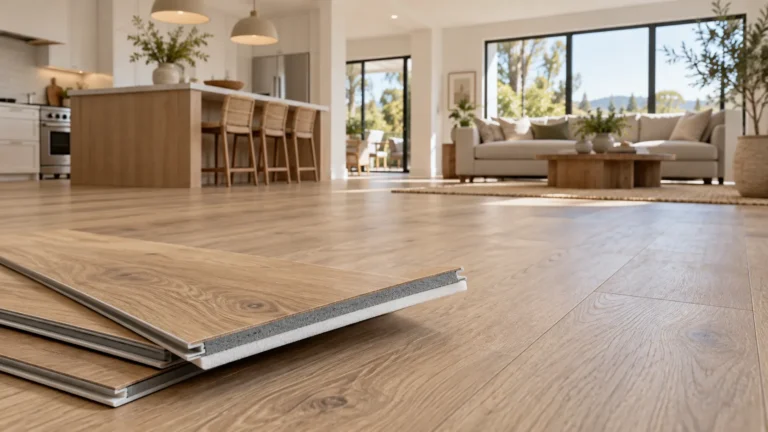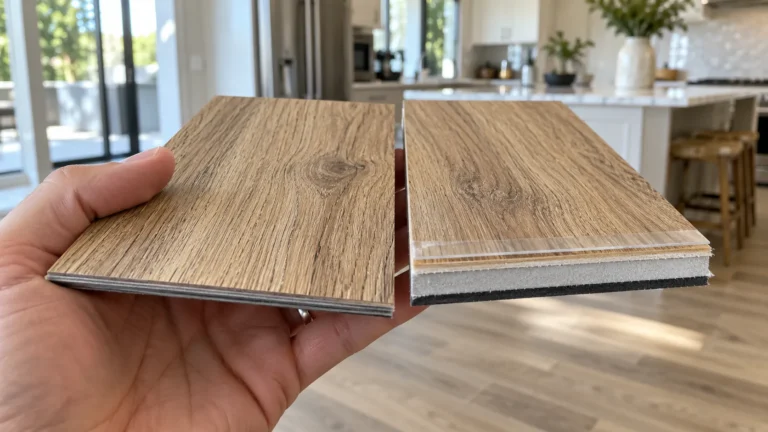
Engineered hardwood is not one single product. The main differences are in the core, the real-wood wear layer, the way that top layer is cut, and how the finished plank is designed to be installed. Those details affect stability, appearance, refinishing potential, moisture suitability and price.
Quick answer: For most homes, plywood-core engineered hardwood is the easiest all-around starting point. HDF-core products are common in click-lock floating floors, while softwood-core, finger-core and LVL constructions are more product-specific. Whatever core you choose, pay close attention to the wear-layer thickness and the manufacturer’s approved installation conditions.
Still comparing engineered hardwood with other materials? See our complete guide to flooring types to compare hardwood, vinyl, tile, laminate, carpet and other options before narrowing your choice.
Engineered hardwood types at a glance
The core is the easiest way to separate the main engineered hardwood types. It sits below the real-wood surface and influences how the plank behaves, how it is milled and which installation methods are commonly available.
| Type | What it is | Best fit | Main point to check |
| Plywood core | Layers of wood veneer arranged in alternating directions | Most residential projects | Wear layer, bonding quality and approved installation method |
| HDF core | Dense fiberboard beneath a real-wood surface | Click-lock floating floors | Moisture warranty and wear-layer thickness |
| Softwood / SPF core | Spruce, pine or fir strips in an all-wood build | Premium three-layer products | Product-specific installation and radiant-heat approval |
| Finger-core | Short wood blocks joined to form the middle layer | Multi-layer wood-core products | Core quality, adhesive system and warranty |
| LVL core | Bonded structural veneers with consistent grain direction | Niche or specification-driven products | Whether the full product suits your subfloor and installation |
| Strand-woven bamboo core | Compressed bamboo fiber beneath a hardwood face | Uncommon specialty products | Verify the full specification rather than relying on density alone |
1. Types by core construction
Core construction matters, but it is not a quality grade by itself. A well-made HDF product can be a better fit for one room than a poorly specified plywood product, and the reverse can also be true. Use the core as a starting point, then compare the wear layer, finish, installation approval and warranty.
Plywood-core engineered hardwood
Plywood core is the most common and versatile option. Thin wood plies are layered in alternating directions, which helps reduce seasonal movement compared with a solid board of similar width.
It is a strong choice when you want flexibility: many plywood-core products are available for glue-down, nail/staple or floating installation, depending on the specific plank. It is also commonly paired with thicker sawn or sliced wear layers, so it can offer better refinishing potential than many thin-veneer products.
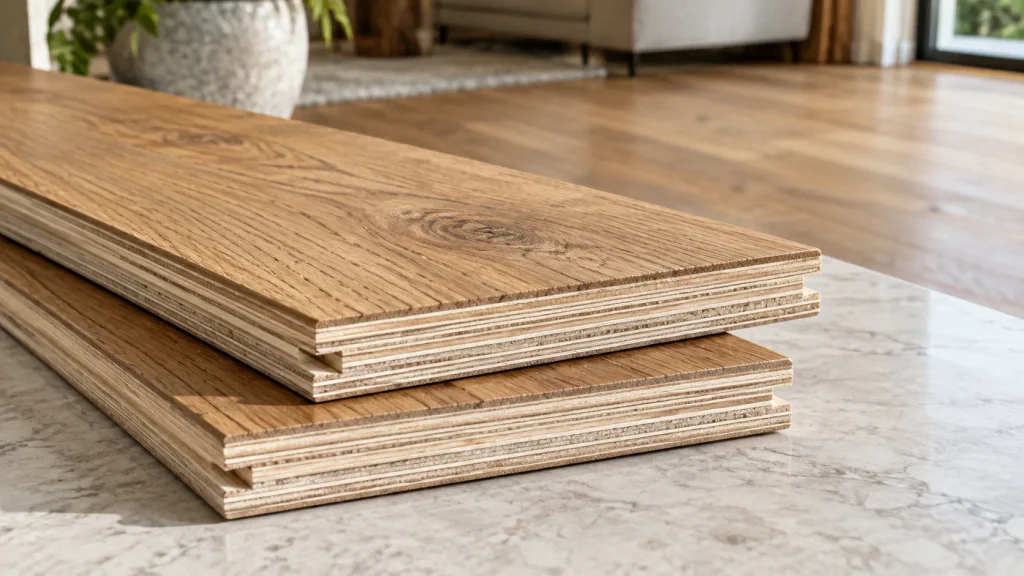
Best for: homeowners who want a broad range of styles and installation options. Do not judge quality by ply count alone; the wear layer, bonding, finish and warranty matter more.
HDF-core engineered hardwood
HDF-core flooring uses high-density fiberboard beneath a real hardwood surface. Because HDF can be machined very precisely, it is often used for click-lock floating floors.
The main trade-off is that many HDF products have relatively thin real-wood wear layers, which can limit future sanding. HDF also does not automatically mean waterproof: water performance depends on the complete product and its written warranty.
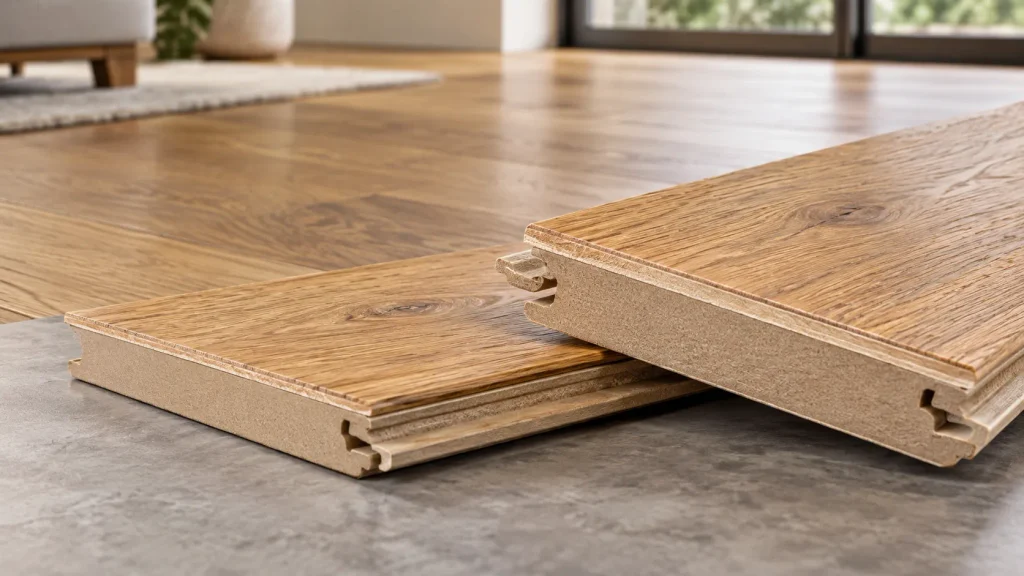
Best for: buyers who want a click-lock floor or a simpler floating installation over a flat, dry and properly prepared subfloor.
Softwood / SPF-core engineered hardwood
Some engineered floors use spruce, pine or fir strips as the middle layer, usually with a hardwood face and a balancing layer underneath. This creates an all-wood, three-layer construction.
These products are often found in the premium market and may come with substantial wear layers. However, installation and radiant-heat approval vary by product, so the three-layer label alone should not drive the decision.
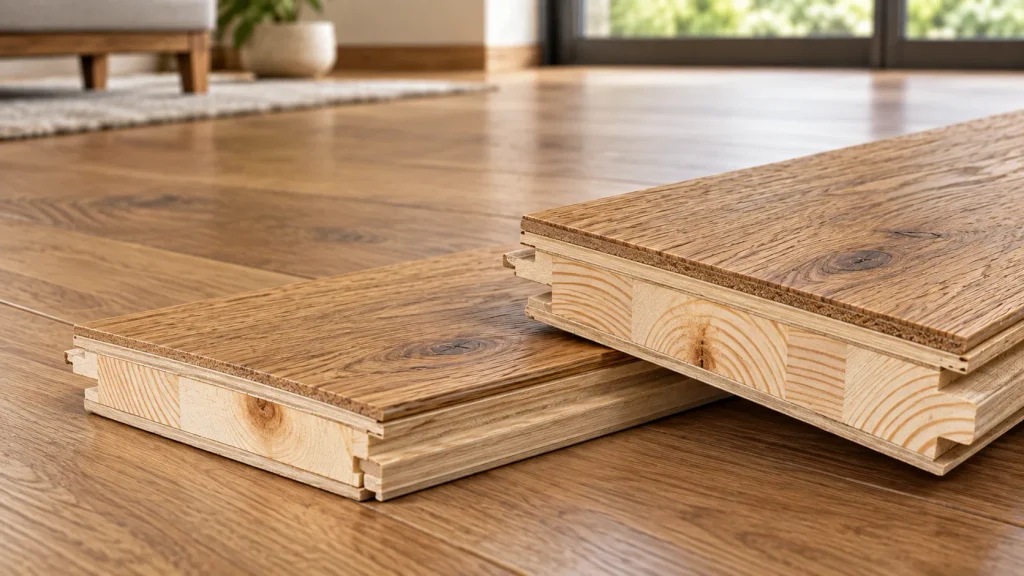
Best for: buyers who prefer an all-wood construction and find a product with the wear layer and installation approvals they need.
Finger-core engineered hardwood
Finger-core construction uses shorter wood blocks joined end to end to form the middle layer. It can make efficient use of timber while still producing a wood-based structural core.
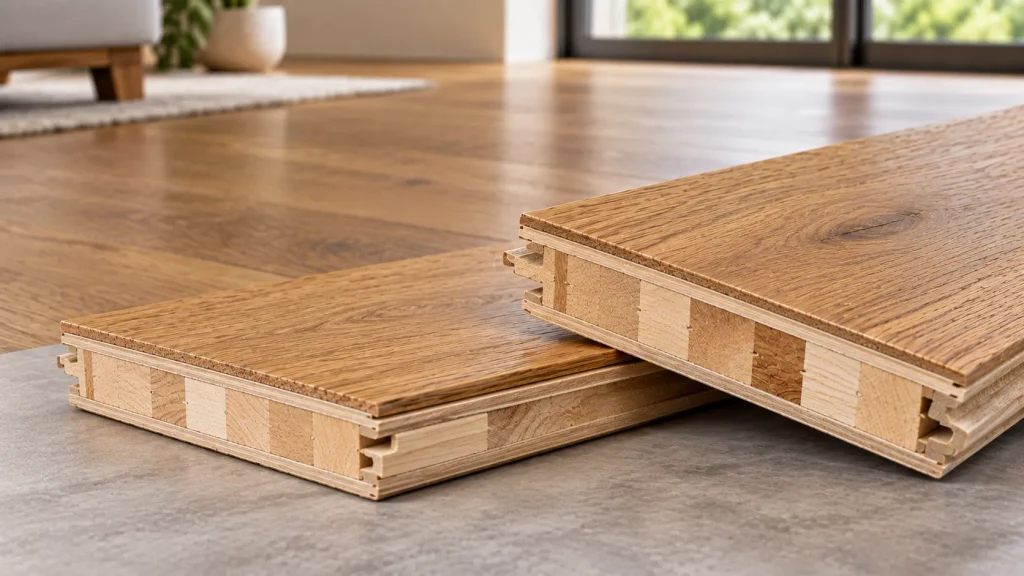
Quality is less predictable from the name alone because core species, joints, adhesives and manufacturing tolerances can vary. If a product only says “multi-layer wood core,” look for more detail before comparing it with other floors.
Best for: a clearly documented product where the construction, wear layer and warranty justify the price.
LVL-core engineered hardwood
LVL means laminated veneer lumber. Its bonded veneers create a structurally consistent core, but LVL is much less common in residential engineered flooring than plywood or HDF.
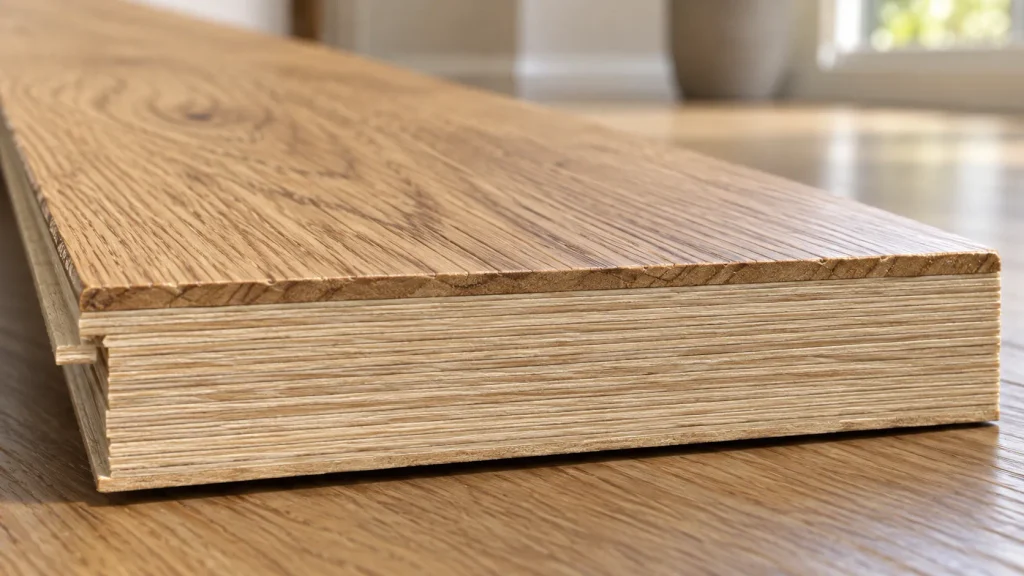
Treat LVL as a construction method, not as a premium badge. It is worth considering when the complete product is a strong match for your plank size, subfloor and installation method.
Strand-woven bamboo core
A small number of products use compressed, resin-bonded bamboo strands beneath a hardwood face. Bamboo is a grass rather than a hardwood species, but it can still function as an engineered core material.
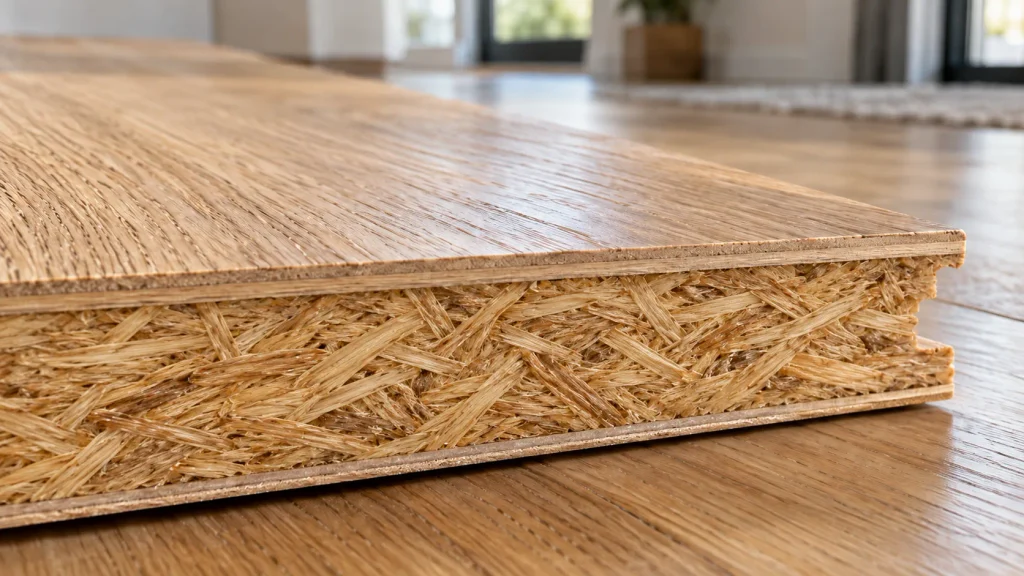
Because this construction is uncommon, verify the wear layer, installation approvals and warranty carefully instead of assuming that a dense core automatically makes the floor more durable.
2. Veneer cut: how the real-wood surface is made
The wear layer is the real wood you see and walk on. How it is cut affects the grain appearance, typical thickness and price.
Sawn veneer
A sawn veneer is cut from the log in a way that closely resembles the production of solid hardwood boards. It usually gives the most natural solid-wood appearance and can accommodate a thicker wear layer. The trade-off is usually a higher price.
Choose it when: you want a premium wood look and future refinishing matters.
Sliced veneer
Sliced veneer is cut in sheets with a knife. It often keeps a natural, linear grain while using the log more efficiently than sawing. It can be a practical middle ground between appearance and cost.
Choose it when: you want a convincing wood appearance without automatically paying for the thickest premium face.
Rotary-peeled veneer
Rotary peeling turns the log against a blade and unrolls a continuous sheet. This is material-efficient and common in more economical engineered floors, but the grain can look broader or more repetitive.
Choose it when: budget matters more than refinishing headroom. Many rotary-peeled products use thinner wear layers, so check the actual millimeter measurement.
3. Wear-layer thickness: the specification that matters most for refinishing
Do not confuse total plank thickness with wear-layer thickness. Total thickness is the whole board. The wear layer is only the real hardwood above the core, and it determines how much wood is available for future surface renewal.
| Wear layer | What it usually means for the buyer | Best fit |
| Under 1 mm | Little or no full-sanding headroom | Budget floors or shorter ownership horizons |
| 1-2 mm | Usually not intended for full sanding; recoating may still be possible | Mainstream use when refinishing is not a priority |
| 2-3 mm | Some refinishing potential, depending on bevel depth and condition | A useful middle range for longer-term ownership |
| 3-4 mm | Meaningful refinishing headroom in many products | Buyers who want a longer service horizon |
| 4-6 mm | Substantial real-wood face | Premium products where renewal is a major priority |
Useful reference: NWFA’s Engineered Wood Flooring Refinishable Program uses minimum wear-layer requirements for qualifying products. Those thresholds are useful comparison points, but they do not guarantee a fixed number of future sandings; bevel depth, previous sanding, floor condition and the amount of wood removed also matter.
4. Hardwood species: choose the look first, hardness second
The surface species controls the visible grain, color and base wood hardness. It does not tell you what the core is. A white oak floor, for example, can be made with plywood, HDF or another approved core.
| Species | Look | Relative hardness / wear note | Good choice if you want |
| Red oak | Open grain with warmer pink-red undertones | Balanced everyday hardness; grain can hide minor wear | A traditional, visibly grained wood floor |
| White oak | Tighter grain with neutral brown tones | Slightly harder than red oak | A versatile look that works with many finishes |
| Hard maple | Pale, fine and less figured | Harder than oak, but fine grain can show marks differently | A clean, light, contemporary surface |
| Hickory | Strong grain and natural color variation | Very hard among common domestic choices | A rustic or high-character floor |
| Walnut | Rich chocolate-brown color | Softer than oak, maple and hickory | Deep color and a more refined visual |
Do not choose by hardness alone. The finish, texture, maintenance and traffic pattern strongly affect how visible scratches and wear become in real use.
5. Texture and finish: what you will notice every day
Texture describes the shape of the wood surface. Finish is the protective coating over it. They work together, but they solve different problems.
Smooth: Clean and contemporary, but dust and scratches can be easier to see.
Wire-brushed: Adds subtle texture and can disguise everyday scratches and pet marks.
Hand-scraped: Creates visible undulations and a more traditional or aged look.
Distressed: Uses intentional dents or worn details to create a rustic surface that hides new marks more easily.
For the protective finish, factory-cured urethane and aluminum-oxide-enhanced systems generally prioritize abrasion resistance, while penetrating or hardwax oils can favor a natural look and localized maintenance. The better choice depends on whether you value lower routine maintenance or easier spot repair.
6. Installation and room suitability
A floor is only a good choice if the manufacturer approves it for your subfloor, grade level and installation method. Engineered hardwood can be installed by nail/staple, glue-down or floating, but not every product supports all three.
Nail or staple down: Common over suitable wood subfloors. It can feel solid underfoot, but plank thickness, fasteners and subfloor construction must match the product instructions.
Glue-down: Common over prepared concrete slabs. Moisture control, adhesive choice and slab preparation are critical.
Floating: The planks connect to each other rather than to the subfloor. It can be DIY-friendly, but the substrate still needs to be flat, clean and dry.
What about kitchens, basements and bathrooms?
Do not assume engineered hardwood is waterproof as a category. Some products carry water-resistant or waterproof warranties, while others are intended only for dry rooms. The written product warranty is more important than a general marketing label.
Kitchen: Use a product explicitly approved for kitchen use and follow its spill, sealing and installation requirements.
Basement: Look for explicit below-grade approval, moisture testing requirements and the specified moisture-control system.
Full bathroom: Use engineered hardwood only if the exact product and written warranty explicitly allow full-bathroom installation.
Radiant heat: Choose only a product that is specifically approved for the heating system and follow its temperature, humidity and installation limits.
7. Which type of engineered hardwood is best for your home?
There is no single “best” engineered hardwood. The best product is the one that matches your room, subfloor, maintenance expectations and how long you want the floor to remain renewable.
| Your situation | What to prioritize |
| General living areas | A well-documented plywood-core product with a suitable wear layer and approved installation method |
| You want future refinishing | A substantial wear layer, ideally in a sawn or sliced face, with enough real wood for renewal |
| DIY floating installation | A click-lock product explicitly approved for floating installation over your subfloor |
| Concrete slab | A product approved for the slab with the required moisture testing and glue-down or floating system |
| Basement | Explicit below-grade approval and the specified slab moisture-control system |
| Dogs, kids or heavy traffic | A durable factory finish plus a texture that helps disguise everyday wear |
| Kitchen | Explicit kitchen approval and a written water-performance warranty that fits your use |
| Premium long-term floor | A substantial sawn wear layer, documented core construction and a finish chosen for durability or repairability |
| Tighter budget | A thinner veneer or HDF/rotary-peeled option, accepting limited sanding potential |
8. A simple buying checklist
When you compare two engineered hardwood products, skip the marketing labels and look for these specifications first:
Wear-layer thickness in millimeters: This tells you how much real wood sits above the core and whether future sanding may be realistic.
Core construction: Know whether the product uses plywood, HDF, softwood, finger-core, LVL or another material.
Veneer cut: Sawn, sliced and rotary-peeled faces can look different and are commonly sold at different price points.
Approved installation method: Confirm nail/staple, glue-down or floating approval for your exact project.
Grade and room approval: Check above-grade, on-grade or below-grade use, plus kitchen, bathroom or other moisture restrictions.
Water and radiant-heat warranty: Read the written terms instead of relying on the product-page headline.
Finish and texture: Choose based on the balance you want between visible wear, maintenance and repairability.
Indoor-air check: If the product contains regulated composite wood materials, verify its emissions compliance documentation. The U.S. EPA formaldehyde standards page explains the federal TSCA Title VI requirements for applicable composite wood products and finished goods.
Frequently asked questions
What are the main types of engineered hardwood flooring?
By core construction, the main types are plywood core, HDF core, softwood/SPF core, finger-core and LVL core. Strand-woven bamboo core appears in a smaller number of products. You can also compare engineered hardwood by veneer cut, wear-layer thickness, species, finish and installation method.
Is plywood or HDF engineered hardwood better?
Plywood is usually the more versatile starting point when installation flexibility and a substantial wear layer are priorities. HDF is common in precisely milled click-lock floating floors. Neither is automatically better or waterproof; compare the complete product specification.
What wear-layer thickness should I look for?
If future refinishing matters, prioritize a thicker real-wood wear layer rather than total plank thickness. Around 2.5-3 mm or more is a useful comparison range for buyers thinking about future renewal, but the actual ability to sand depends on the product, bevel depth and floor condition.
Can engineered hardwood be refinished?
Some engineered hardwood can be refinished, but only when enough real wood remains above the core. Thin-veneer products may only support recoating or surface maintenance rather than full sanding.
What type is best for a concrete slab or basement?
Choose a product with explicit approval for the grade level and subfloor. For concrete, moisture testing and the specified moisture-control method are essential. Below-grade basements require a product that is specifically approved for below-grade use.
Is engineered hardwood waterproof?
Not as a category. Water performance is product-specific. Some floors have written water-resistant or waterproof warranties, while many standard engineered hardwood products do not. Always read the warranty and room exclusions.
How long does engineered hardwood last?
There is no single lifespan. Service life depends on wear-layer thickness, finish quality, installation, moisture exposure, traffic and maintenance. A well-made floor that is correctly installed and maintained can remain useful for decades.
How to choose without overthinking it
Start with the room and subfloor, then narrow the products by core type. After that, compare the wear-layer thickness, veneer cut, finish and approved installation method. Those details tell you far more about real-world suitability than labels such as “premium,” “waterproof” or “extra durable.”
For a typical residential project with no unusual moisture or heating requirements, a well-documented plywood-core floor with a substantial wear layer is a sensible starting point. If you prefer a floating installation, HDF click-lock can be practical. In either case, the exact product specification and warranty should make the final decision.