Cork flooring is a floor covering made with cork, the harvested bark of the cork oak tree. The bark is ground into granules, bonded, pressed, and finished into tiles or planks. Step on it barefoot and you’ll notice the difference right away. It gives a little. It feels warm.
That softness comes from millions of tiny air-filled cells. Cork flooring comes in several forms, from tiles made almost entirely of cork to engineered planks with a cork surface. You’ll also see cork-backed vinyl in the same listings, but it’s a different type of floor. Here’s how to tell them apart.
What Is Cork Flooring?
Cork flooring is a resilient floor covering made from the harvested bark of the cork oak (Quercus suber). Manufacturers grind the bark into granules, bind them with resin, and press them into sheets. Those sheets become glue-down tiles or click-together planks with a protective finish.
Cork counts as a natural flooring material because its defining ingredient comes straight from a tree, and nobody cuts the tree down to get it. That’s the big difference from hardwood: hardwood comes from the trunk, while cork comes from the bark.
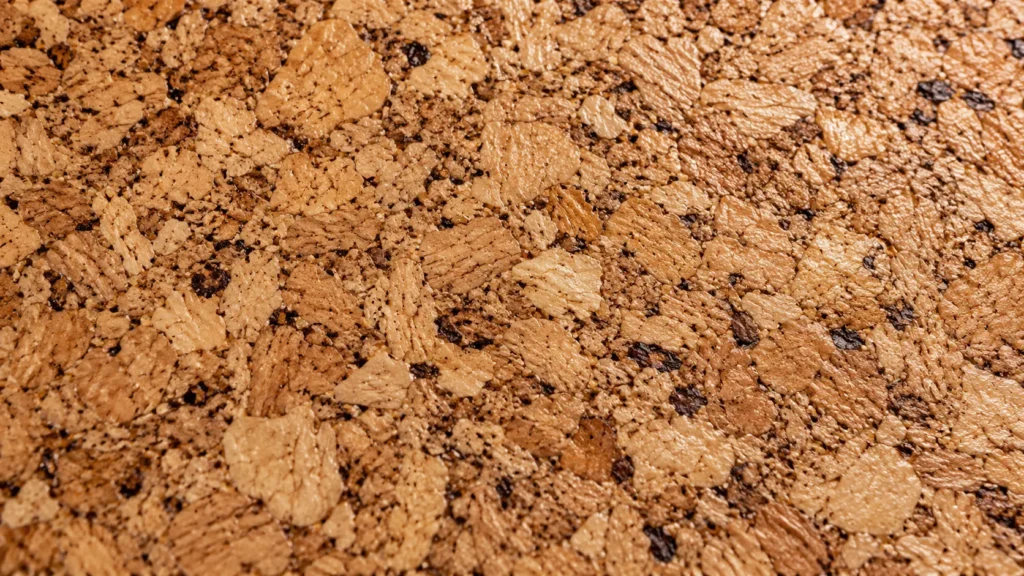
One fact surprises a lot of people. Most cork floors aren’t slices of bark. They’re agglomerated cork, made of small granules bonded into a dense board. The European standard BS EN 12104 defines cork floor tiles this way.
Two products often get lumped in with cork flooring:
- Cork underlayment is a thin cork sheet laid under another floor, such as tile or laminate. You never see it.
- Cork-backed vinyl is a vinyl plank with cork bonded to its back. The surface you walk on is vinyl.
Neither one is cork flooring in the true sense.
Where Does Cork Flooring Come From?
Cork comes from Quercus suber, an evergreen oak native to the western Mediterranean. Most of the world’s cork comes from Portugal and Spain, and Portugal is the center of cork processing.
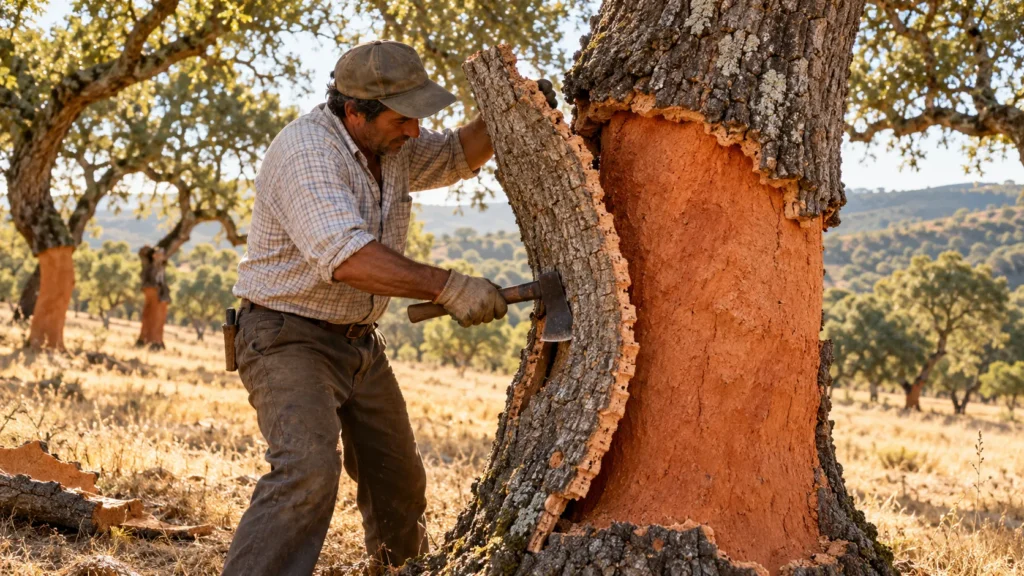
Workers harvest the bark by hand, stripping the outer layer carefully so the living tissue underneath stays intact. The tree then grows a fresh coat of bark, and roughly nine years later it’s ready to harvest again. Portuguese law regulates how often each tree can be stripped.
A cork oak needs decades of growth before its first useful harvest. From then on, workers can harvest the same tree again and again over its long life without cutting it down.
A Brief History of Cork Flooring
Cork sealed wine bottles long before anyone walked on it.
The turning point came in 1891, when an American named John Smith found a way to produce agglomerated cork. That discovery opened the door to cork wall tiles, flooring, and underlayment, since scraps and granules could now be pressed into usable boards.
Cork floors also earned a place in notable architecture. In 1937, cork flooring went into Frank Lloyd Wright’s Fallingwater.
More recently, manufacturers have introduced cork planks with water-resistant and waterproof cores, expanding the range of available cork flooring products.
What Is Cork Flooring Made Of?
Cork Oak Bark
Bark is the main ingredient. Cork is built from tiny closed cells filled with gas, and that structure explains much of how it behaves. The cell walls also contain suberin, a waxy natural compound that helps cork shed water.
Cork Granules From Stopper Production
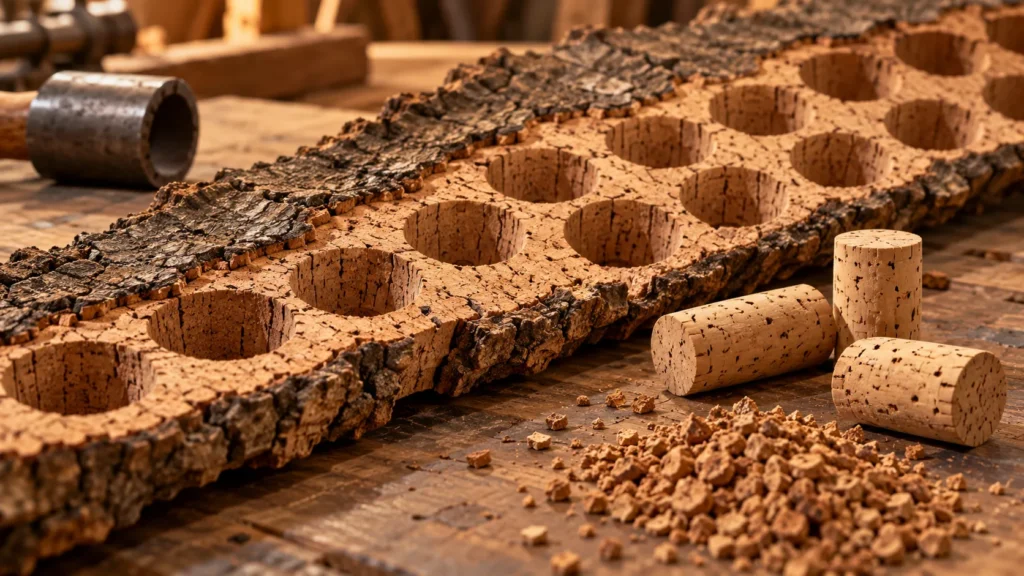
Much of the cork used in flooring comes from wine-stopper production. Stopper makers punch corks out of bark strips, and manufacturers grind the leftover material into granules. Flooring makers also use cork from pruning and other sources, so material that might otherwise go unused ends up under your feet.
Binders, Finishes, and Engineered Layers
Cork granules need a binder to hold them together. Makers mix them with resin and press them into sheets. They then add a decorative layer and a finish to protect the surface.
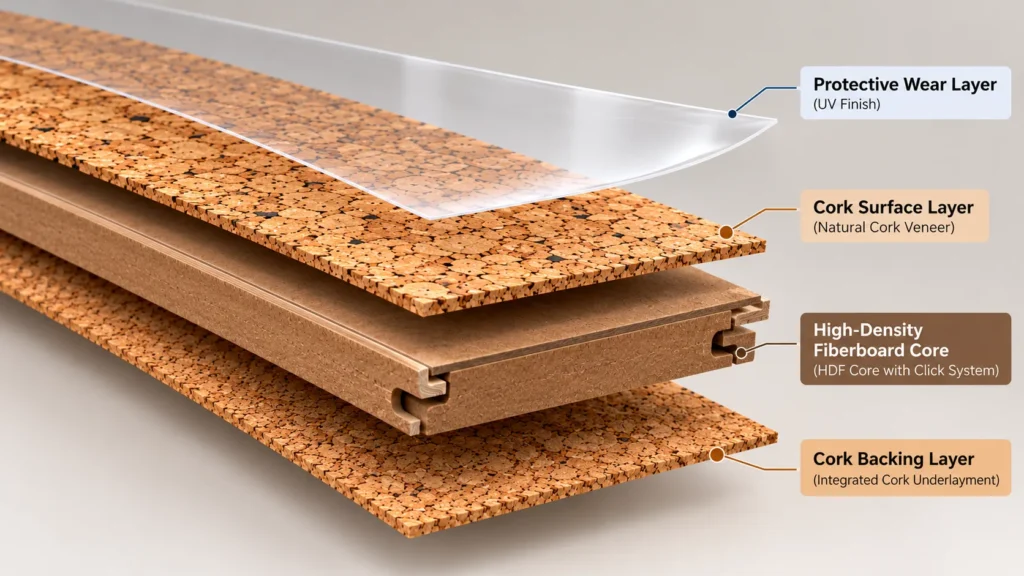
How much else goes into the floor depends on the product. Some glue-down tiles are almost entirely cork. An engineered plank puts a cork top layer over a fiberboard or waterproof core, often with cork backing on the bottom. A cork-backed vinyl plank is mostly vinyl and core.
How Is Cork Flooring Made?
Harvesting the Bark
Production starts in the forest, where workers strip the bark by hand on a roughly nine-year cycle.
Stabilizing and Boiling
After harvesting, cork bark is typically left to stabilize for at least six months. Depending on the intended product, it may also be boiled and further prepared. According to APCOR, the Portuguese cork association, boiling cleans the bark, softens it, and evens out its cell structure. Flooring manufacturers often work with processed cork granules, including material recovered from stopper production.
Granulating, Binding, and Pressing
Some guides describe cork flooring as sliced sheets of bark, but most of it is made from granules. Manufacturers mix the granules with a binder and cure the mix under heat and pressure to form dense blocks or sheets.
Decorating and Finishing
Next, manufacturers add the visible surface. Many tiles get a thin cork veneer for a natural look, while others get a printed wood or stone image. A factory finish, often cured with UV light, seals the surface.
Building Engineered and Hybrid Planks
Planks take a few more steps. Manufacturers laminate the cork top layer to a core, add cork backing to the bottom, and machine click joints along the edges so the planks lock together.

What Are the Different Types of Cork Flooring?
Shoppers usually hear about tiles and planks, but those terms describe shapes. A more useful way to sort cork flooring is by how it’s built.
Predominantly Cork Flooring
These floors are cork almost all the way through: a layer of agglomerated cork, usually topped with a thin cork veneer and a protective finish. Most are glued straight to the subfloor. Some sellers call this “solid cork,” even though it’s still made from bonded granules.
Engineered Cork Flooring
Engineered planks put cork on the surface and a stiffer core underneath, often with a second cork layer as backing. They usually click together and float over the subfloor.
Waterproof / Hybrid Cork Flooring
Manufacturers also offer hybrid cork floors with water-resistant or waterproof cores. A typical design pairs a high-density cork surface with a waterproof core, click joints, and attached cork underlay. The core resists water, although the complete floor still has seams and joints.
For comparison, SPC flooring uses a rigid stone-polymer core beneath a vinyl surface, rather than a cork walking surface.
Cork Mosaic and Cork Rolls
Two niche formats round out the list. Cork mosaic is made from solid pieces of cork rather than granules cast in a mold. Cork is also sold in rolls, but many rolls are underlayment rather than a finished walking surface, so check which one you’re buying.
Related Product: Cork-Backed Vinyl
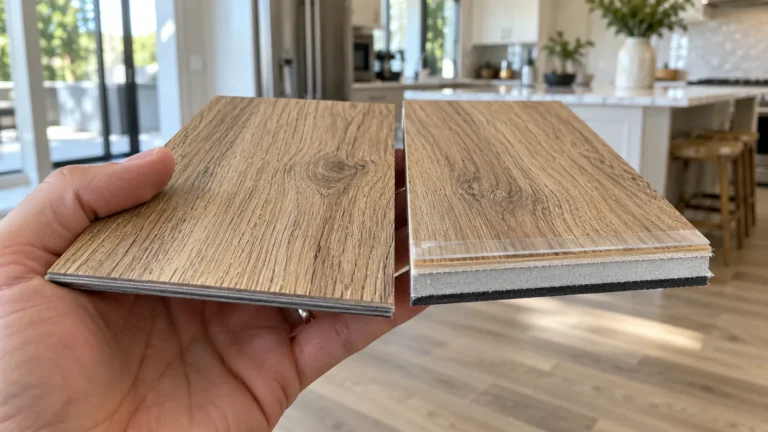
You’ll often see cork-backed vinyl shelved next to cork flooring, but it belongs to a different category. A cork-backed vinyl plank has a vinyl wear layer, a waterproof core, and cork underlayment attached to the bottom. The cork adds comfort and helps with sound, but you’re buying a vinyl floor.
The distinction matters when comparing product specifications. Our guide to types of vinyl flooring explains how vinyl plank construction, core materials, and attached backing layers differ.
Cork Tiles vs. Cork Planks
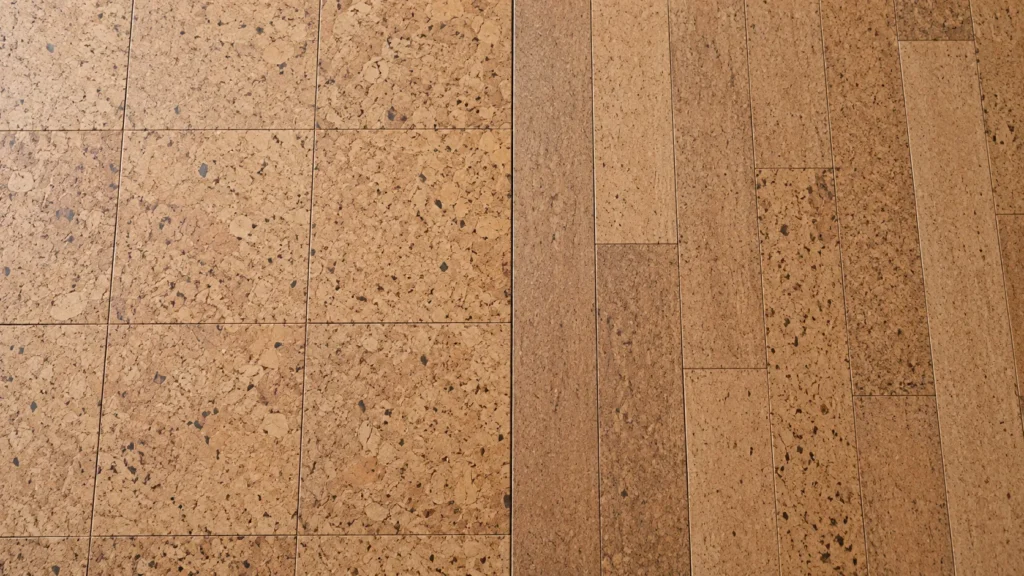
Tiles are usually square or rectangular and glued down. Planks are long and narrow, and they typically click together. Either format can be made mostly of cork, though most planks on the market today are engineered.
| Type | How it’s built | Typical format | Typical thickness |
| Predominantly cork | Agglomerated cork, veneer, and finish | Glue-down tiles | About 4–6 mm |
| Engineered cork | Cork surface, engineered core, cork backing | Click planks | About 10–12 mm |
| Waterproof/hybrid cork | Cork surface over a waterproof core | Click planks | Varies |
| Decorative/printed cork | Printed design over a cork base | Tiles or planks | Varies |
| Cork-backed vinyl (related product, not cork flooring) | Vinyl wear layer, rigid core, cork backing | Click planks | Varies |
These categories overlap. A printed cork plank can also be a waterproof hybrid, for example.
Cork Flooring Thickness, Density, and Finishes
Thickness and Density
Cork flooring comes in many thicknesses. Glue-down tiles often measure around 4–6 mm (roughly 5/32 to 1/4 inch), while engineered planks commonly run 10–12 mm (roughly 3/8 to 1/2 inch). Sizes vary by manufacturer.
Thicker cork isn’t always stronger. The cork’s density and surface finish also matter. A thin, dense tile may handle heavy use better than a softer plank.
What “Wear Layer” Means for Cork
With vinyl, “wear layer” usually means a clear protective film on top. Cork works differently. On a glue-down tile, the wearing surface is a thin cork veneer plus several coats of finish. On an engineered plank, it can be a few millimeters of real cork.
Surface Finishes
Cork floors may have a polyurethane, UV-cured acrylic, or hard-oil finish, or a coating developed by the manufacturer. The finish matters as much as the cork itself, since it shapes how the completed floor handles wear.
What Does Cork Flooring Look Like?
Modern cork comes in far more looks than the bulletin-board version most people picture.
Natural cork shows off its granules with a speckled, organic texture in warm tans and browns. Some tiles are stained darker or dyed in bold colors, and others have marbled or patterned surfaces. High-definition digital printing has added wood grains and stone effects, with cork still underneath.
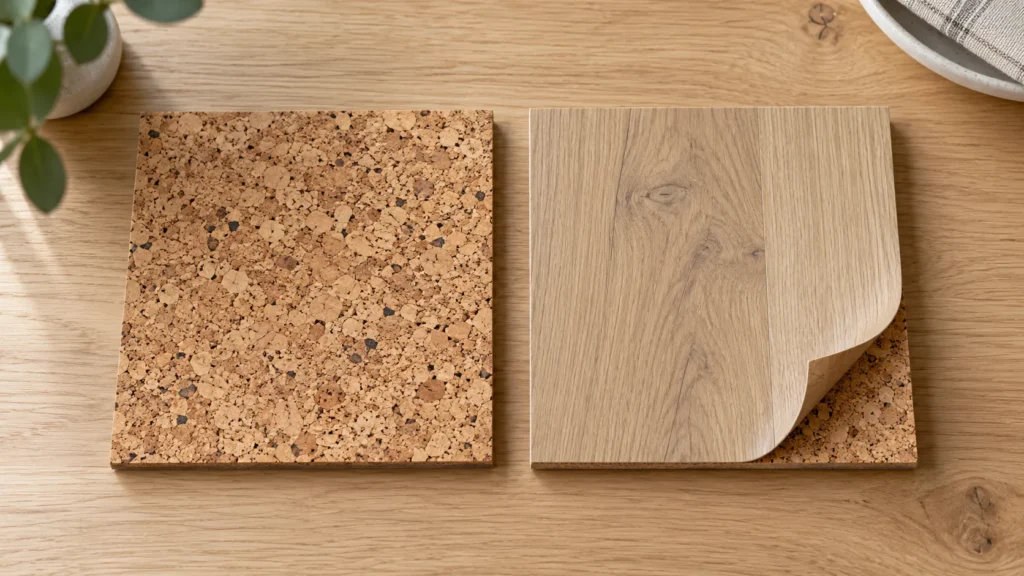
Surfaces range from flat matte to smoother, glossier finishes. Engineered cork planks come with beveled, micro-beveled, or square edges. Expect small shade differences, too, because natural cork varies slightly in color even within a single batch.
Key Physical Properties of Cork Flooring
Most of cork’s character comes from its air-filled cells. Press a thumb into a cork floor and it gives slightly, then springs back, so it feels softer underfoot than wood or tile. Those same cells absorb sound and soften the noise of footsteps. They also slow heat loss, so cork feels warm even over a cold concrete slab.
That warmth matters with radiant floor heating, since cork can slightly reduce heat output, so check the manufacturer’s heating limits. Heavy, concentrated loads can still leave a mark. Our cork flooring pros and cons guide explains how these properties affect daily use, durability, and maintenance.
What Makes Cork Flooring Different From Wood, Laminate, and Vinyl?
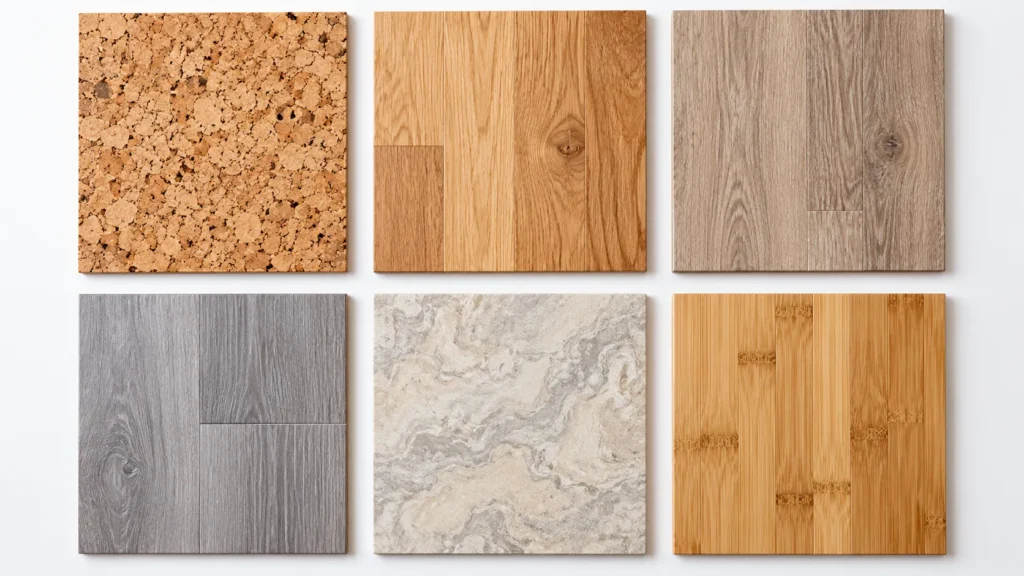
Each of these floors starts from a very different raw material. Here’s how they compare.
| Flooring | What it’s made of | Where the material comes from |
| Cork | Cork granules plus binder; engineered planks add a core | Bark of the cork oak, harvested without felling the tree |
| Hardwood | Solid or engineered timber | Tree trunks |
| Laminate | Wood-fiber core with a printed image layer and resin overlay | Processed and recovered wood, synthetic resins |
| Vinyl / LVT | Layered synthetic polymers | Petrochemicals |
| Linoleum | Linseed oil, wood flour, jute | Mostly plant-based raw materials |
| Bamboo | Compressed bamboo fibers | A grass; Moso bamboo matures in about 4–5 years |
Cork and bamboo both come from renewable natural sources, but their construction and performance differ. Our bamboo flooring guide explains how compressed bamboo planks are made and why they behave differently from softer cork surfaces.
Cork and linoleum sit closest together, since both are plant-based resilient floors. Cork is the only one in the group made from bark.
Is Cork Flooring Real Wood?
No. Cork comes from a tree, but not from timber. Hardwood is cut from the trunk, and the tree is felled. Cork is the outer bark, and the tree keeps living.
To understand how cork differs from solid hardwood, engineered wood, and other wood-look products, see our guide to types of wood flooring.
The mix-up is understandable, since some engineered cork planks contain a wood-fiber (HDF) core. Still, the surface you walk on is bark, and cork is a material of its own.
Is Cork Flooring Waterproof or Water-Resistant?
Cork itself resists water. A cork floor may or may not.
The suberin in cork’s cell walls helps it repel moisture, and that’s why cork keeps wine inside a bottle. A finished floor, though, has seams, adhesive, a coating, and sometimes a wood-fiber core. Water that slips past any of those can cause damage.
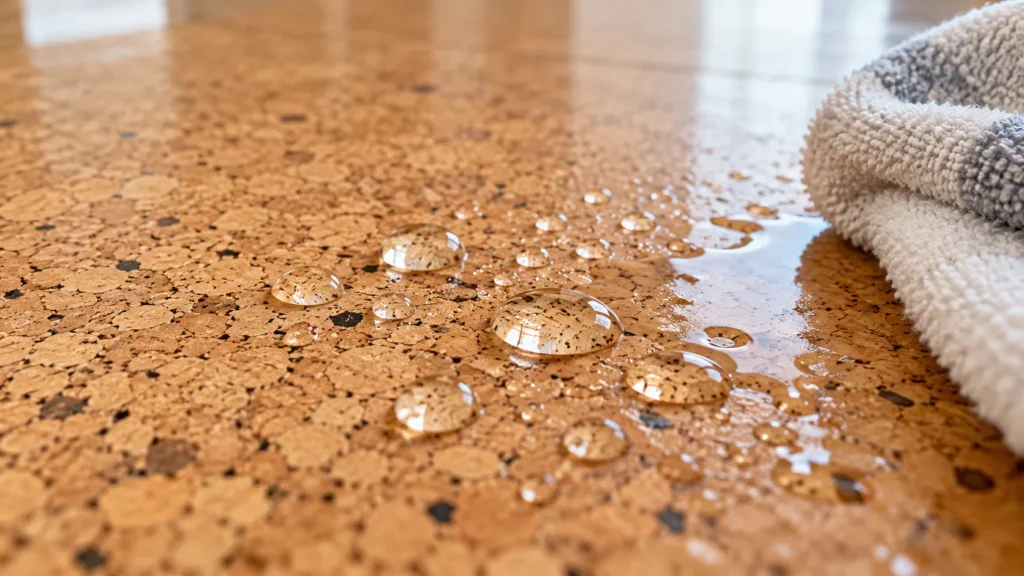
The two terms mean different things:
- Water-resistant: handles everyday spills if you wipe them up promptly.
- Waterproof: built to tolerate standing water, within the limits of its warranty.
A traditional glue-down cork floor with a sealed surface falls in the first group. Waterproof hybrid planks aim for the second. Even then, “waterproof” is a warranty promise with conditions, so read the exclusions before you trust it in a bathroom or basement.
Keep in mind that a waterproof plank protects the plank itself, not the room. Water can still reach the subfloor around the edges or through the perimeter.
How Long Does Cork Flooring Last?
There’s no single number. Lifespan depends on how the floor is built, its finish, product quality, the room’s conditions, and how much traffic it gets.
Warranties offer a useful clue. Residential coverage usually runs longer than commercial coverage, and some ranges carry lifetime limited residential warranties. Still, a warranty isn’t a lifespan. A well-kept glue-down cork floor that can be recoated may serve well beyond its warranty. Care plays a big role, and our [internal link: cork flooring maintenance guide] walks through it.
Is Cork Flooring Safe for Indoor Air?
Cork bark is natural, but a finished cork floor also contains binders, coatings, and sometimes an engineered core. Each of these can affect indoor air quality. To check a specific product, look for independent emissions certifications on the finished floor, such as FloorScore or GREENGUARD Gold.
You’ll also see cork floors marketed as antimicrobial or hypoallergenic. Lab tests show that raw cork can reduce certain bacteria. That doesn’t mean a finished cork floor prevents mold, allergies, or illness.
Is Cork Flooring a Sustainable Material?
Cork starts with a real advantage. Workers harvest the bark without cutting down the tree, the bark grows back, and the same tree can be harvested again about every nine years. Flooring also puts leftovers to use, since much of it is made from granules left over from wine-stopper production.
The finished floor is more complicated than the raw bark. Binders, coatings, and engineered cores aren’t cork, and they shape a product’s environmental profile and what happens to it at the end of its life. Construction varies from product to product, and a tile that’s nearly all cork is simpler in this respect than a multilayer plank.
You’ll also see cork floors labeled “carbon negative.” These claims usually credit forest carbon uptake to the product, so ask how the number was calculated and whether it comes from a current Environmental Product Declaration (EPD). Our [internal link: cork flooring sustainability guide] covers the details.
Where Is Cork Flooring Commonly Used?
Cork turns up wherever comfort and quiet matter, from family homes to busy public buildings.
Residential Spaces
Bedrooms, living rooms, home offices, and libraries are classic cork rooms, where quiet footsteps and a warm surface fit naturally. Kitchens work too, especially with sealed glue-down tiles or a waterproof hybrid. Basements and bathrooms need a product the manufacturer clearly approves for those spaces.
Commercial and Public Interiors
Cork shows up in offices, schools, libraries, retail stores, and hotels. Glue-down cork is sold specifically for commercial buildings, and some floors are classed for commercial traffic. In these settings, the product’s use class matters more than its name.
Frequently Asked Questions About Cork Flooring
Is cork flooring natural or synthetic?
Usually a mix. The cork itself comes from natural tree bark, but finished flooring may also contain binders, protective coatings, fiberboard, or synthetic core materials.
Does harvesting cork kill the tree?
No. Workers strip only the outer bark. The tree regrows it and can be harvested again roughly every nine years.
Does cork flooring fade in sunlight?
Yes. Natural cork can change color when exposed to sunlight. Printed or coated products may respond differently, so look for UV-resistance details on the product’s spec sheet.
Is cork flooring fire resistant?
Cork floors don’t share one rating. Fire classifications apply only to the floor that was tested, so look up the rating for the exact product you’re considering.
What to Remember Before You Shop
Cork flooring comes from the bark of the cork oak tree. Manufacturers turn it into tiles or engineered planks, often with added protective finishes or supporting cores. Cork-backed vinyl is a separate product because its walking surface is vinyl rather than cork.
If you’re still choosing between cork and other materials, our guide to types of flooring compares popular options by room suitability, moisture resistance, comfort, and cost.
My advice is to shop by construction first and color second. Ask for the spec sheet, the finish type, and current certifications.