Shop for vinyl flooring and you will meet a wall of acronyms within minutes: LVP, LVT, SPC, WPC, VCT, EVP. Add labels like rigid core, waterproof, loose-lay and peel-and-stick, and one of the simplest flooring categories starts to feel like a chemistry exam.
The main types of vinyl flooring are luxury vinyl plank (LVP), luxury vinyl tile (LVT), sheet vinyl, vinyl composition tile (VCT), SPC and WPC rigid-core vinyl, peel-and-stick vinyl, loose-lay vinyl and groutable vinyl tile. Some of those names describe a shape, some describe what is inside the board, and some describe how the product is attached or finished. Once you know which is which, comparing floors gets much easier.
This guide breaks down each type, shows how they relate to each other, and helps you match the right one to your room. If you are still deciding between vinyl and other materials altogether, our guide to flooring types compares every major option side by side.
| Key takeaways •LVP and LVT are the same family (luxury vinyl). LVP is plank-shaped and usually looks like wood; LVT is tile-shaped and usually looks like stone or ceramic. •SPC and WPC are core types, not shapes. Most SPC and WPC floors are sold as LVP, so one floor can be “SPC” and “LVP” at the same time. •Sheet vinyl comes in rolls and gives the fewest joints of any vinyl, which is why it is popular in bathrooms and laundry rooms. •VCT is not LVT. It is a limestone-heavy commercial tile used in schools, stores and hospitals. •Wear layer and total thickness are different numbers. A 7 mm plank does not have a 7 mm wear layer; check the mil rating separately. •“Waterproof” is a performance claim, not a type. Sheet, LVP, LVT, SPC and WPC can all carry it. |
Types of vinyl flooring at a glance
Use this table as your map. Each type gets its own section below.
| Type | What it is | Typical look | Relative cost* | Best suited to |
| LVP | Luxury vinyl plank | Hardwood | Low to high (depends on core) | Living rooms, bedrooms, kitchens |
| LVT | Luxury vinyl tile | Stone, ceramic, concrete | Low to high | Kitchens, bathrooms, entryways, mudrooms |
| Sheet vinyl | Continuous roll | Wood, stone, tile, patterns | Low | Bathrooms, laundry rooms, healthcare |
| VCT | Vinyl composition tile | Solid or flecked colors | Low | Schools, retail, hospitals |
| SPC | Stone plastic composite rigid core | Mostly wood planks | Medium | Busy homes, basements, light commercial |
| WPC | Wood plastic composite rigid core | Mostly wood planks | Medium to high | Living areas, bedrooms, upper floors |
| Peel-and-stick | Self-adhesive tile or plank | Wood, marble, patterns | Low | Small rooms, quick refreshes, rentals |
| Loose-lay | Heavy plank or tile with gripping backing | Wood, stone | Medium to high | Offices, retail, rentals, homes |
| Groutable vinyl tile | Vinyl tile finished with real grout lines | Ceramic, stone | Medium | Bathrooms, kitchens, entryways |
Relative material cost within the vinyl category. Actual prices vary widely by brand, wear layer and region.
What is vinyl flooring?
Vinyl flooring is a resilient floor covering made mainly from polyvinyl chloride (PVC), combined with plasticizers, stabilizers, fillers and pigments. “Resilient” means it has some give underfoot, unlike ceramic tile or stone. The recipe changes depending on whether the finished product needs to be flexible, rigid, thin or heavy.
Most modern vinyl, especially luxury vinyl, is built in layers. From the bottom up, a typical plank has a backing, a core, a printed design film, a clear wear layer and a protective top coat (often urethane, sometimes reinforced with aluminum oxide or ceramic bead). The design film carries the wood or stone image; the wear layer protects it.
Not every vinyl floor works this way. Homogeneous vinyl has its color running all the way through, with no printed image. VCT is mostly limestone held together with vinyl. That is why the question “what type of vinyl is this?” rarely has a one-word answer.
Why vinyl flooring has so many confusing names
Vinyl product names stack several labels together, and each label answers a different question. Take a product called “waterproof SPC luxury vinyl plank.” That is one floor, not four types:
- Luxury vinyl is the product family.
- Plank is the shape.
- SPC is the core inside it.
- Waterproof is a performance claim.
Sort any vinyl name into these buckets and the confusion disappears.
| Label answers… | Examples |
| What shape is it? | Plank, tile, sheet (roll) |
| What family is it? | Luxury vinyl (LVF), VCT, sheet vinyl |
| What is the core? | Flexible vinyl, SPC, WPC, homogeneous, heterogeneous |
| How is the design made? | Printed film, through-color |
| What kind of backing does it have? | Peel-and-stick, loose-lay |
| What does it claim to do? | Waterproof, commercial-grade, acoustic |
You will also see brand-specific names such as EVP (engineered vinyl plank), rigid vinyl plank or enhanced vinyl plank. These almost always mean a rigid-core LVP, usually SPC or WPC. Check the spec sheet for the actual core.
1. Luxury vinyl plank (LVP)
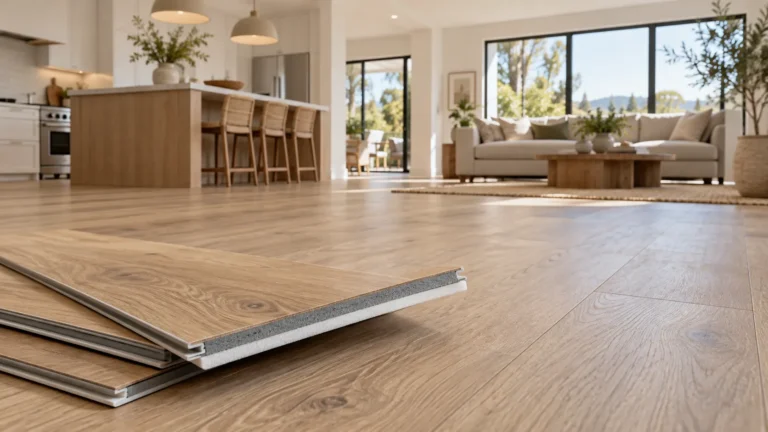
Luxury vinyl plank (LVP) is vinyl flooring made in long, narrow boards designed to look like hardwood. It is the most popular type of vinyl flooring in homes today, largely because it gives a convincing wood look at a lower price than solid hardwood.
The wood species, grain, knots and color variation all come from the printed design film. Better products add surface texture that follows the printed grain, beveled edges that mimic real board seams, and varied plank images so the same knot does not repeat every few feet. Planks commonly run about 6 to 9 inches wide and 36 to 60 inches long, with wide-plank ranges going larger.
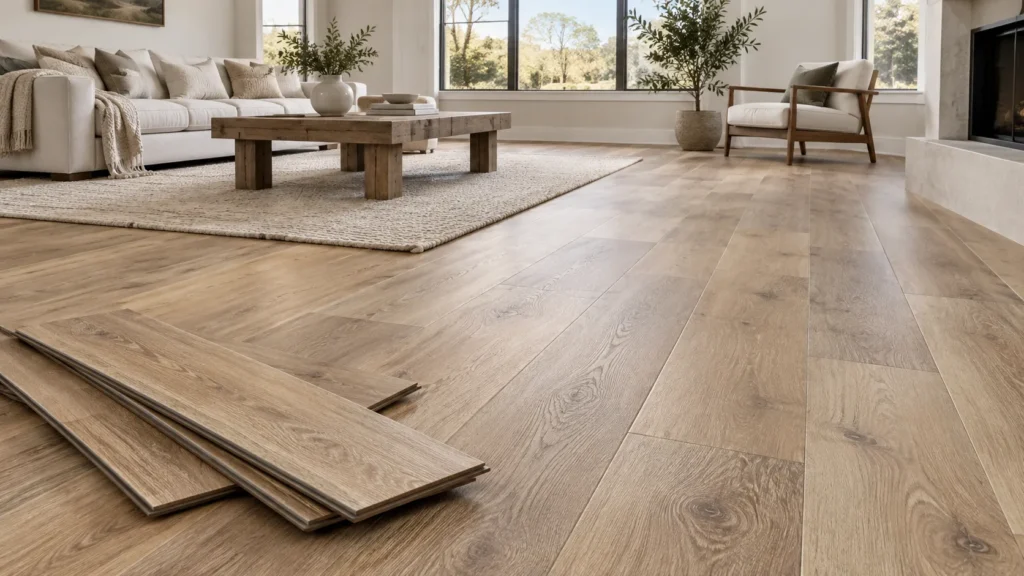
Total thickness usually falls between about 2 mm and 8 mm (roughly 1/12 to 5/16 inch). US manufacturers list plank thickness in millimeters but wear layers in mil, so expect both units on the same box. Thin, flexible LVP sits at the low end; rigid-core LVP sits at the high end, sometimes with an attached foam or cork pad adding another millimeter or two.
Types of vinyl plank flooring
Because LVP describes the shape, not the core, “vinyl plank” covers three distinct constructions:
- Flexible LVP: a thin, bendable plank with a solid vinyl core, typically 2 to 3 mm.
- SPC LVP: a plank built on a dense stone-plastic composite core (see type 5).
- WPC LVP: a plank built on a lighter, foamed composite core (see type 6).
If you want to understand these constructions in more detail, our complete guide to LVP flooring explains what LVP flooring is, how its layers are built, how SPC and WPC differ, and where different LVP constructions are commonly used.
LVP is commonly selected for living rooms, bedrooms, kitchens, hallways and open-plan interiors.
2. Luxury vinyl tile (LVT)
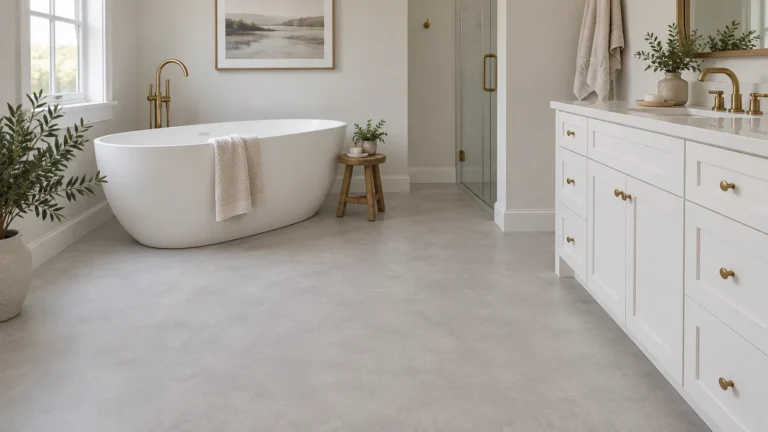
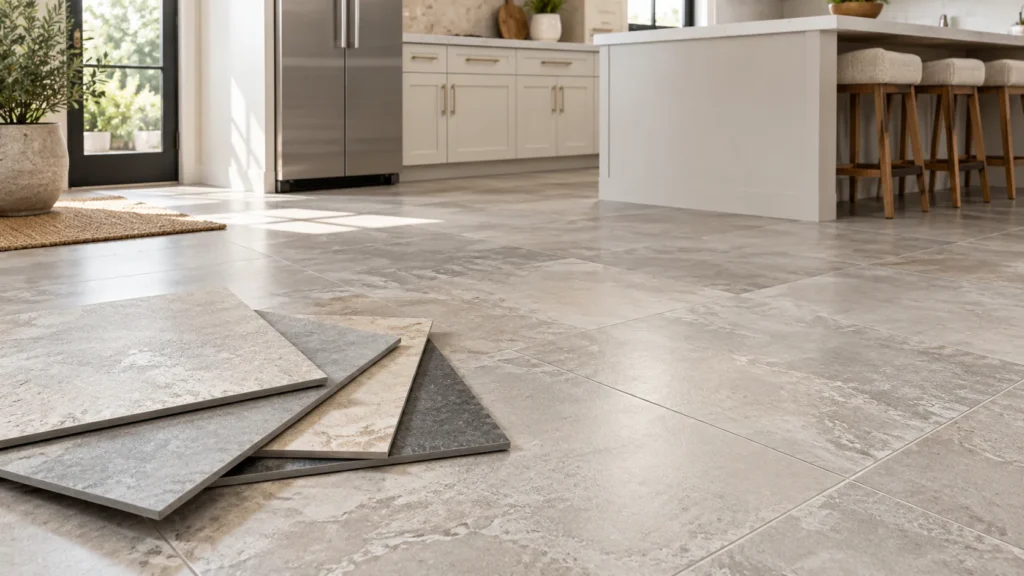
Luxury vinyl tile (LVT) is the tile-shaped version of luxury vinyl, usually designed to look like stone, ceramic, marble or concrete. Its construction can be identical to LVP; only the format and the visual change.
LVT typically comes in squares and rectangles that mirror real tile sizes, such as 12 x 12, 12 x 24 or 18 x 18 inches. Detailed printing, textured surfaces and beveled edges help each tile read as a separate piece. Like LVP, LVT is available with flexible, SPC or WPC cores.
An easy way to keep them straight:
- LVP = plank shape, usually wood-look.
- LVT = tile shape, usually stone- or tile-look.
Together, LVP and LVT make up the luxury vinyl flooring (LVF) family. You will also see “LVT” used loosely as an umbrella term for all luxury vinyl, especially in commercial specifications. For tile sizes, layers and what the labels on the box mean, see our complete guide to LVT flooring.
3. Sheet vinyl flooring
Sheet vinyl is vinyl flooring sold in large continuous rolls, usually 6 or 12 feet wide, that are cut to fit the room. In a small bathroom or laundry room, a single piece can cover the entire floor with no joints at all.
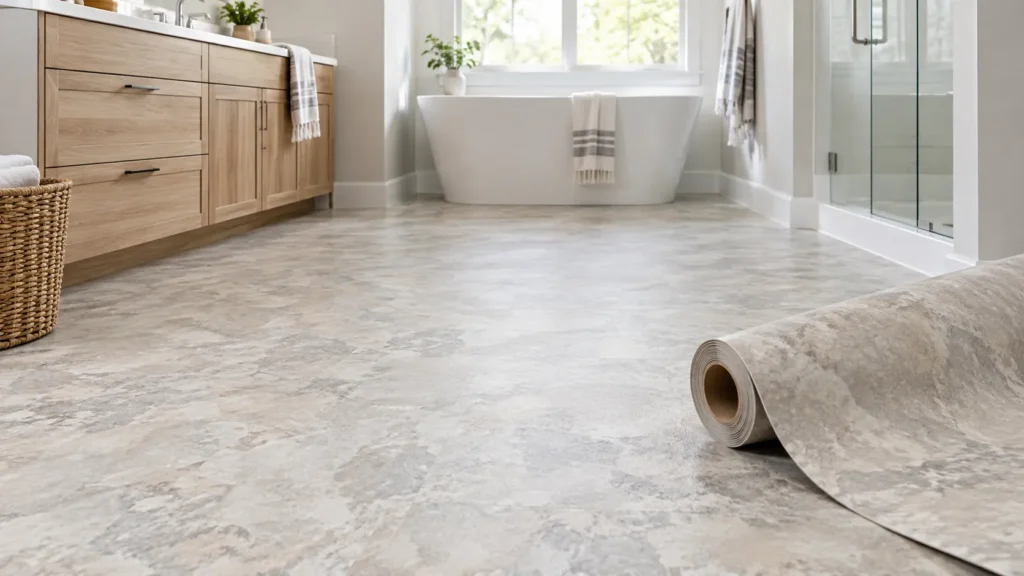
If “sheet vinyl” makes you picture a curling 1970s kitchen floor, the category has moved on. Modern sheets print realistic wood, stone and tile designs, and some have a cushioned foam layer that makes them noticeably softer and warmer underfoot than tile. Sheet vinyl splits into two construction types.
Homogeneous vinyl
Homogeneous vinyl is a single-layer sheet with the same color and pattern running through its full thickness. There is no printed image to wear away, which is why it dominates hospitals, laboratories, clean rooms and busy corridors. The trade-off is design range: most homogeneous vinyl comes in solid, speckled or chip-style patterns rather than realistic wood.
Heterogeneous vinyl
Heterogeneous vinyl is a multi-layer sheet with a printed design protected by a clear wear layer. Its backing may include fiberglass, felt or foam for stability and comfort. Because the design is printed, it can reproduce detailed wood, stone and tile looks, so most residential sheet vinyl and much commercial sheet vinyl in schools and retail falls into this group.
To see how both types are built and which rooms suit them best, read our guide to sheet vinyl flooring.
4. Vinyl composition tile (VCT)
Vinyl composition tile (VCT) is a hard, commercial-grade tile made mostly of limestone filler bound with PVC resin, plasticizers and pigments. Despite the similar acronym, VCT and LVT are completely different products.
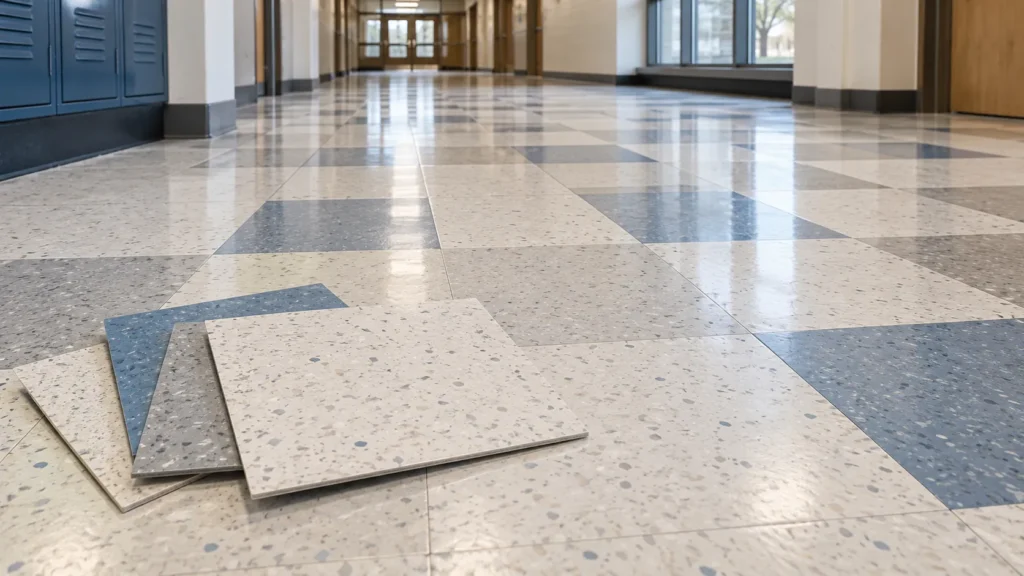
You have almost certainly walked on VCT in a school hallway, grocery store or hospital corridor. It usually comes in 12 x 12-inch tiles about 1/8 inch (3.2 mm) thick, in solid colors or subtle flecked patterns rather than photographic wood or stone. The color runs through the full thickness of the tile, so there is no separate printed layer.
VCT is rarely chosen for homes today because luxury vinyl offers far more realistic designs. If a retailer groups VCT and LVT together under “vinyl tile,” check which one you are actually looking at.
5. SPC vinyl flooring (stone plastic composite)
SPC vinyl is luxury vinyl built on a rigid core made mostly of powdered limestone (calcium carbonate) mixed with PVC and stabilizers. SPC stands for stone plastic composite or stone polymer composite; some brands also use “solid polymer core.”
SPC and WPC are the two main forms of rigid-core vinyl, the category that reshaped the vinyl market over the last decade. Where flexible vinyl bends like a thick sheet of rubber, a rigid-core plank feels stiff and solid in the hand. That stiffness is what makes rigid-core planks behave more like laminate or engineered wood.
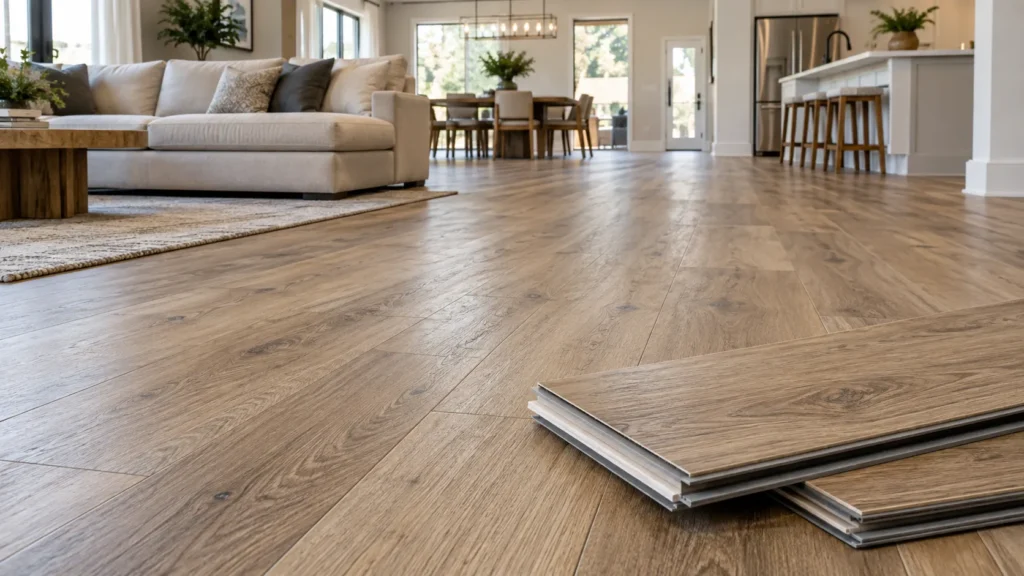
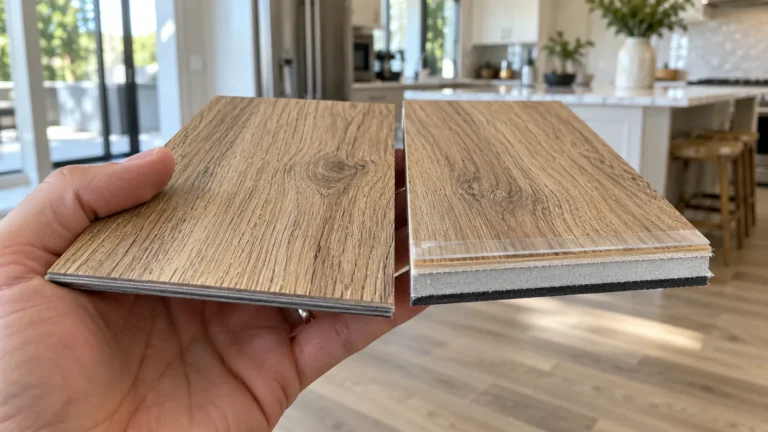
The mineral-heavy SPC core is thin but very dense. Compared with WPC, SPC typically feels harder underfoot, resists dents from heavy furniture better, and is less affected by temperature swings. It is the most common core in today’s mid-priced “waterproof LVP” ranges.
Remember that SPC is a core, not a shape. Most SPC floors are sold as planks, so “SPC LVP” is a perfectly accurate description of a single product.
Want to know what’s inside the core, how it’s made and how to spot real SPC in a store? Read our full guide: what is SPC flooring.
6. WPC vinyl flooring (wood plastic composite)
WPC vinyl is luxury vinyl built on a thicker, lighter rigid core made from foamed PVC blended with fillers, and in some products wood flour. WPC usually stands for wood plastic composite or wood polymer composite, though some brands market it as “waterproof plastic composite” or “waterproof core.”
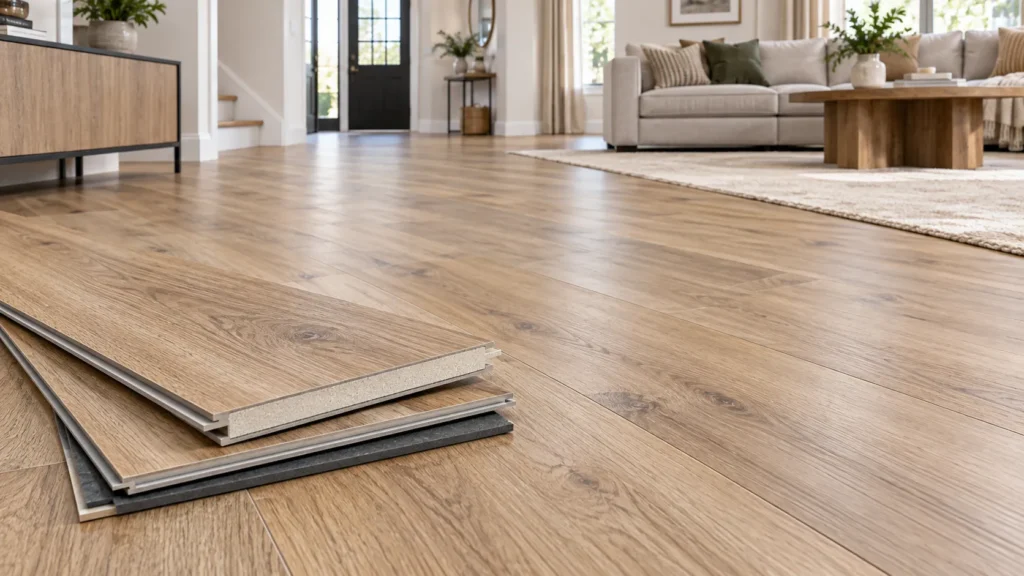
WPC reached the mainstream in the early 2010s, with brands such as COREtec helping to popularize it, and SPC followed a few years later. Despite the name, many modern WPC cores contain little or no actual wood. The key difference is structure: the foamed core makes WPC planks thicker, lighter, softer and quieter underfoot than SPC.
SPC vs WPC: the real difference
| Feature | SPC | WPC |
| Full name | Stone plastic/polymer composite | Wood plastic/polymer composite |
| Core | Dense, mineral-heavy | Foamed, lighter |
| Typical thickness | About 4 to 7 mm | About 5.5 to 8 mm |
| Feel underfoot | Firmer, harder | Softer, warmer, quieter |
| Dent resistance | Higher | Lower under heavy point loads |
| Relative cost | Medium | Medium to high |
| Common format | LVP, some LVT | Mostly LVP |
| Best fit | Busy family homes, basements, light commercial | Living rooms, bedrooms, upper floors where comfort matters |
A simple rule: choose SPC if durability and stability are the priority; choose WPC if comfort and a quieter floor matter more. If a listing just says “rigid core,” check the specifications to find out which one you are getting.
For an independent quality check, look for the ASSURE Certified badge. The Resilient Floor Covering Institute created it specifically for SPC and WPC products, and certified floors are third-party tested for indoor air quality, key performance properties, heavy metals and ortho-phthalates, wherever they are manufactured.
7. Peel-and-stick vinyl flooring
Peel-and-stick vinyl is thin vinyl tile or plank with a factory-applied adhesive backing. It is not a different kind of vinyl; it is a vinyl tile or plank defined by its self-adhesive back.
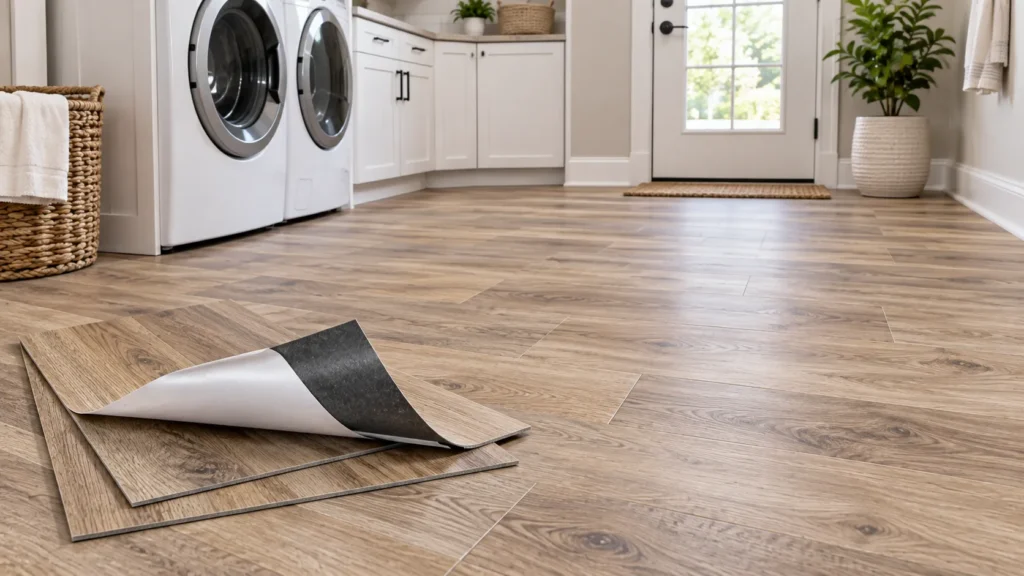
It is usually the thinnest and most affordable vinyl you can buy, often around 1.5 to 2 mm, with a lighter wear layer than standard luxury vinyl. That makes it a natural fit for small rooms, laundry areas, rental refreshes and budget projects rather than high-traffic main living spaces. Designs range from wood and marble to bold geometric and patterned tiles.
8. Loose-lay vinyl flooring
Loose-lay vinyl is heavy luxury vinyl plank or tile with a high-friction backing that holds it in place mainly through weight and grip, rather than adhesive or locking joints. It shares most of its construction with LVT and LVP but adds bulk and stability underneath.
A typical loose-lay plank stacks a lacquer finish, a wear layer of about 20 mil, a printed design film, a cushioning layer, fiberglass reinforcement, a compact middle layer and a textured backing. Total thickness is usually around 5 mm, noticeably heavier than standard flexible LVT.
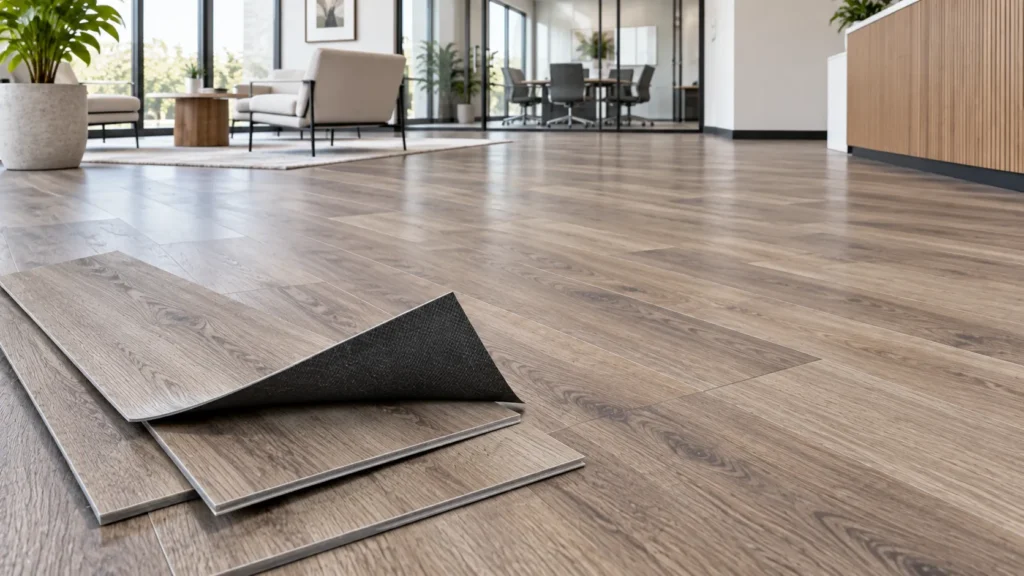
Loose-lay is popular in offices, stores and rental properties because its heavy, stable construction suits spaces that change layout often. Like other vinyl labels, it stacks with the shape: “loose-lay luxury vinyl plank” is one product, not two.
9. Groutable vinyl tile
Groutable vinyl tile is vinyl tile designed to be set with small gaps between each piece and finished with real grout, creating the look of ceramic or stone tile. The grout lines are what separate it from ordinary LVT, where tiles butt tightly together.
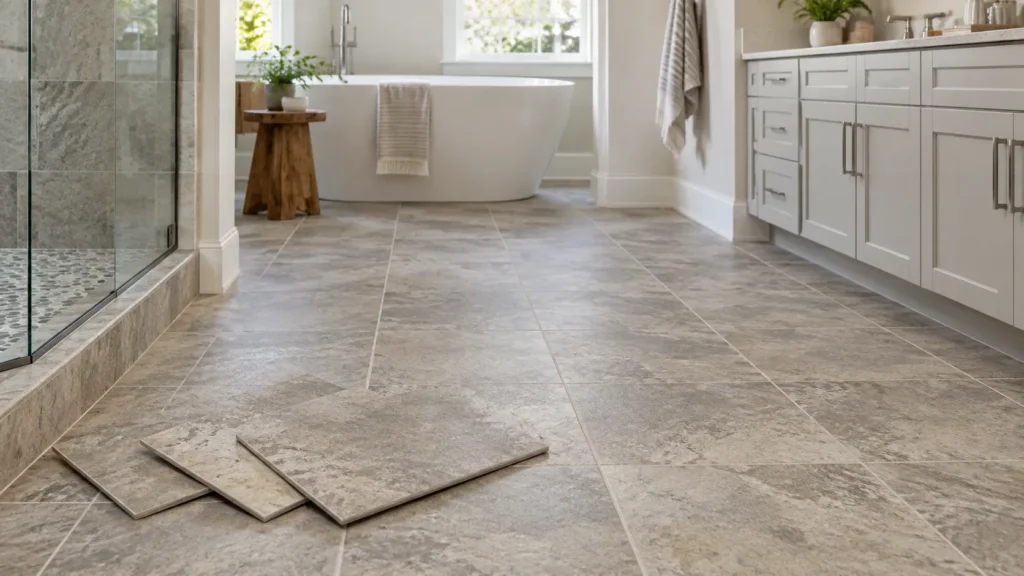
Because the joints are filled with actual grout, the finished floor reads much more like traditional tile, with visible lines, depth and texture, while staying warmer and softer underfoot than ceramic. It is still vinyl, not ceramic, and it is most often chosen for bathrooms, kitchens, entryways and mudrooms by people who want a tile look without cold, hard tile.
Terms that describe vinyl flooring but are not separate types
Several labels appear on vinyl products so often that they look like types of their own. They are useful, but each one describes a feature that can apply to several of the types above.
Printed vinyl
Printed vinyl is any vinyl with a decorative image layer under a clear protective surface. LVP, LVT, heterogeneous sheet vinyl and peel-and-stick products are almost all printed vinyl. Some guides list it as a type, but it is really a design method. Its opposite is through-color vinyl, such as homogeneous sheet and VCT.
Waterproof vinyl flooring
“Waterproof” describes performance, not a shape or core. Sheet vinyl, most LVP and LVT, SPC and WPC can all be marketed as waterproof, because PVC-based materials do not absorb water or swell the way wood-based floors do.
Keep one distinction in mind: a waterproof material does not make the whole floor waterproof. Water can still travel through joints and around the edges of a room and reach the subfloor underneath. Read the manufacturer’s wording closely, because “waterproof” and “water-resistant” are not the same claim.
Rigid-core vinyl
Rigid core is the umbrella term for SPC, WPC and other stiff composite cores. It tells you the plank is stiff, not which core it uses.
LVP vs LVT vs sheet vinyl vs VCT
These four names cause most of the confusion around types of vinyl flooring, so here they are side by side.
| Question | LVP | LVT | Sheet vinyl | VCT |
| Format | Plank | Tile | Roll | Tile |
| Typical look | Hardwood | Stone, tile | Wood, stone, tile, pattern | Solid, flecked |
| Construction | Layered luxury vinyl | Layered luxury vinyl | Homogeneous or layered | Limestone-rich composite |
| Main market | Homes and commercial | Homes and commercial | Homes and commercial | Mainly commercial |
| Rigid-core versions | Yes | Yes | No | No |
| Printed design | Yes | Yes | Usually | No |
The takeaway: LVP and LVT are close relatives, while sheet vinyl and VCT are genuinely different products.
Sheet vinyl vs vinyl plank: which is better?
Sheet vinyl gives you the fewest joints and the lowest cost; vinyl plank gives you the most realistic wood look and the most design choice.
Because sheet vinyl covers a room in one or two pieces, there are very few seams for spills to find, which is why it remains a favorite for bathrooms, laundry rooms and healthcare spaces. Vinyl plank, especially rigid-core LVP, wins on realism: individual boards with beveled edges and textured grain look far more like real hardwood than a printed wood pattern on a continuous sheet. For a small bathroom or laundry room, sheet vinyl is hard to beat. For open living spaces where appearance matters most, LVP is usually the better choice.
Wear layer and thickness: the numbers that matter
Two floors that look identical in a showroom can perform very differently, and the difference is usually on the spec sheet.
The wear layer is the clear protective layer on top of the printed design. In North America it is measured in mil, and one mil is one-thousandth of an inch (about 0.025 mm), not a millimeter. As a rough guide:
| Wear layer | Typical use |
| 6 to 12 mil | Low-traffic rooms such as bedrooms and closets; peel-and-stick |
| 12 to 20 mil | Most homes, including kitchens and family rooms |
| 20 mil and up | Busy households with kids and pets; light commercial |
| 28 to 40 mil | Commercial and heavy-traffic spaces |
Total thickness is a different number. It measures the whole product, typically about 2 mm to 8 mm, and mostly reflects the core and any attached pad. A 7 mm plank with a 6 mil wear layer is thicker than a 4 mm plank with a 20 mil wear layer, but the thinner plank has far more surface protection.
So thicker vinyl is not automatically better vinyl. Judge the wear layer, core type and top coat together rather than chasing the biggest number on the box.
Which type of vinyl flooring is best for each room?
There is no single best vinyl floor, but there is usually a best fit for each room.
Bathroom
Best picks: sheet vinyl or groutable vinyl tile; SPC LVT or LVP as the alternative. Fewer joints means fewer entry points for water, which puts sheet vinyl first. Groutable tile suits people who want a ceramic look. If you prefer planks, choose an SPC product explicitly rated for bathroom use.
Kitchen
Best picks: SPC LVP for a wood look, LVT for a tile look, sheet vinyl for a seamless surface. Kitchens combine spills, dropped pans and chair traffic, so aim for a wear layer of at least 12 mil, and 20 mil if you have pets or young children.
Living room and bedroom
Best picks: WPC LVP or a premium rigid-core LVP. These rooms reward comfort and appearance. Wide planks with textured grain and varied patterns look the most like real hardwood, and WPC’s softer, quieter core feels good underfoot. In low-traffic bedrooms, a 12 mil wear layer is usually enough.
Basement
Best pick: SPC LVP. Its dense, stable core handles the cooler temperatures and humidity swings of below-grade spaces well. Sheet vinyl is a budget alternative. Keep in mind that no floor covering fixes an existing water problem; resolve leaks or dampness first.
Rental property
Best picks: SPC LVP with a 12 to 20 mil wear layer, or loose-lay for easy plank replacement. Peel-and-stick works for quick, low-cost refreshes in small rooms.
Commercial space
Best picks: homogeneous sheet vinyl for healthcare and labs, commercial LVT with a 20 to 40 mil wear layer for offices and retail, and VCT for large, budget-driven areas such as school corridors. In commercial settings, the product’s commercial rating matters more than the word “luxury.”
Which type of vinyl flooring is best overall?
For most homes, rigid-core luxury vinyl plank (SPC or WPC) is the best all-round type of vinyl flooring. It combines a realistic wood look, a stable core and a waterproof surface in one product. Choose SPC for durability and busy areas; choose WPC for comfort and quiet.
| Quick picks •Most realistic wood look: WPC or SPC LVP with textured, embossed-in-register grain •Most realistic tile look: groutable vinyl tile, then LVT •Fewest seams (bathrooms, laundry rooms): sheet vinyl •Busy home with kids or pets: SPC LVP with a 20 mil wear layer •Softest and quietest: WPC LVP or cushioned sheet vinyl •Lowest budget: sheet vinyl or peel-and-stick •Heavy commercial traffic: homogeneous sheet vinyl, commercial LVT or VCT |
Which vinyl flooring looks most like real wood?
Luxury vinyl plank looks the most like real wood, because its plank shape copies the proportions of hardwood boards. The most convincing products combine four details: a high-resolution wood image, embossed-in-register (EIR) texture that lines up with the printed grain, beveled edges, and a large number of different plank images so patterns do not repeat. A low-sheen matte finish also looks more natural than a glossy one.
SPC and WPC can both deliver this realism, because the look comes from the design layer, not the core. LVP tells you what the floor looks like; SPC or WPC tells you what is inside it.
Which vinyl flooring looks most like stone or tile?
Groutable vinyl tile looks the most like real ceramic or stone, because real grout lines recreate the joints of traditional tile. Standard LVT comes a close second and can reproduce marble, slate, travertine, limestone and concrete convincingly. Sheet vinyl can print tile patterns, but because it is one continuous surface, it looks flatter up close.
Vinyl vs laminate, linoleum and hardwood
These materials are often shopped alongside vinyl, but they are not types of vinyl. Here is how they differ at the material level. For a full comparison of every option, see our guide to the different types of flooring.
| Flooring | What it is made of |
| Vinyl | PVC-based resilient flooring, with flexible or rigid cores |
| Laminate | High-density fiberboard (HDF) core with a printed image and melamine wear layer |
| Linoleum | Natural materials such as linseed oil, wood flour, cork dust and limestone on a jute backing |
| Hardwood | Solid real wood |
| Engineered hardwood | A real-wood top layer over a layered plywood or wood-composite base |
Vinyl vs laminate
The core is the key difference: vinyl is plastic-based, while laminate is wood-fiber-based. Both can mimic wood convincingly, but a standard laminate core can swell if water gets into it, while a vinyl core does not absorb water. Laminate tends to feel harder and more wood-like underfoot, while vinyl is softer and usually quieter.
Sheet vinyl vs linoleum
They look alike and both come in rolls, but they are made from completely different materials. Sheet vinyl is synthetic and PVC-based. Linoleum is made from natural, renewable ingredients, led by linseed oil. Many Americans call any older sheet floor “linoleum,” but many of those floors are actually vinyl.
Vinyl plank vs hardwood
Vinyl plank copies the look of hardwood; hardwood is the real thing. LVP gives you the appearance of oak, hickory or walnut with a water-resistant, lower-cost surface, but the wood you see is a printed image. Real and engineered hardwood offer genuine wood, natural variation and the feel only real wood provides.
How to compare vinyl flooring types before you buy
The product name gets you into the right category. The specification sheet tells you what you are actually buying. Check these points in order:
- Format: plank, tile or sheet, based on the look you want and how many joints you can accept.
- Core: flexible, SPC, WPC, homogeneous or heterogeneous.
- Wear layer (mil): match it to your traffic level using the table above.
- Total thickness: useful for feel and stability, but judge it alongside the wear layer.
- Surface texture and finish: EIR embossing, beveled edges and a matte finish all add realism.
- Intended use rating: residential, light commercial or commercial.
- Standards: reputable products list the ASTM standard they meet, such as ASTM F1700 (solid vinyl tile), ASTM F3261 (rigid-core resilient flooring), ASTM F1303 (sheet vinyl) or ASTM F1066 (VCT).
- Indoor air and health: look for FloorScore certification, the Resilient Floor Covering Institute’s program confirming a floor meets California’s strict VOC emission limits, or GREENGUARD. Check for “phthalate-free” if that matters to you.
- Warranty: read what it actually covers and whether it differs for residential and commercial use.
Most major manufacturers publish technical datasheets and Environmental Product Declarations (EPDs) for each product line, so ask for them if the retailer’s listing is thin.
Frequently asked questions about types of vinyl flooring
What are the main types of vinyl flooring?
The main types are luxury vinyl plank (LVP), luxury vinyl tile (LVT), sheet vinyl, vinyl composition tile (VCT), SPC and WPC rigid-core vinyl, peel-and-stick vinyl, loose-lay vinyl and groutable vinyl tile. Some names overlap because they describe shape, core or attachment method rather than separate materials.
What is the difference between LVP and LVT?
Both are luxury vinyl. LVP comes in plank shapes and usually imitates hardwood, while LVT comes in tile shapes and usually imitates stone or ceramic. Their construction can be identical.
Is SPC the same as LVP?
No. SPC describes the rigid core inside the floor, while LVP describes the plank shape. Most SPC flooring is sold as LVP, so one product can be both.
What is the difference between SPC and WPC?
Both are rigid-core luxury vinyl. SPC has a dense, limestone-based core that is harder and more dent-resistant. WPC has a thicker, foamed core that is softer, warmer and quieter underfoot.
Are LVT and VCT the same?
No. LVT is layered luxury vinyl with a printed design and clear wear layer. VCT is a hard, limestone-heavy commercial tile with color running through it, mostly used in schools, stores and hospitals.
What does EVP mean in vinyl flooring?
EVP usually stands for engineered vinyl plank. It is a marketing term for rigid-core luxury vinyl plank, typically with an SPC or WPC core.
Is sheet vinyl the same as linoleum?
No. They can look similar and both come in rolls, but sheet vinyl is PVC-based, while linoleum is made from natural materials such as linseed oil, wood flour and cork.
Is all vinyl flooring waterproof?
No. Most modern sheet vinyl, LVP, LVT, SPC and WPC products are marketed as waterproof because their cores do not absorb water. Peel-and-stick and VCT are generally water-resistant rather than waterproof, and even a waterproof floor can let water reach the subfloor through its joints and edges.
Which type of vinyl flooring looks most like hardwood?
Luxury vinyl planks look the most like hardwood, especially products with embossed-in-register texture, beveled edges and many different plank images.
What is the cheapest type of vinyl flooring?
Sheet vinyl and peel-and-stick tiles are usually the least expensive types of vinyl flooring, while premium WPC and loose-lay products sit at the top of the price range.
What does luxury vinyl flooring (LVF) mean?
Luxury vinyl flooring is the family that includes LVP and LVT. These products use layered construction with a realistic printed design protected by a clear wear layer, and they come with flexible or rigid cores.